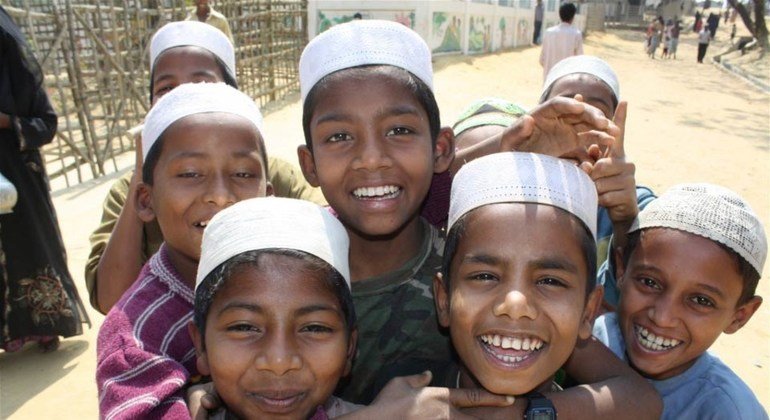
“Statelessness affecting Rohingya refugees and the protracted situation of displacement contributes to serious risks of human trafficking with devastating consequences for victims,” the Human Rights Council-appointed experts said in a statement.
Long denied citizenship in Myanmar and facing brutal attacks from the armed forces and police that escalated in 2017, the UN has described the ethnic minority Rohingya Muslims as “the most persecuted minority in the world.”
In August 2017 alone, more than 750,000 Rohingya fled to neighboring Bangladesh, where they formed the world’s largest refugee camp.
NGO Doctors Without Borders reported 6,700 Rohingya killed in the first month of the 2017 crackdown, and the UN has found that the Myanmar government had “genocidal intent” in its persecution of the Rohingya.
In 2025, more than 900 Rohingya refugees died at sea, mostly in the Andaman Sea and Bay of Bengal. About 66 per cent were women and children, according to the experts.
Refugees face difficulties in Bangladesh
Bangladesh currently hosts nearly 1.2 million Rohingya refugees, many of whom lack opportunities to access education, employment and safe and regular migration pathways, the experts said. Criminals often exploit the lack of opportunities to deceive refugees in human trafficking schemes.
Children and young people living in refugee camps are especially likely to be trafficked, while women and girls face elevated risks of gender-based violence.
Bahá’í face arbitrary arrest, torture in Iran
Another group of Council-appointed human rights experts expressed concern on Wednesday over allegations of arbitrary arrests, forced disappearances and torture of the Bahá’í religious minority in Iran.
“We are profoundly troubled by reports that Bahá’í individuals are being subjected to incommunicado detention, torture and enforced disappearance,” they said in a statement. “This is a clear violation of international law.”
The rights experts do not work for the UN or receive any salary. They are independent of any government or organization.
Baháʼí is a global universalist religion which believes in the unity of all religions, the unity of humanity and the elimination of all forms of prejudice. Founded in the mid-1800s in modern-day Iran, the World Religion Database estimates there are about 8.5 million Baháʼí around the world today.
Fifty-seven members of the Bahá’í community are currently detained or imprisoned by the Iranian government. Many have been forced to confess under threat of torture or while broadcasted on state media.
Arrests have increased dramatically in Iran more broadly since the start of the war, raising new concerns about the persecution of religious minorities, the experts said.
Iran must uphold commitment to freedom of religion
As a party to the International Covenant on Civil and Political Rights, Iran must uphold the freedom of religion or belief, the prohibition of torture and forced disappearance, ensure due process, and protect minority rights.
“The targeting of religious minority communities through alleged arbitrary detention, enforced disappearance, and coercion constitutes a flagrant violation of the right to freedom of religion or belief,” the experts said.
They urged national authorities to immediately guarantee access to legal counsel and medical care for Bahá’ís and to hold perpetrators of arbitrary detention, forced disappearance, torture and ill-treatment accountable.
More militants disarm in Central African Republic
Between last Friday and Tuesday, 100 members of the armed group Retour, Réclamation et Réhabilitation (3R) voluntarily laid down their weapons in the towns of Besson and Péhouri as part of a UN disarmament, demobilization, reintegration and repatriation (DDRR) programme.
‘Blue helmets’ from the UN peacekeeping mission in CAR (MINUSCA) collected 69 weapons, more than 4,400 rounds of ammunition and 24 rockets from the ex-combatants, allowing them to rejoin their communities.
Second in a month
In another MINUSCA-supported operation earlier this month, 34 members of various armed groups willingly disarmed in the capital, Bangui.
Since signing a fragile 2019 peace agreement with armed groups, the Government has worked to reintegrate some former fighters into government and security roles.
“The Mission continues to work alongside the Central African authorities and national partners in support of peace, security and the implementation of the Peace Agreement,” UN spokesperson Farhan Haq told reporters on Wednesday.