Ava Boettiger, University of Colorado Boulder, discusses her article: What we measure matters: Trait choice shapes inferences about grassland functional diversity under altered precipitation
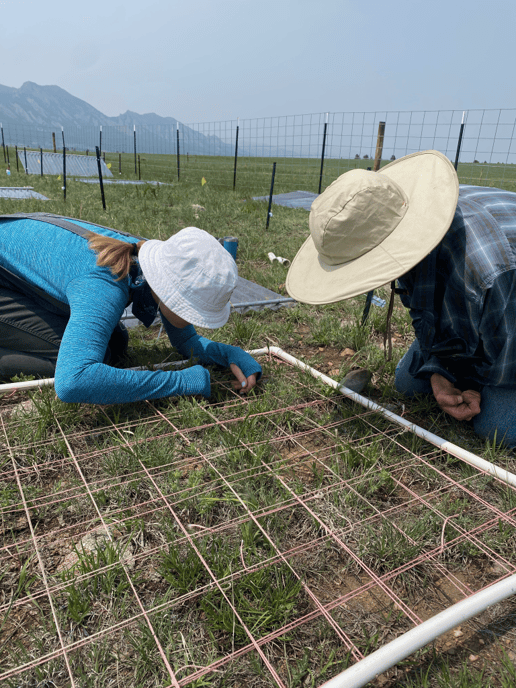
Two ecologists can study the same grassland, ask the same question, yet reach different conclusions. Usually, we look for differences in climate, soils, species, or experimental design to explain why. But what if part of the difference comes from something less obvious: how we choose to measure and describe the plants?
Plant traits are increasingly used to understand how plants respond to environmental change. Instead of only asking which species are present, traits let us ask how those plants differ in the ways they grow, acquire resources, and respond to their environment. But there are many traits to choose from. We can measure characteristics of individual organs such as stems, leaves, roots, or even whole plants, and different studies often use different combinations of traits. Those choices may seem like small methodological decisions, yet they can influence the ecological patterns we see.
Asking the same question in different ways
We used a four-year rainfall manipulation experiment in a semi-arid grassland near Boulder, Colorado. Across 24 plots, we reduced rainfall by 66% to simulate drought, added 66% more water to simulate increased precipitation, or left other plots under ambient rainfall. We followed the plant communities over four growing seasons and measured nine traits across 64 species.
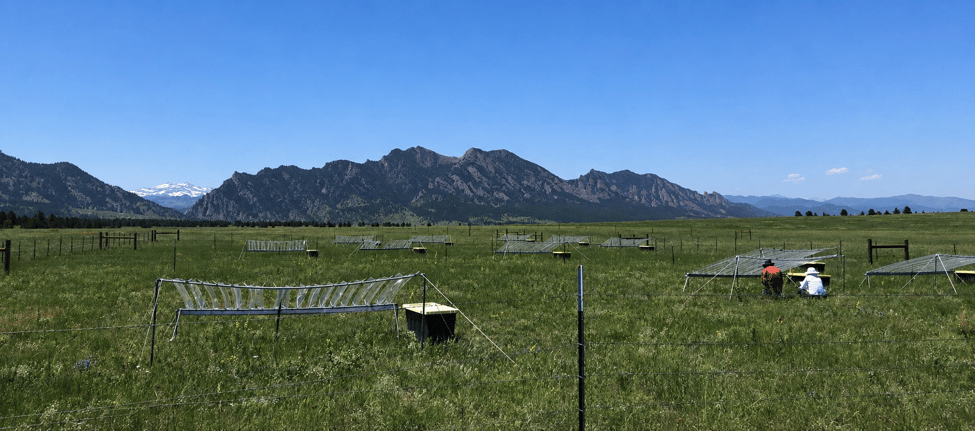
Rather than choosing one set of traits and moving on, we asked a different question: what happens when we use different trait combinations to describe the same plant community?
We measured nine leaf, root, and whole-plant traits and grouped them into six sets based on trait-based literature: (1) all traits, (2) commonly used traits (e.g., specific leaf area, root dry matter content), (3) mechanistic drought traits, (4) economic spectrum traits, (5) aboveground traits, and (6) belowground traits. For each set, we assessed drought and irrigation effects on community composition using community-weighted means and four functional diversity indices: richness, evenness, divergence, and dispersion. We also examined how trait and metric selection influenced temporal biomass stability across treatments.
In other words, the grassland, rainfall treatments, and ecological questions stayed the same. What changed was which characteristics of the plants we used to represent the community and how we analyzed them.
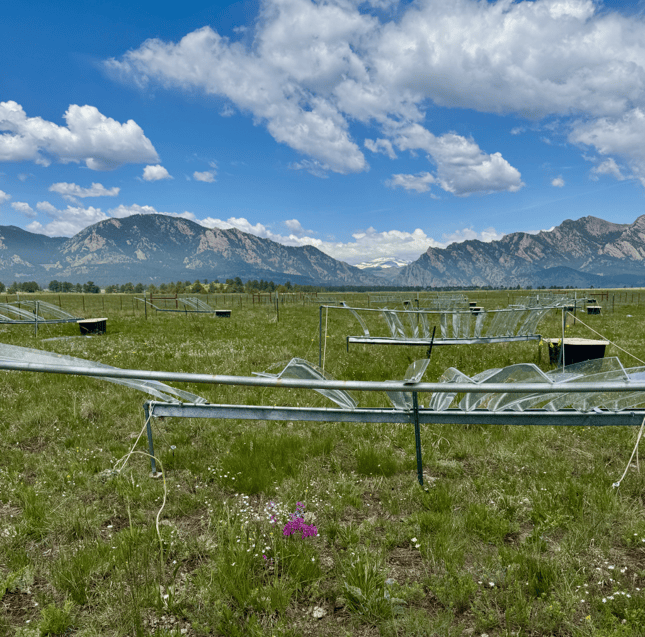
What we measure shapes what we see
Some patterns were consistent across trait choices. For example, functional divergence increased under both drought and increased precipitation across all six trait suites. But other patterns depended on which traits we included and which measure of functional diversity we used. We also found that the relationship between functional diversity and biomass stability depended on these choices. We went into the study expecting a relatively straightforward relationship between diversity and stability. Instead, the relationship was more complicated, and part of that complexity came from how we characterized functional diversity.
This made me think about how we compare ecological studies. When studies reach different conclusions, we consider factors such as the ecosystems, environmental conditions, and plant traits being studied. Our results suggest that it is also worth considering how those traits are combined and used to measure functional diversity, as these choices can influence the patterns we find. This is especially relevant when studying relationships between functional diversity and ecosystem responses.
When bringing results from multiple studies together, these differences are worth keeping in mind. Researchers may use different traits or measures of functional diversity to answer their questions, and each approach can highlight different aspects of a plant community. Recognizing these differences can help us better interpret findings across studies and understand why they may not always agree.
So, which traits should we use?
Our results do not point to one perfect set of traits, and I don’t think that is the lesson we should take from them. Instead, trait selection should start with the ecological question. In our experiment, adding water increased specific leaf area and specific root length, traits associated with resource acquisition, but it also increased root diameter, which is often associated with a more conservative strategy. Under drought, root dry matter content decreased, contrary to what we might expect if plants were shifting toward conserving resources. These unexpected responses show that plants do not always respond to changes in water availability in straightforward ways. Traits chosen to capture particular strategies may therefore tell a different story from traits selected simply because they are commonly measured. Thinking carefully about which traits best reflect the ecological processes we want to understand can help us interpret those responses more accurately.
For me, that is the biggest takeaway from this study. Choosing which traits to measure can seem like a straightforward methodological decision, but it also shapes how we represent a plant and what aspects of its biology we consider important. When those choices are combined with different ways of measuring functional diversity, they can influence the ecological patterns we detect and the conclusions we draw.