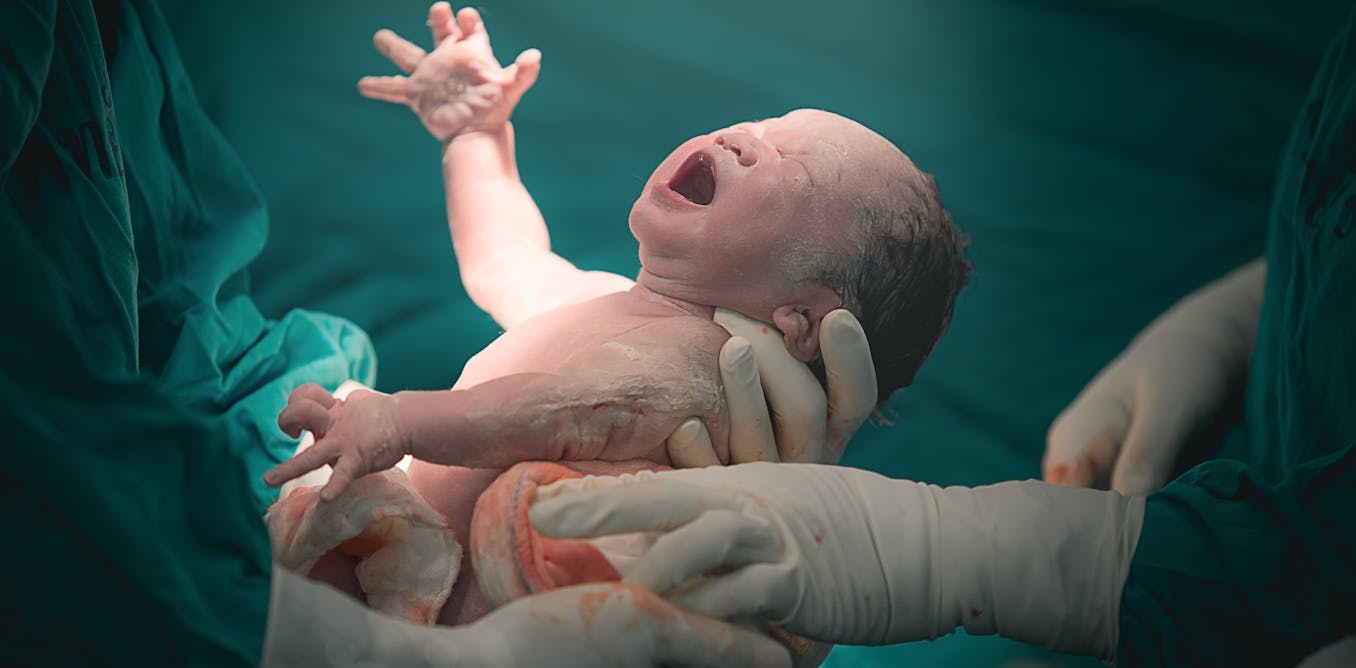
Official NHS maternity statistics show that caesareans accounted for 45% of deliveries in English NHS hospitals in 2024-25. More recent monthly NHS maternity data reported that 27% of deliveries under NHS maternity services in January 2026 were emergency caesareans.
But a recent BBC analysis noted that this increase has not been accompanied by similarly clear reductions in stillbirth or neonatal mortality rates. If outcomes are not improving at the same pace as interventions, what is driving the growth in caesarean births?
Common explanations include workforce shortages, litigation concerns, maternity safety scandals and changing perceptions of risk. However, focusing solely on clinical factors risks overlooking how ideas about safety, responsibility, trust and uncertainty all shape childbirth decisions.
Fear, anxiety and uncertainty
In Bangladesh, where I recently completed doctoral research on childbirth and rising caesarean section rates, caesareans accounted for around 45% of births in 2022. Approximately 69% of institutional births were delivered surgically.
Unlike England’s NHS-based system, childbirth in Bangladesh increasingly takes place within a commercial healthcare market. This includes private clinics, out-of-pocket payments and maternity packages. In practice, this can make paid access to scans, senior doctors, private facilities and fixed packages feel like routes to safety. Caesarean birth may then be understood less as an exceptional intervention and more as the managed, predictable option.
For many families in Bangladesh, safety was a medical, emotional and financial concern. It was sought through spending, testing and access to trusted doctors. As one husband put it: “If I could afford 20,000 BDT [around £120], why not pay 25,000 BDT for better care?” Yet improvements in maternal mortality have been far less pronounced, raising questions similar to those emerging in England.
My research explored how childbirth decisions are made. Women and families frequently described caesarean section as “nirapod” (safe). Yet many also experienced it as a lifelong “khoto” (wound), associated with pain, emotional distress and financial burdens. As Monisha, one of the mothers I interviewed, reflected: “Caesarean leaves scars (khoto) that last a lifetime.”
This contradiction reveals an important feature of childbirth decision-making. Caesarean birth is both a medical procedure and a social and moral experience shaped by fear, anxiety, uncertainty and the promise of safety. As Nadia, who underwent two caesareans, recalled: “I felt I had no space to express my choice, and I ended up convincing myself that they were doing it for my good.”
Decisions were shaped by medical advice, family expectations, trust in doctors and economic pressures. Among surveyed mothers, 44% underwent elective caesareans and 56% emergency procedures. Yet 60% reported that the decision had been made at least a month before delivery, suggesting that many birth pathways were established well before labour. Trust in medical expertise was central: most women surveyed, 71%, underwent caesareans recommended by doctors, while only 6% reported making the decision themselves.
Trust in medical authority often became a way of managing uncertainty. As one woman said: “I trusted her more than anyone else.” Decisions were rarely framed as personal preference. They were presented as responsible actions taken for the baby’s wellbeing. One participant recalled: “The doctor left the decision to me, so I decided. That was my weakness, but also my right.” Although responsibility was shared across families and healthcare providers, it often fell most heavily on women.
Related tensions around responsibility, risk and professional accountability can also be seen in England, although they take different forms.
Scrutiny and litigation
In England, clinicians work within systems shaped by scrutiny, inquiries and legal claims following adverse outcomes.
In Bangladesh, the pressures described by doctors in my research were often more immediate and personal. As one obstetrician observed: “If something goes wrong, I always worry about the risk of violence. I have to prioritise my safety first.” The contexts differ sharply, but in both England and Bangladesh caesarean section can become a way of managing uncertainty, avoiding blame and producing a form of safety that is as institutional and social as it is clinical.
In Bangladesh, these pressures operate within a healthcare system facing severe workforce shortages. The country has approximately seven physicians and six nurses or midwives per 10,000 people. By comparison, the UK has around 33 physicians and 95 nurses or midwives per 10,000 people.
Opportunities for continuous labour support and counselling are therefore limited. Midwives in my research often described having little influence over birth decisions. In both clinical and family narratives, caesarean section frequently emerged as the most predictable and controllable option, while vaginal birth remained associated with uncertainty.
Yet the promise of safety did not end vulnerability. Most women left hospital within days of surgery, while recovery was largely managed by families. Participants described ongoing pain, restricted mobility and emotional distress months after birth. As Maya reflected: “I did not understand why I was feeling like that… When my baby cried at night, I felt anger rising inside me.” Looking back, she felt she had experienced postpartum depression for almost a year.
Others described similar experiences, including chronic pain, sleep disruption and emotional distress during recovery. Mothers I spoke to in focus groups also repeatedly described chronic back pain as part of their post-caesarean recovery.
These accounts suggest that caesarean birth often redistributes rather than eliminates risk. While hospitals manage the surgery itself, much of the work of recovery is transferred to households, where families assume responsibility for ongoing care and support.
Emergency caesareans remain necessary, vital and often life saving. However, rising emergency caesarean rates in England, alongside very high rates in Bangladesh, suggest that broader social and institutional pressures shape how risk is understood and managed.
The rise in caesarean births is often framed as a clinical or public health issue. Yet evidence from England and Bangladesh suggests it is also social and political. Rising intervention rates cannot be understood through medical factors alone, but through how safety, uncertainty and responsibility are organised within maternity systems.
Increasingly, birth is shaped by efforts to anticipate and prevent future harms, placing responsibility for uncertain outcomes on women and families even when many of the forces influencing those decisions lie beyond their control. Childbirth therefore becomes a question of medical necessity, and of how societies organise safety, risk and care.

Dr Halima Akhter received funding from the Commonwealth Scholarship Commission, UK, and she completed her PhD in Anthropology of Health at Durham University, UK.
Doctoral Thesis, "The Preferred Option": C-sections and Bangladeshi Women's Navigation of Fear, Responsibility, and Care in Childbirth, completed under the primary supervision of Professor Dr Nayanika Mookherjee, Department of Anthropology, Durham University, UK.