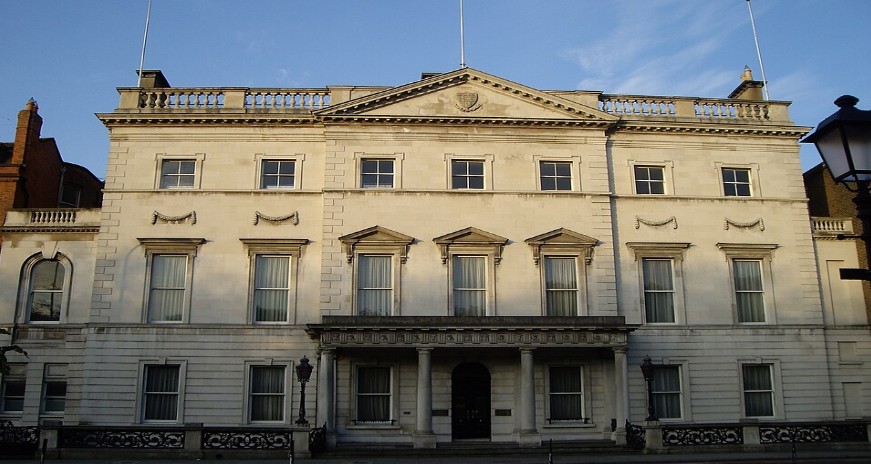
DUBLIN — A dedicated memorial garden has been established at Iveagh House, the headquarters of the Department of Foreign Affairs on St Stephen’s Green in Dublin, to honor the memory of the 1.5 million child victims of the Holocaust.
The ceremony was led by Foreign Affairs Minister Helen McEntee, who was joined by Holocaust survivor Suzi Diamond and secondary school students from Stratford College in Rathgar, south Dublin.
Commemorative Planting & Historical Significance
The memorial installation centers around yellow crocus bulbs, symbolizing the yellow Star of David that Jewish children and families were forced to wear under Nazi rule.
Iveagh House Holocaust Memorial Garden Summary
+-------------------------------------------------------------------------+
| LOCATION: Iveagh House Gardens, St Stephen's Green, Dublin             |
| DEDICATION: In memory of 1.5 million child victims of the Holocaust     |
| PARTICIPATING DIGNITARIES: Minister for Foreign Affairs Helen McEntee,  |
|                            Holocaust Survivor Suzi Diamond              |
| YOUTH REPRESENTATION: Students from Stratford College (Dublin 6)        |
| SYMBOLIC FLORA: Yellow Crocuses (symbolizing the yellow star)           |
+-------------------------------------------------------------------------+
The garden serves as a permanent space for reflection at the center of Irish diplomatic operations, reinforcing Ireland’s commitment to international human rights, remembrance, and genocide prevention frameworks ahead of Ireland taking its seat on the UN Human Rights Council.
Educational Alignment & Survivor Testimony
The event highlights ongoing national efforts to integrate Holocaust education across Irish secondary schools.
Students from Stratford College participated in the planting alongside Suzi Diamond, one of Ireland’s last remaining Holocaust survivors, who was liberated from the Bergen-Belsen concentration camp as a young child before coming to Ireland.
Key Elements of National Holocaust Education Initiatives
+-------------------------------------------------------------------------+
| CROCUS PROJECT: Annual nationwide planting initiative connecting youth  |
|                 with historical remembrance across schools.             |
| EDUCATIONAL FUNDING: Irish state contributions supporting the           |
|                      Auschwitz-Birkenau Foundation and educational tools.|
| YOUTH ENGAGEMENT: Direct dialogue between surviving witnesses and       |
|                    secondary school students to combat antisemitism.   |
+-------------------------------------------------------------------------+
Two-Sided Perspectives on Historical Remembrance and Educational Impact
The establishment of public memorial spaces and youth-focused remembrance projects draws widespread support while highlighting ongoing discussions regarding historical curricula.
Perspectives on Public Holocaust Remembrance Infrastructure
+-------------------------------------------------------------------------+
| EDUCATIONAL ADVOCATES & SURVIVOR ORGANIZATIONS                          |
| * Commend physical memorial spaces for providing tangible connection     |
|   points for younger generations as survivor voices diminish over time. |
| * Stress that survivor-led projects are vital tools against rising       |
|   online disinformation, hate speech, and historical revisionism.      |
+-------------------------------------------------------------------------+
| HISTORICAL & CIVIC EDUCATORS                                            |
| * Emphasize that physical memorials must be actively paired with       |
|   comprehensive classroom learning modules to have long-term impact.   |
| * Call for expanded state funding to support educational visits to      |
|   historical sites across Europe for Irish secondary students.          |
+-------------------------------------------------------------------------+
State and Educational Leadership
Minister Helen McEntee emphasized that preserving the memory of Holocaust victims—especially children whose futures were stolen—is a moral imperative. Government officials noted that active youth participation through institutions like Stratford College ensures that future generations carry forward the lessons of tolerance, dignity, and anti-discrimination.
Rights Monitors and Historians
Human rights educators praised the project, highlighting that as the era of direct survivor testimony draws to a close, living memorials like the Iveagh House garden ensure that anti-prejudice education remains grounded in personal history and human dignity.
Looking Ahead
The memorial garden will bloom each spring at Iveagh House, serving as an annual reminder of the innocent lives lost during World War II and reinforcing Ireland’s diplomatic dedication to safeguarding human rights globally.
Minister Helen McEntee Dáil Statement
This clip shows Minister Helen McEntee speaking in the Dáil on state accountability, historical trauma, and institutional human rights protections.
Dublin’s Iveagh House Wiki Picture by Jnestorius