ZAPORIZHZHIA, Ukraine — The death toll from a devastating Russian aerial bombardment on a humanitarian aid distribution center in Ukraine’s southeastern Zaporizhzhia region has risen to 37, with at least 59 people remaining missing beneath the rubble.
The attack, which targeted a former school building serving as a vital community shelter and weekly food distribution point in the frontline settlement of Komyshuvakha, marks one of the single deadliest strikes on civilians and rescue personnel this year.
Anatomy of the Double-Tap Strike on Komyshuvakha
According to local emergency services and the Zaporizhzhia Regional Military Administration, the attack occurred on Monday, November 2, 2026, when Russian aircraft dropped multiple guided aerial bombs (KABs) directly onto the distribution site.
Komyshuvakha Humanitarian Incident Profile
+-------------------------------------------------------------------------+
| LOCATION: Komyshuvakha, Zaporizhzhia Oblast, Ukraine                    |
| TARGET SITE: Former local school (functioning as shelter & aid hub)      |
| MUNITIONS USED: Multiple FAB/KAB guided aerial bombs                   |
| CONFIRMED FATALITIES: 37 (including 2 first responders & 4 police)      |
| MISSING / TRAPPED: 59 civilians under rubble                            |
| INJURED: Multiple hospitalized with severe injuries                     |
| ATTACK PATTERN: "Double-Tap" strike targeting initial victims & rescuers|
+-------------------------------------------------------------------------+
Ukrainian officials confirmed that a initial strike hit as residents gathered to receive weekly aid packages. Minutes later, a second “double-tap” strike targeted the shelter where survivors and first responders had rushed to assist the wounded. Two members of the State Emergency Service of Ukraine (DSNS) and four police officers were among those killed in the line of duty.
Emergency crews supported by heavy machinery continue to comb through smoldering debris as search and rescue operations enter a critical phase.
Universal Humanitarian Law: Protection of Aid and Healthcare Personnel
The deliberate or reckless targeting of humanitarian infrastructure and relief workers has drawn fierce global condemnation, highlighting universal mandates under International Humanitarian Law (IHL).
Core Principles of Geneva Convention Protection for Aid Personnel
+-------------------------------------------------------------------------+
| PRINCIPLE OF NEUTRALITY & PROTECTION                                   |
| * Humanitarian personnel, rescue workers, and medical staff are strictly|
|   non-combatants under the Geneva Conventions.                          |
| * All warring parties are obligated under international law to protect   |
|   and facilitate humanitarian operations on both sides of any conflict.|
+-------------------------------------------------------------------------+
| PROHIBITION OF DOUBLE-TAP STRIKES                                       |
| * Launching secondary strikes on disaster sites targeting incoming      |
|   emergency responders constitutes a severe war crime under the         |
|   Rome Statute of the International Criminal Court (ICC).               |
+-------------------------------------------------------------------------+
Under Additional Protocol I to the 1949 Geneva Conventions, aid distribution networks, emergency responders, and medical units are recognized as neutral, non-combatant entities. International human rights monitors maintain that regardless of operational theater or geopolitical divide, all parties to a conflict must guarantee safe passage and absolute protection to those delivering life-saving relief to civilian populations.
The United Nations Office for the Coordination of Humanitarian Affairs (OCHA) reiterated that civilian infrastructure dedicated to human survival must never be treated as a military objective.
Two-Sided Perspectives on the Zaporizhzhia Air Strikes
The incident has drawn sharply contrasting statements from Ukrainian leadership and the Russian Defense Ministry regarding target selection and military objectives.
Perspectives on the Komyshuvakha Bombing
+-------------------------------------------------------------------------+
| UKRAINIAN OFFICIALS & INTERNATIONAL MONITORS                            |
| * Assert Russian forces deliberately targeted a known civilian gathering |
|   place and aid distribution point to instill terror.                    |
| * Highlight the death of emergency responders as evidence of illegal    |
|   "double-tap" tactics aimed at maximizing casualties.                  |
+-------------------------------------------------------------------------+
| RUSSIAN DEFENSE MINISTRY & MILITARY COMMAND                             |
| * Claims airstrikes were directed at military personnel and Ukrainian    |
|   staging areas near Komyshuvakha.                                      |
| * Denies targeting civilian infrastructure or humanitarian operations,  |
|   reiterating official policy against attacking non-combatants.         |
+-------------------------------------------------------------------------+
Ukrainian Officials Condemn Targeted Violence
Ukrainian President Volodymyr Zelenskyy and regional authorities emphasized that Russian command could not have been unaware of the site’s civilian function, noting that Komyshuvakha residents gather at the former school every Monday for essential food and medical distribution. Officials condemned the repeat bombardment on the shelter as a calculated terrorist tactic intended to destroy critical civilian support networks.
Russian State Stance
Conversely, the Russian Ministry of Defense stated that its long-range precision strikes in the Zaporizhzhia sector targeted Ukrainian military units and combat equipment positions near Komyshuvakha and surrounding settlements. Moscow maintains that Russian forces do not intentionally strike civilian populations or humanitarian facilities, attributing civilian destruction to the proximity of military assets in populated zones.
Humanitarian Outlook
As regional authorities in Zaporizhzhia observe days of mourning for the victims, international human rights monitors are conducting verification assessments to document the strike for ongoing international legal proceedings. Aid organizations have renewed calls on all international bodies to enforce strict compliance with international protections for frontline relief workers operating in conflict zones worldwide.
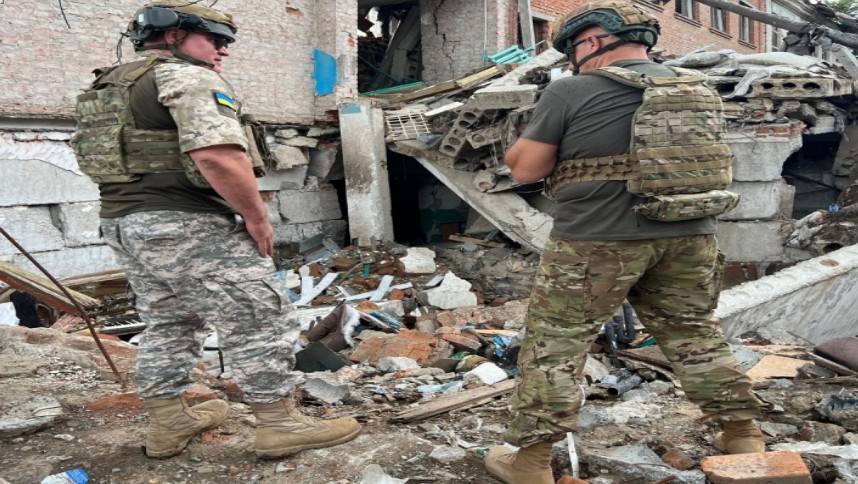
Sen. Tom Brewer and Chaplain Gennady Mokhnenko at the basement of a humanitarian aid depot in Orikhiv, Ukraine in 2023 Wiki picture by JGrin3 for illustration purposes only.