Miaojun Ma. Lanzhou University, discusses his article: Warming advanced leaf senescence in alpine plants through advancing leaf emergence and increasing soil drought
Background
Plant autumn leaf senescence, which marks the end of photosynthesis and the growing season, as well as the onset of dormancy, is particularly critical in the plant annual cycle. Early or late leaf senescence can shorten or prolong the plant growth season, potentially affecting plant carbon accumulation and the recovery of nutrients for the following year’s growth. Therefore, the optimal timing of plant leaf senescence is important for regulating the length of the aboveground growing season of plants, ecosystem productivity, and carbon storage. Understanding plant autumn leaf senescence in response to climate change is essential for predicting growing season length, productivity, and ecosystem carbon cycling. However, there is a lack of observational records and research related to autumn phenology compared to spring phenology, especially for herbaceous plants, thus the response processes and driving mechanisms of autumn leaf senescence under climate change remain unclear.
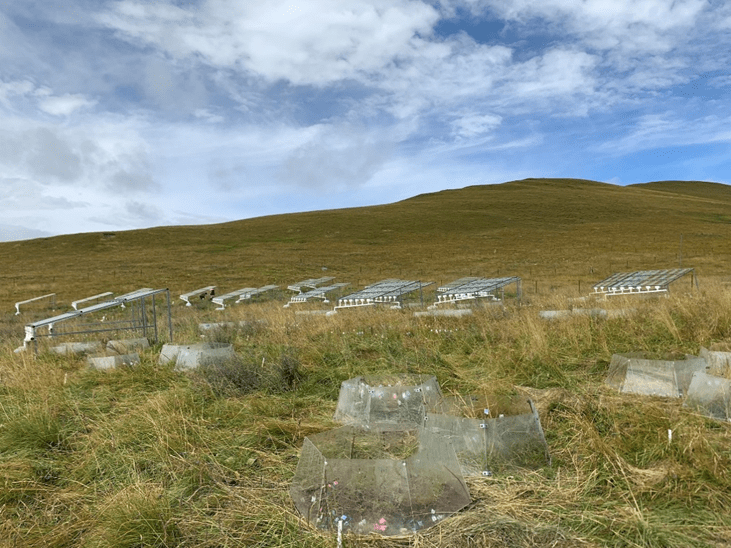
To learn how plant autumn phenology responds to climate change and the underlying mechanisms, we used 1,800 phenological records (the onset, end, and duration of leaf senescence) of 10 common species monitored during a 3-year (2019-2021) experiment on climate warming and precipitation manipulation in Gansu Gannan Grassland Ecosystem National Observation and Research Station, located in an alpine meadow on the eastern Tibetan Plateau.
Hypotheses
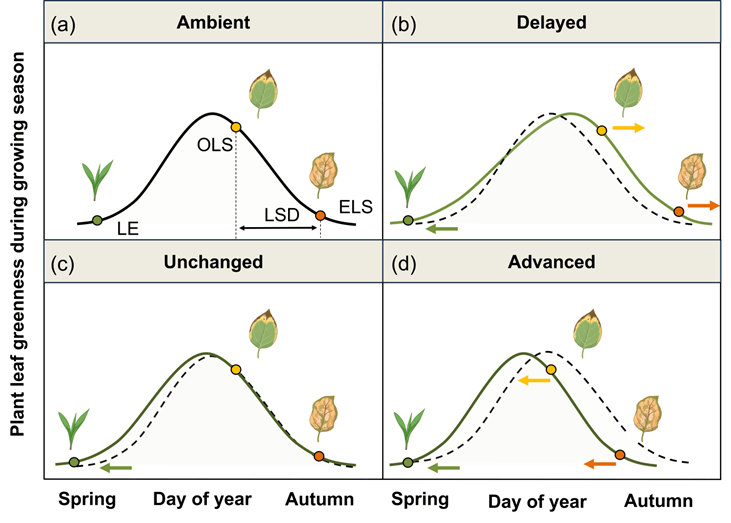
We asked two questions: (1) How do the onset, end, and duration of leaf senescence (across the community and for different life forms) respond to warming and precipitation changes? (2) What are the key mechanisms driving leaf senescence under warming and precipitation change? We hypothesized that warming would advance spring leaf emergence of alpine plants: if the delaying effect of warming on autumn phenology is greater than the advancing effects of early spring leaf emergence and soil drought, then plant autumn leaf senescence will still tend to be delayed under warming. Conversely, if the two are equal, or if the advancing effect is greater than the delaying effect, then autumn phenology will not be delayed or will even advance under warming. In addition, an increase or decrease in precipitation alone and their interaction with warming may delay or advance plant leaf senescence by regulating soil moisture.
Key findings
1. Warming overrode precipitation change in advancing the onset and end of leaf senescence, but duration of leaf senescence was almost unchanged. This suggests that future warming may not delay autumn phenology as predicted by most previous models, and it may even show a trend towards earlier senescence in alpine herbaceous plants.
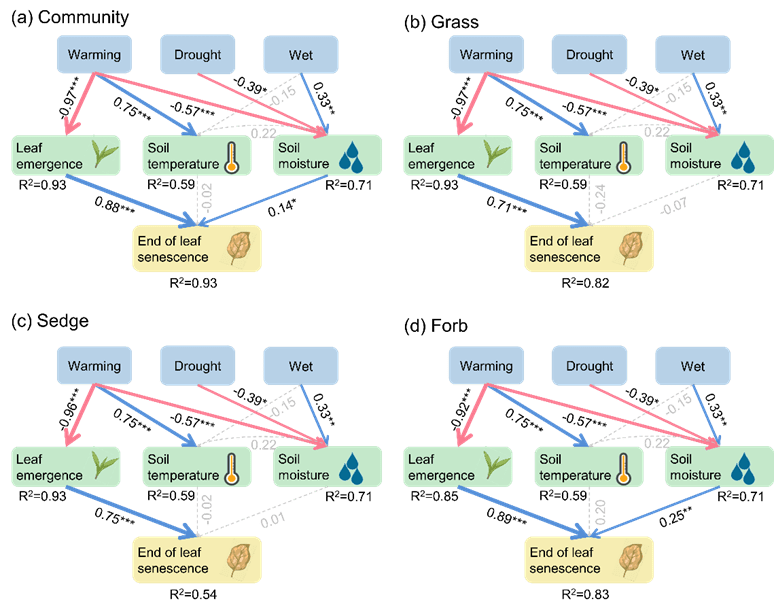
2. Increased soil temperature, soil drought, and advanced leaf emergence due to warming regulated the autumn phenological response to warming. Specifically, warming advanced the onset of leaf senescence by advancing leaf emergence, while it also advanced the end of leaf emergence, by advancing the onset of leaf emergence and soil drought. This result further suggests that future warming may induce a lag-effect in advanced spring phenology, and soil drought may limit or even reverse autumn growth delays.
Implications
Our results suggest that leaf senescence in alpine herbaceous plants will occur earlier than currently expected under climate warming, implying that the warming-induced delay in autumn senescence in alpine ecosystems may be overestimated or even reversed. This study provided novel evidence of the effects of warming and precipitation change on alpine plant leaf senescence by influencing different biotic and abiotic factors (e.g., plant spring phenology, temperature, and soil moisture). Moreover, these results enhance our understanding of the process and mechanism of leaf senescence under climate warming and precipitation change, and are important for future predictions of alpine ecosystem productivity and carbon cycle modeling. Plant phenology and soil conditions for the whole annual cycle, including spring and autumn, should be considered as we strive to understand plant responses to climate warming.
For more from Miaojun Ma, see previous posts here, here, and here.