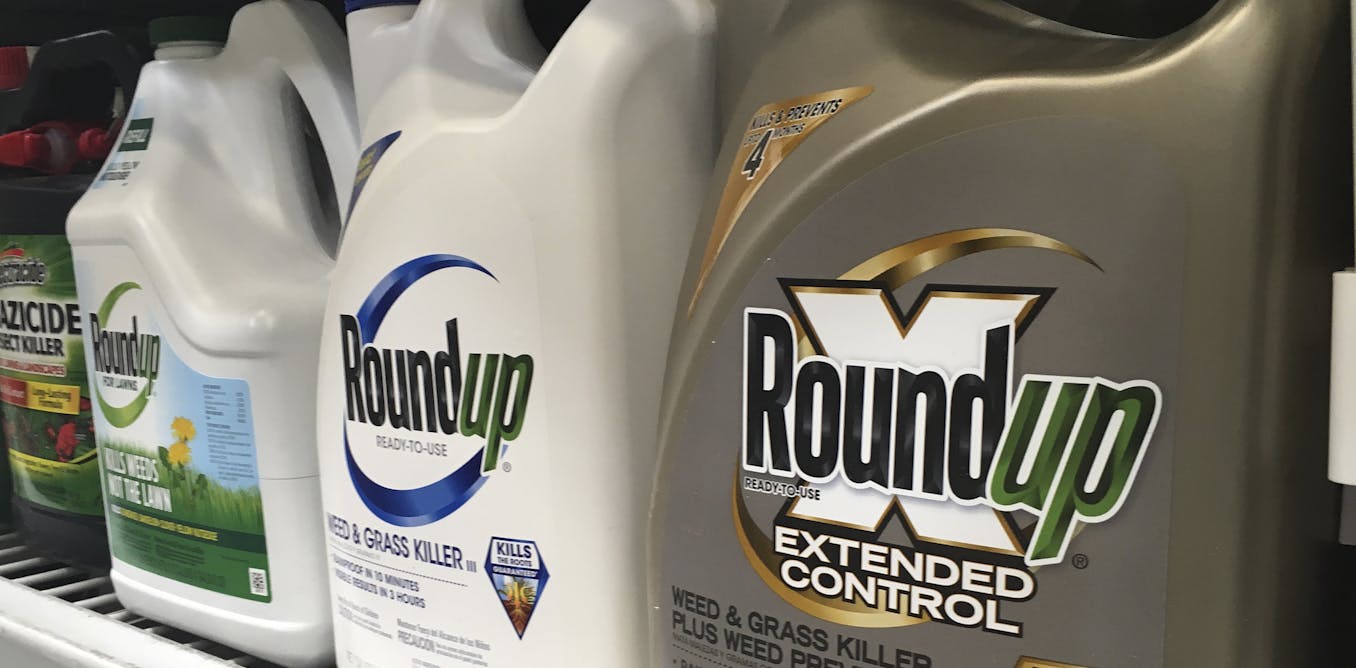
Chemical giant Monsanto has argued for years that if the U.S. Environmental Protection Agency approves a pesticide label without requiring a cancer warning, states cannot hold its manufacturer liable in court for failing to warn consumers about cancer risks. The U.S. Supreme Court has now taken up the question after hearing oral arguments for and against that position on April 27, 2026.
Between 2009 and 2019, the EPA repeatedly concluded there is no evidence that glyphosate causes cancer in humans. The agency has, therefore, allowed glyphosate-based weed killers, including Monsanto’s Roundup, to remain on the market without a cancer warning on its label. That’s despite a 2015 report from the International Agency for Research on Cancer, a branch of the World Health Organization, that classified glyphosate as “probably carcinogenic to humans” based on “limited” evidence of cancer in humans from real-world exposure and “sufficient” evidence of cancer in experimental animals. A 2025 study had similar findings in lab rats.
Several U.S. lawsuits have used the 2015 report to win legal cases claiming that Monsanto failed to warn them of the chemical’s dangers. One of the first, Hardeman v. Monsanto Co., ended in a US$80 million verdict against Monsanto in 2019. The jury found that Edwin Hardeman, a California man who used the weed killer on his properties, had proved that Roundup had caused his cancer and that Monsanto had failed to warn consumers of the dangers of its product. That finding was upheld on appeal.
In the years since, Monsanto, now owned by German chemical giant Bayer, has paid out over $10 billion to settle about 100,000 claims from people who said their health was harmed after they were exposed to Roundup. But Monsanto continues to say that a federal law passed in 1947 and significantly amended in 1972, the Federal Insecticide, Fungicide, and Rodenticide Act, bars states from imposing any labeling requirement beyond what the federal government has approved – meaning state courts cannot hold the company liable for failing to include a warning that the U.S. EPA does not require.
While the law was originally administered by the U.S. Department of Agriculture, today the Environmental Protection Agency regulates the registration, use and sale of pesticides in the United States. Companies that wish to sell pesticides must, according to the law, demonstrate that they will not “cause unreasonable adverse effects on the environment,” including “water, air, land, and all plants and man and other animals … and the interrelationships which exist among these.”
As a scholar of environmental and food law, I know the Supreme Court’s decision in the case will affect tens of thousands of pending cases of those alleging harm from glyphosate.
Tasos Katopodis/Getty Images
A short history of the case
The case before the Supreme Court began in 2019, when John Durnell, a resident of St. Louis, sued Monsanto in a Missouri state court, claiming that his regular use of Roundup in neighborhood beautification efforts over many years had caused him to develop non-Hodgkin lymphoma, a type of blood cancer.
As it had done in previous cases, Monsanto sought to dismiss the lawsuit by claiming the federal law prevented Durnell from making those claims in state court. But the trial proceeded, and in 2023 a Missouri jury found that Monsanto had, in fact, failed to warn Durnell of the danger and awarded him $1.25 million in damages.
In February 2025, a state appeals court upheld the jury’s verdict, ruling that Missouri’s laws requiring companies to warn of dangers are not preempted by federal law. Both Missouri and federal law, the appeals court found, require companies to label products with adequate warnings to protect public health. The fact that the EPA had not required a cancer warning on Roundup did not, in the court’s view, absolve Monsanto of its separate obligation under Missouri law to warn consumers of known dangers.
The Supreme Court agreed to hear an appeal in the case, seeking to determine whether federal law bars states from holding a company liable for failing to include a warning that the EPA reviewed and chose not to require.
At the Supreme Court
During the oral argument, lawyer Paul Clement, representing Monsanto, claimed that Missouri was trying to require a different label than federal law allows, and that the company could not have added a cancer warning on its own. The company argued that EPA regulations prohibit manufacturers from changing safety warnings without the agency’s prior approval, a step Monsanto never took.
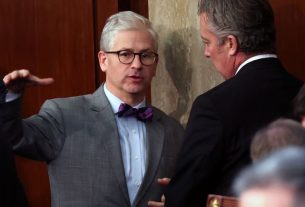
Principal Deputy Solicitor General Sarah Harris, a top Justice Department attorney, told the court the Trump administration agrees with Monsanto’s interpretation of the law.
Durnell’s attorney, Ashley Keller, argued that registration of a pesticide with the EPA does not exempt a company from civil liability for its product’s safety.
Legal commentators have suggested the justices are split but that perhaps a majority favors Monsanto’s position.

AP Photo/Rafael Yahgobzadeh
What comes next
A Supreme Court ruling in Monsanto’s favor would block Durnell’s claim. Other efforts are also underway to defend corporations from similar claims by consumers alleging products were dangerous.
In February 2026, President Donald Trump signed an executive order calling glyphosate “crucial to the national security and defense” because of its role in boosting food production by killing weeds in farmers’ fields.
Congress is also considering a proposal that would prevent state and local governments from imposing stricter labeling requirements than approved by the EPA. That legislation could also prevent courts from holding manufacturers liable for harms caused by products whose labels the EPA had approved. Six states have also introduced bills to limit pesticide manufacturers’ liability. If successful, those efforts would effectively shield pesticide companies from lawsuits similar to Durnell’s.
A broader legal principle is also at stake: whether Congress or federal agencies can block states from protecting people when federal regulators have not required companies to warn the public about potential harm.
In April 2026, Sen. Ted Cruz, a Texas Republican, introduced a bill that would prevent people from filing lawsuits in state courts that seek to hold oil and gas companies responsible for environmental damage, including their contributions to climate change. In late 2026 or early 2027, the Supreme Court is also expected to hear a case about whether existing federal law already blocks those lawsuits.
Together, these efforts reflect concerted efforts to protect large corporations from consumers’ claims that products have harmed them and to prevent states from holding companies accountable when federal regulation falls short.