(Bangkok) – Two journalists were arrested in the Maldives in the second week of May, 2026, the first journalists jailed on criminal charges since the country adopted a democratic constitution in 2008, Human Rights Watch said today.
The Maldives authorities should immediately release the arbitrarily imprisoned journalists, Leevan Ali Naseer, 29, and Mohamed Shahzan, 31, and drop charges against media officials caught up in an escalating crackdown on press freedom in the country.
“The Maldives government’s wrongful jailing of two journalists and raiding of independent news outlets sends a chilling message about media freedom in the country,” said Elaine Pearson, Asia director at Human Rights Watch. “The government should urgently reverse the dangerous backsliding on media freedom.”
On April 27, the Serious and Organized Crime Department raided the office of the online newspaper Adhadhu in Malé, the capital, seizing journalists’ laptops and hard drives. On March 28, the news outlet had released the documentary “Aisha,” which alleges sexual misconduct and abuse of power by President Mohamed Muizzu against a former employee. Muizzu has denied the allegations.
The authorities subsequently imposed travel bans on Adhadhu’s CEO, Hussain Fiyaz Moosa, and managing editor, Hassan Mohamed. On May 10, the Prosecutor General’s Office charged the two under section 612(a) of the penal code for “qazf,” the false accusation of adultery under Islamic law, which carries a prison sentence of up to 19 months and up to 80 lashes.
On May 10, the Maldivian Criminal Court issued a gag order prohibiting public discussion of the documentary. Two days later, it convicted and sentenced Adhadhu journalists Naseer and Shahzan to 10 and 15 days in prison, respectively, for reporting on the gag order. The men were also ordered to pay fines of approximately Maldivian rufiyaa (MVR) 26,000 (US $1,700).
The media reported that both journalists were being held in poor and unsanitary conditions at Maafushi prison. On May 15, prison officials transferred Naseer to a separate unit, placed him in solitary confinement, and denied him access to medical treatment for a skin condition that had worsened in custody.
On May 17, the High Court rejected an appeal filed by the Maldives Journalists Association against the gag order, finding that the group did not qualify to appeal this case. The High Court subsequently accepted an appeal brought by Moosa on May 19 but has not yet ruled on it.
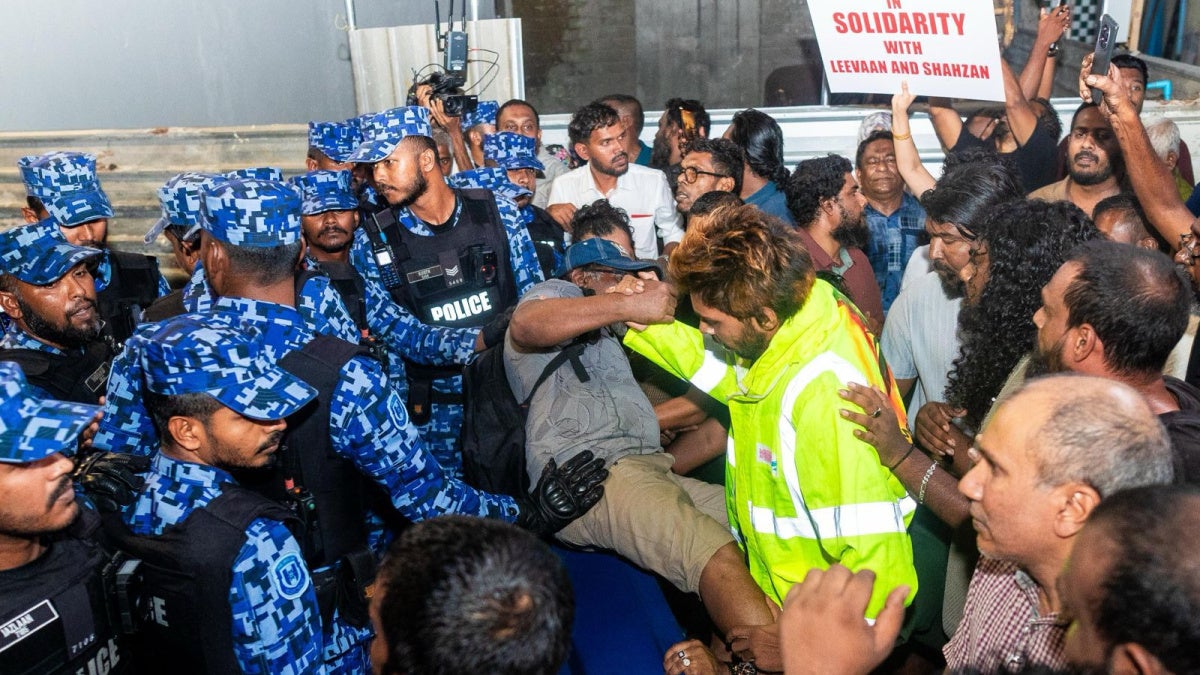
Following the arrests of Naseer and Shahzan, journalists and opposition party supporters staged public protests in Malé. Police obstructed and attacked the demonstrators, and on May 13 arrested 10 people at a protest organized by the People’s National Front and the Maldives Democratic Party; several remain detained. On May 19, 13 media outlets observed a 12-hour media blackout, suspending their daily reporting in protest against escalating attacks on the media.
The Maldives Journalists Association’s executive director, Mohamed Junayd, told Human Rights Watch that “in a criminal justice system that is struggling with a backlog of cases, the haste with which the executive, prosecutors, and judiciary have done their work in order to jail journalists, in secret trials without lawyers, is shocking. The seizure of protected journalistic material, travel bans, the sweeping gag order, and the jailing of journalists represents a calculated dismantling of the legal safeguards designed to protect journalists.”
Human Rights Watch and other human rights groups wrote to President Muizzu on May 8 to express serious concerns about the targeting of Adhadhu and other media outlets and journalists, and said that the government should publicly reaffirm its commitment to freedom of expression and independence of the media.
The media crackdown followed the Maldives’ parliament, the People’s Majlis, passing a law on September 16, 2025, the Maldives Media and Broadcasting Regulation Bill, that provides the government broad and discretionary powers to control and regulate the media. Adhadhu’s Mohamed said that under the law, “the government effectively has full control over the regulatory body, since members are elected through parliament, which the government controls. The law isn’t meant to promote media rights; it’s meant to suppress them.”
The law established a regulatory body, the Maldives Media and Broadcast Commission, that is empowered to order media outlets to issue correction notices on online content and to impose fines from MVR 5,000 ($325) to MVR 25,000 ($1,600) on journalists and media workers who fail to comply. In late April, the commission ordered Channel 13 television to halt its live transmission of opposition protests.
On May 19, three former Maldivian presidents, Mohamed Nasheed, Abdulla Yameen Abdul Gayoom, and Ibrahim Solih, sent a joint letter to diplomatic missions and civil society groups covering the Maldives, including Human Rights Watch, saying that the current administration should release the journalists and those detained during protests.
The former presidents wrote that “a free press is among the clearest markers of the democracy… and its suppression follows a broader pattern of backsliding: the disempowerment of Parliament, the undermining of independent commissions, and the passage of a media act that empowers a government-aligned commission to discipline and shut down outlets.”
Islamist extremist gangs in the Maldives have long targeted activists and journalists for material deemed “offensive” to Islam. Some of these gangs have links to prominent politicians and have assaulted and murdered journalists with impunity.
“The Maldives is a very small country… so, when journalists are targeted, it’s very easy for people to identify and confront us,” Mohamed said. “When officials label us as anti-Islamic or aggressive, it puts us at real risk. …The threat is very real, and it affects how we live our daily lives – going to work, taking our children to school, etc.”
“The renewed crackdown on the press in the Maldives shows that the gains in media freedom are very fragile,” Pearson said. “President Muizzu needs to send a strong public message to the police that free expression must be protected and that attacks on the media by anyone won’t be tolerated.”