
KEY TAKEAWAYS
-
Europe is not following the American path, but three specific clusters stand out, from the British Isles to Poland and across Sweden.
-
Europe’s despair phenomenon is increasingly affecting the elderly: alcohol-related deaths among the over 65s now exceed US levels in most regions.
-
“Deaths of despair” are far from inevitable: Southern Europe shows how low the phenomenon can be.
In the United States, life expectancy diverged from Europe before it stopped rising during the 2010s, even before the COVID-19 pandemic. The economists Anne Case and Angus Deaton gave a name to a phenomenon that was then booming, partly explaining this trend: “deaths of despair”, which have soared since the turn of the 21st century, especially among middle-aged white people without a college degree.
Is Europe following in the footsteps of the US? Are there regions on the continent where this mortality has risen as fast as in the US, and others where it has already reached comparable levels?
A European study covering 400 million inhabitants
These are the questions we answered in a study published in The Lancet Regional Health – Europe. We did this by analysing mortality and demographic data from national institutes and the World Health Organization’s database.
The data concerns 169 regions across 23 European countries between 2002-2019 (representing nearly 400 million inhabitants over the age of 15) with the US as a benchmark. The data from national institutions and WHO statistics required several years of data collection and substantial harmonisation efforts. To measure the impact of the pandemic, we extended the analysis to 2022 for the 16 countries for which data was available.
“Deaths of despair” covers three main types of causes of death: suicides, deaths related to drugs and toxic substances, and alcohol-related deaths. Alcohol-related mortality is measured in two complementary ways: deaths caused by acute alcohol poisoning, and liver diseases (such as cirrhosis and other hepatic pathologies) which largely reflect the impact due to prolonged consumption.
To measure the burden of these deaths, we calculated the loss in life expectancy. The idea is simple: how many years of life does a population lose on average, as a result of these premature deaths? This figure is all the higher because of the high volume of these deaths and because they occur early in life.
Life expectancy loss of up to 26 months in Poland
The first finding is reassuring for Europe: before the COVID-19 pandemic (2017-2019, the most recent period for which we have data for all regions studied), a European lost an average of 12 months of life expectancy due to “deaths of despair”, against 22 months for an American. For women, the figures are respectively 4 and 10 months. Deaths of despair indeed leave a deeper mark on men.
European averages cover very contrasting situations geographically, as revealed in our first figure below. Across the continent, losses vary by a factor of seven. Among men, the heaviest losses are concentrated in the north and east: they peak at more than two years in parts of Poland (up to 26 months in the region of Łódź), Lithuania and Scotland, where the values exceed those observed in the United States. At the other end, southern Europe is largely spared: losses are sometimes less than 4 months, for example in Liguria, Sicily or in Latium (Italy).
Among women, the same north–south gradient appears, but in muted form: eastern Europe is less exposed, and it is Scotland (10 months, the only region on the continent to exceed the American level), Wallonia, southern Finland, and Lithuania that stand out. On the other hand, Calabria and Sicily in Italy, as well as Extremadura in Spain, close the gap, with barely a month and a half of life lost.
Florian Bonnet/INED, Author provided (no reuse)
Rising in the British Isles, Sweden and eastern Europe
The second finding is, again, reassuring for Europe. Over the whole 2002–2019 period, the burden of deaths of despair fell by 15% in Europe, while it leapt by 75% in the United States.
But that average hides opposing trajectories: our study shows that in one region in three, the burden due to “deaths of despair” stagnated or even rose in the years before the pandemic. These struggling regions cluster into three hotspots that often spread across national borders. The first stretches across the north-west of the continent, from the British Isles (Northern Ireland, England outside London, Wales) to Flanders and the Netherlands. The second covers a broad area in eastern Europe, from Poland to Czechia and Slovakia. The third takes in almost all of Sweden.
Together, these three hotspots carry a central lesson. The continent is not immune from this phenomenon, embedded in specific regional contexts. However, the steepest regional increase is still slower than that seen in the US.
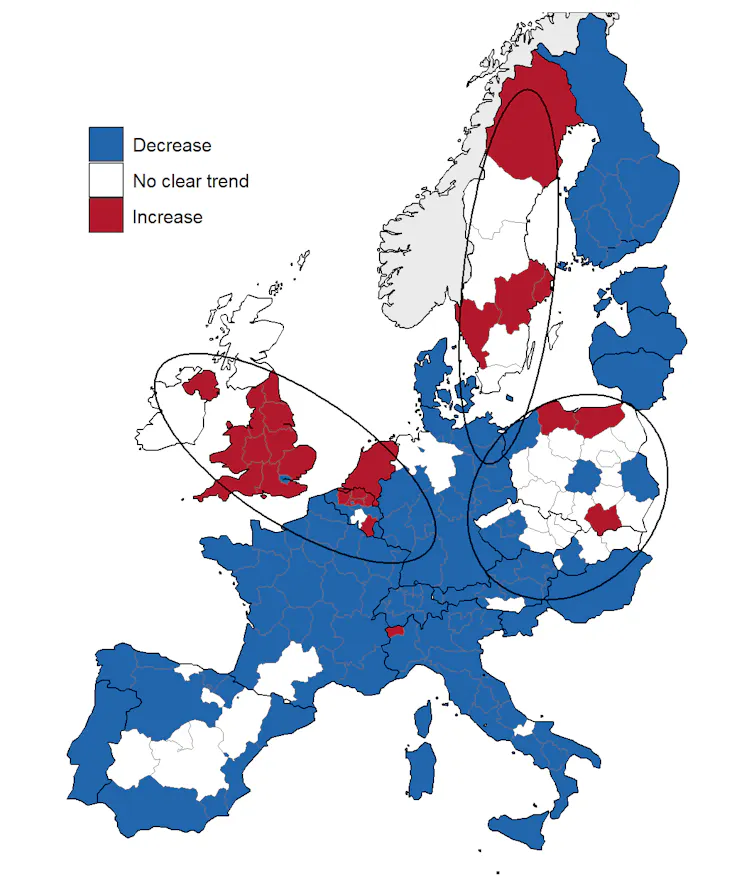
Florian Bonnet/INED, Author provided (no reuse)
Overdoses up among working-age adults, acute alcohol deaths up among retirees
The three hotspots do not owe their crises to the same causes. Behind the “deaths of despair” lie distinct dynamics, which appear once trends are broken down by causes of death and age. Two of them caught our attention.
The first concerns drugs among working-age adults. Their toll has risen sharply in Sweden and the British Isles. Scotland, in particular, is the only region to match the recent surge in American overdoses. Yet this front remains largely contained: across the continent, overdose mortality is still one eighth of the US level. The opioid crisis ravaging the United States has, for now, reached only the fringes of Europe.
The second is distinctly European. The American literature has largely cast despair as a matter for working-age adults. Yet we have uncovered a particularly harmful trend among people aged 65 and over: deaths from acute alcohol poisoning. Their burden is rising in nearly one European region in two and, in 2017–2019, exceeded the US level in six regions out of ten. On this front, Europe does not compare favourably with the US.
COVID-19: mortality climbed in over half of regions across Europe
By extending the analysis to include the 2020-2022 period, a final signal appears: within the 16 countries for which we have data, the burden due to deaths of despair increased in 55% of the continent’s regions. This increase is particularly pronounced in the British Isles and the Netherlands, where it extends already unfavourable trends. It is also observed in Finland, Estonia, Hungary and northern Germany.
Swedish regions stand out as exceptions. Despite being a hotspot before COVID-19, we observed declines during the pandemic, in contrast with much of the rest of Europe.
Southern Europe shows the way forward
This panorama of deaths of despair could be worrying. But it also offers grounds of hope. These deaths are not inevitable: the experience of Southern Europe shows that their toll can remain comparatively low. In Calabria and Sicily, they cost a month and a half of life expectancy for women, the lowest level observed across the continent.
Getting there will mean pulling the right levers. Where drugs are gaining ground, in northern Europe and the United Kingdom, the urgent task is to strengthen drug policies. Particular attention must also be given to retirees, as alcohol appears to be causing significant harm in many European regions.
To conclude, our study shows that national averages often hide regional realities that only detailed monitoring at the territorial level can flag up. The rise in “deaths of despair” seems to be confined to some islands within the European archipelago. By identifying them before they spread, and by taking inspiration from the parts of Europe which escape them, the continent will be able to contain a threat that must not cross the Atlantic.
Beyond this article, all of our results can be accessed via an interactive application.

A weekly e-mail in English featuring expertise from scholars and researchers. It provides an introduction to the diversity of research coming out of the continent and considers some of the key issues facing European countries. Get the newsletter!