The Autumn 2026 Economic Forecast shows that the EU economy held up better than expected in the first three quarters of 2026. It is set to keep expanding, despite stronger and more persistent inflationary pressures and tighter financing conditions.
EU real GDP is expected to grow at
- 1.4% in 2026 and 2027
- 1.5% in 2028
The euro area is expected to follow a similar path, with real GDP set to grow by
- 1.2% in both 2026 and 2027
- 1.3% in 2028
EU yearly inflation is forecast to
- reach 3.3% in 2026 and 3.2% in 2027
- ease to 2.3% in 2028
Inflation in the euro area is expected to show a similar trend
- reaching 3.2% in 2026 and 3.1% in 2027
- easing to 2.1% in 2028
Growth holds up
Better-than-expected growth was driven by steady consumption and a sharp rebound in exports of goods, while investment came in slightly below expectations. Households’ real disposable income and private consumption are expected to recover gradually. Strong external demand is set to keep exports an important driver of activity next year.
Energy inflation to moderate next year
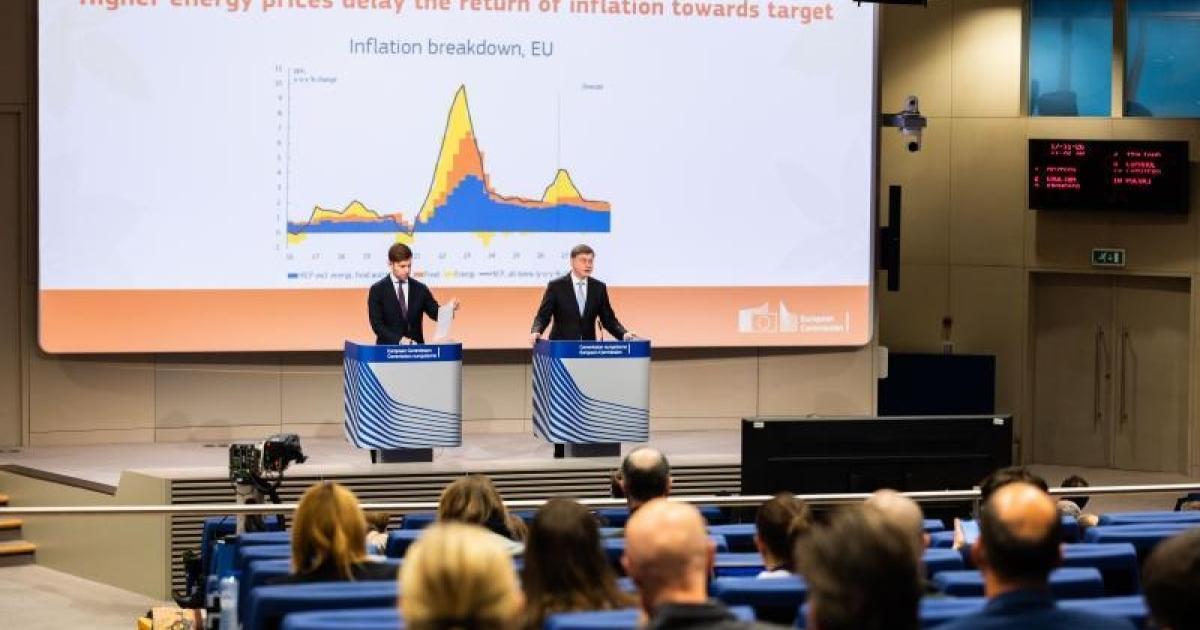
Inflation in the euro area reached 4% in October. It is expected to peak above 4% between late 2026 and early 2027, before gradually easing. Energy inflation is projected to moderate next year, while food inflation is set to accelerate, driven by higher energy and fertiliser costs and crop disruptions caused by extreme summer weather.
Job growth slows, but unemployment stays low
Employment growth is projected to slow down, though still resulting in 800 000 additional jobs in 2026. The unemployment rate is set to remain close to 6% (its record low), while the labour force expands only marginally. Wages are projected to grow marginally more than expected in the Spring Forecast and to slightly outpace inflation, implying moderate positive real wage growth.
Reforms and energy transition could support growth
Faster progress on reforms to address bottlenecks to competitiveness and growth could support stronger economic activity than currently projected.
Developments in energy markets could lower inflation projections and support growth. Progress in the energy transition to reduce Europe’s dependence on imported fossil fuels would further boost economic resilience.
For more information
This article was originally published on https://commission.europa.eu/news-and-media/news/autumn-economic-forecast-continued-growth-amid-higher-inflation-2026-11-17_en. It is shared here under a Creative Commons license.