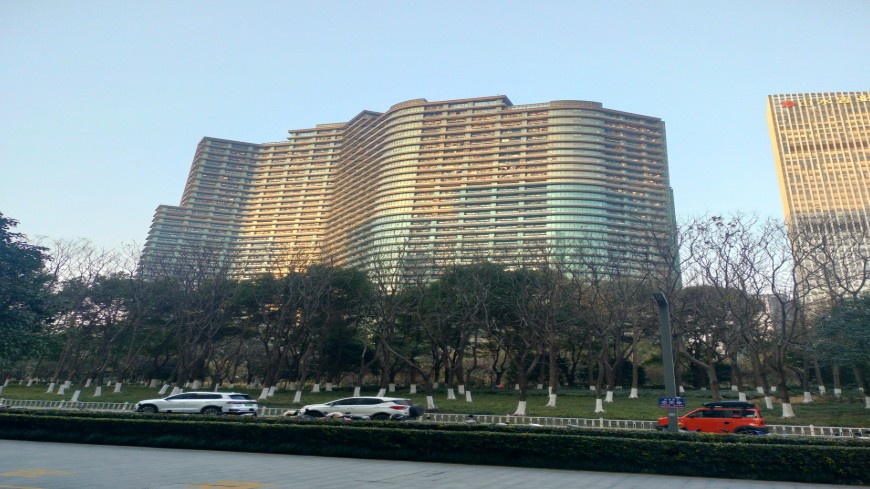
HANGZHOU, China — Rising 208 meters (675 feet) over Qianjiang Century City, the S-shaped Regent International Center stands as one of the world’s largest residential structures by capacity. Accommodating up to 30,000 residents within a single multi-story complex, the building operates as a self-contained “vertical city” where tenants can access daily necessities without stepping outside.
Designed by architect Alicia Loo—known for her work on Singapore’s landmark Marina Bay Sands—the structure originally opened in 2013 as a six-star luxury hotel. It was later converted into a high-density residential hub comprising between 11,000 and 11,250 individual apartment units spread across 36 to 39 floors.
Architectural Scale and Demographics
The building’s vast scale caters primarily to young professionals, university graduates, digital nomads, and social media influencers. Located in Hangzhou’s expanding central business district, its centralized model offers accessible housing options within a major tech and commercial hub.
Regent International Center: Core Specifications
+-------------------------------------------------------------------------+
| LOCATION: Qianjiang Century City, Hangzhou, China                       |
| ARCHITECT: Alicia Loo                                                   |
| HEIGHT & FLOORS: 208 meters (675 feet); 36 to 39 floors                 |
| TOTAL UNITS: ~11,000 to 11,250 individual apartments                    |
| ESTIMATED POPULATION: 20,000 to 30,000 residents                        |
| ORIGINAL PURPOSE: Six-Star Luxury Hotel (Opened 2013)                   |
+-------------------------------------------------------------------------+
Monthly rents range from approximately $200 USD for compact, windowless inner units to $550 USD or more for larger apartments featuring private balconies.
Integrated Infrastructure and On-Site Amenities
To support thousands of occupants under one roof, the complex integrates commercial, recreational, and administrative services directly into its common levels.
Internal Amenities and Self-Contained Services
+-------------------------------------------------------------------------+
| DINING & RETAIL: Large food courts, restaurants, and full-service grocers|
| HEALTH & LEISURE: Swimming pools, fitness centers, internet cafes        |
| PERSONAL CARE: Hair salons, beauty parlors, and pet care facilities      |
| UTILITIES: Advanced security networks and centralized fire suppression  |
+-------------------------------------------------------------------------+
Urban Density: Efficiency Versus Living Standards
The hyper-dense residential model has generated widespread debate among urban planners, architectural critics, and social media platforms.
- Efficiency Arguments: Proponents emphasize reduced transit dependencies, low energy footprints relative to footprint area, and affordable housing access near urban employment centers.
- Density Criticisms: Observers point to potential strain on internal elevator networks, noise pollution, lack of personal privacy, and limited outdoor exposure for inward-facing units.
While viral online commentary frequently frames the complex through a dystopian lens, industry observers note that the Regent International Center represents an experimental approach to modern mega-structure urbanism in response to rapid city population growth.
Regent International Center, Qianjiang Century City, Hangzhou Wiki Picture by Huandy618