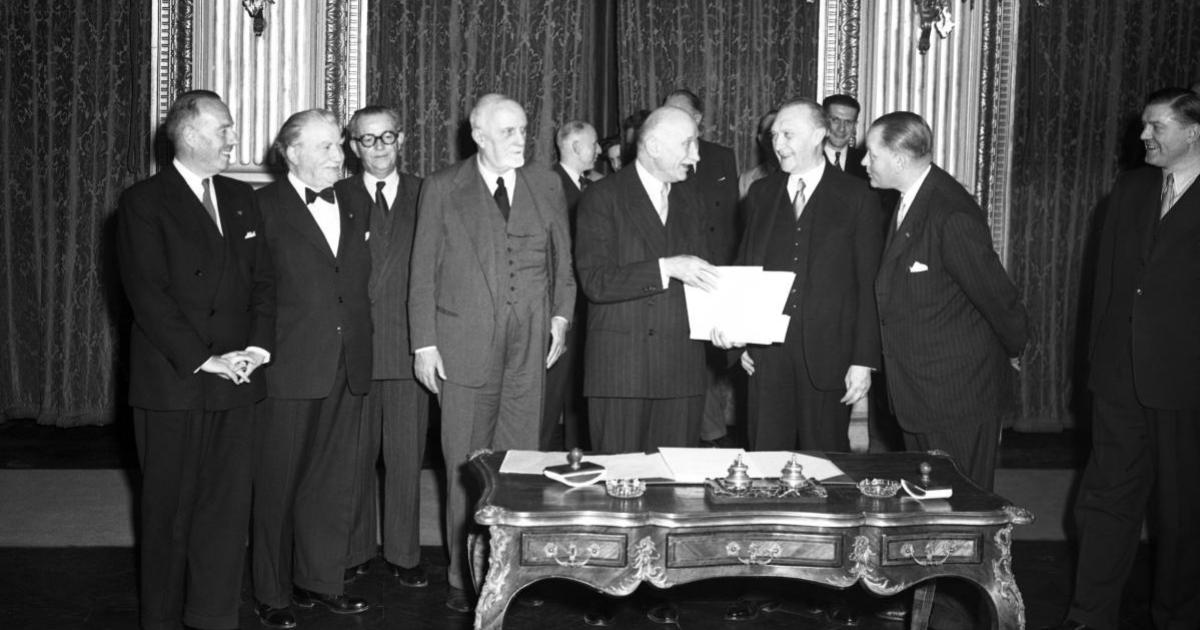
On April 18 we celebrate 75 years since the signing of the Treaty of Paris establishing the European Coal and Steel Community (ECSC), the first Treaty that led to the creation of the European Union.
Signed by Belgium, the Federal Republic of Germany, France, Italy, Luxembourg and the Netherlands, it paved the way for deepening European economic integration and the establishment of the European Economic Community with the 1957 Treaty of Rome and the European Union with the 1992 Treaty of Maastricht.
French Minister for Foreign Affairs Robert Schuman put forward the idea of a coal and steel community in his now famous ‘Schuman Declaration’ on 9 May 1950. Following the devastating effects of the second world war, he asserted: “solidarity in production thus established will make it plain that any war between France and Germany becomes not merely unthinkable, but materially impossible”.
A year later the ECSC was launched. The Community’s primary aim was to organise the free movement of coal and steel, free up access to sources of production and ensure price transparency.
At that time, the choice of coal and steel was highly symbolic: in the early 1950s, coal and steel were vital industries. In addition to the economic benefits, the pooling of French and German resources was intended to mark the end of the rivalry between the two countries. The common coal and steel market was to be an experiment which could gradually be extended to other economic spheres, culminating in a political Europe.
This Treaty also laid the foundations of many of the EU’s modern-day institutions by setting up an executive known as the ‘High Authority’, the predecessor of today’s European Commission, a Parliamentary Assembly, a Council of Ministers, a Court of Justice and a Consultative Committee.
For more information