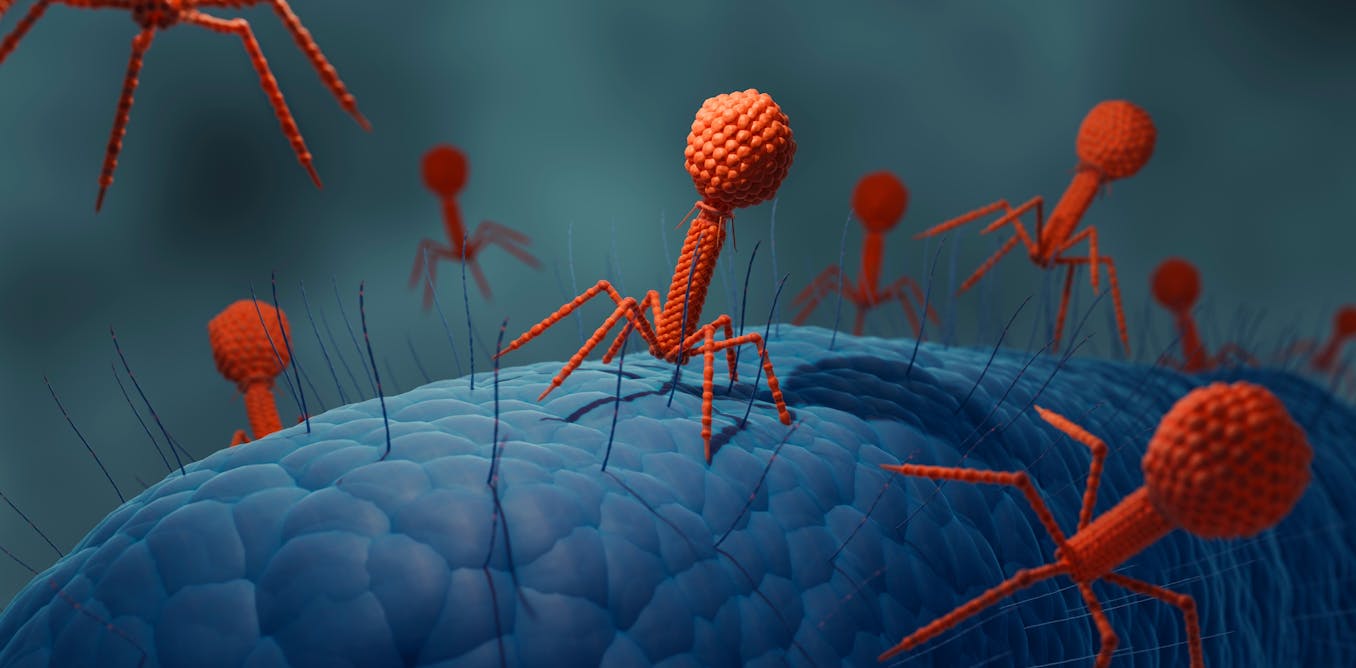
Artificial intelligence has designed viruses that can infect bacteria and reproduce – a first that shows AI is beginning to do more than analyse the genetic code of living things. It can write new versions of it, too.
The viruses in question are bacteriophages, or phages – viruses that infect bacteria rather than people, animals or plants. Researchers used AI to design hundreds of new versions of a well-studied phage, then built the viruses from scratch in the laboratory.
Of 285 AI-designed genomes that the team tested, 16 produced working phages capable of infecting E coli.
The result is an important step for a field sometimes called generative biology, in which AI is used to design new biological molecules and organisms. But it is also important to understand what the researchers have – and have not – demonstrated.
Phages are essentially bacterial predators. They are among the most abundant and diverse biological entities on Earth and have evolved alongside bacteria for billions of years.
Most phages are highly specialised. They recognise molecules on the surface of a bacterium, attach themselves and inject their genetic material inside. The phage then takes over the bacterium’s molecular machinery, using it to make new copies of itself. Eventually, the infected cell bursts, releasing the new phages.
That makes phages useful for testing what AI can do.
Their genomes can be extremely small, so researchers can synthesise the DNA relatively quickly and test whether it works. The result is also unusually clear: either the genetic instructions produce a functioning phage or they don’t.
The AI systems used in the study, called Evo 1 and Evo 2, are designed to work with genetic sequences in much the same way that large language models (such as ChatGPT) work with text.
A language model learns patterns in words and sentences. A genome model learns patterns in DNA sequences.
But a genome is not simply a string of instructions that can be changed one letter at a time. Its different parts have to work together. In a phage, the DNA must contain instructions for recognising the right bacterium, taking over its machinery, producing proteins at the right time and assembling new virus particles.
The researchers trained their AI models on more than 2 million phage genomes. They then asked them to design new versions of a small, extensively studied phage called ΦX174.
ΦX174 has a genome of about 5,400 DNA letters and contains instructions for making just 11 proteins. It infects a strain of E coli that is not associated with disease, making it a relatively simple system in which to test the technology.
The researchers also fine-tuned the models using genomes from about 15,000 close relatives of ΦX174.
So the AI was not inventing a virus from nothing. It was using patterns found in existing biology to generate new combinations within a system that scientists already understand relatively well.
The team then chemically synthesised the DNA sequences and introduced them into E coli to see whether they could produce functioning phages. Most could not, but 16 of the 285 designs worked.
Some of the resulting phages behaved in ways broadly comparable to ΦX174, despite having substantially different DNA sequences. In one case, the AI-generated genome contained a combination of genetic elements that would not have worked in the original phage, but did work in the altered genome.
The researchers also explored whether the new phages could overcome bacterial resistance. They exposed the AI-generated phages to a variant of E coli that was “resistant to” (could fend off) the original phage. After repeated rounds of exposure, hybrid phages emerged that could infect the previously resistant bacteria.
AI had not directly designed these final phages. Instead, it had generated a diverse starting population, giving evolution more possibilities to work with.
This approach could eventually prove useful in the fight against antibiotic resistance. Bacteria are increasingly developing resistance to antibiotics, making some infections difficult or impossible to treat. Phages have long been investigated as an alternative because they can target and kill bacteria, and adapt to combat phage resistance, while leaving human cells untouched.
The challenge is finding the right phage for the right bacterial infection. AI could eventually help researchers predict which phages are most likely to work against particular drug-resistant bacteria.
Large gap
But there is a large gap between designing a phage on a computer and using one to treat a patient. Any potential treatment would first need to be tested against the types of bacteria that cause infections in patients, to make sure it works and is safe. It would then need to be made to the high standards required for medicines.
And the phage used in this study is unusually simple. Many phages that could potentially be useful against serious infections have much larger genomes and contain far more complicated biological machinery.
Scientists still don’t understand much of that machinery. There would also be difficult regulatory questions around personalised phages designed for individual patients. The study is therefore better seen as a demonstration of what might be possible than as the arrival of AI-designed phage therapy.
It is also a reminder of just how useful phages have been to biology. Scientists have studied them for decades to understand the basics of genetics and how cells work. Now they are giving researchers a way to test whether AI can do more than interpret existing DNA – can it design a complete genome that actually works?
The next question is whether the same approach works beyond this relatively simple system. Can AI design more complex phages? Can it help researchers tackle bacteria that cause serious human infections? And can it do so reliably enough to be useful outside the laboratory? The work also raises obvious questions about biosecurity.
Biosecurity
The study involved a relatively simple phage that infects bacteria, not a virus capable of causing disease in humans. It does not demonstrate that AI can simply be asked to produce a dangerous virus and have one emerge from a computer. But it does show that AI systems are beginning to move from reading biological sequences to generating new ones that can work in the real world.
That makes it increasingly important to think about how such systems are trained, what biological information they can access and how potentially risky designs should be screened.
Those questions cannot be left to AI researchers alone. Biologists, physicians, regulators, ethicists and biosecurity experts will all need to be involved as the technology develops.
For now, the achievement is best understood for what it is: a proof of principle showing that AI can generate new versions of an entire viral genome that actually function.
The more difficult task will be discovering how far that ability extends and making sure that its development keeps pace with our understanding of the risks.

Chloe James has previously received funding from The Biotechnology and Biological Sciences Research Council to investigate bacteriophage biology and from The University of Salford to develop educational tools for knowledge exchange about phage biology. She is employed by The University of Salford and sits on scientific advisory groups for The Microbiology Society, the CF-Trailfinder Innovation Hub, and the UK Cross-Government Phage Group.
Martha Clokie receives funding from BBSRC
Rosetrees Trust
JPIAMR (So EU but funded by MRC)
European Union / Horizon Europe
Innovate UK
LEO Foundation
BioLevel (Company)