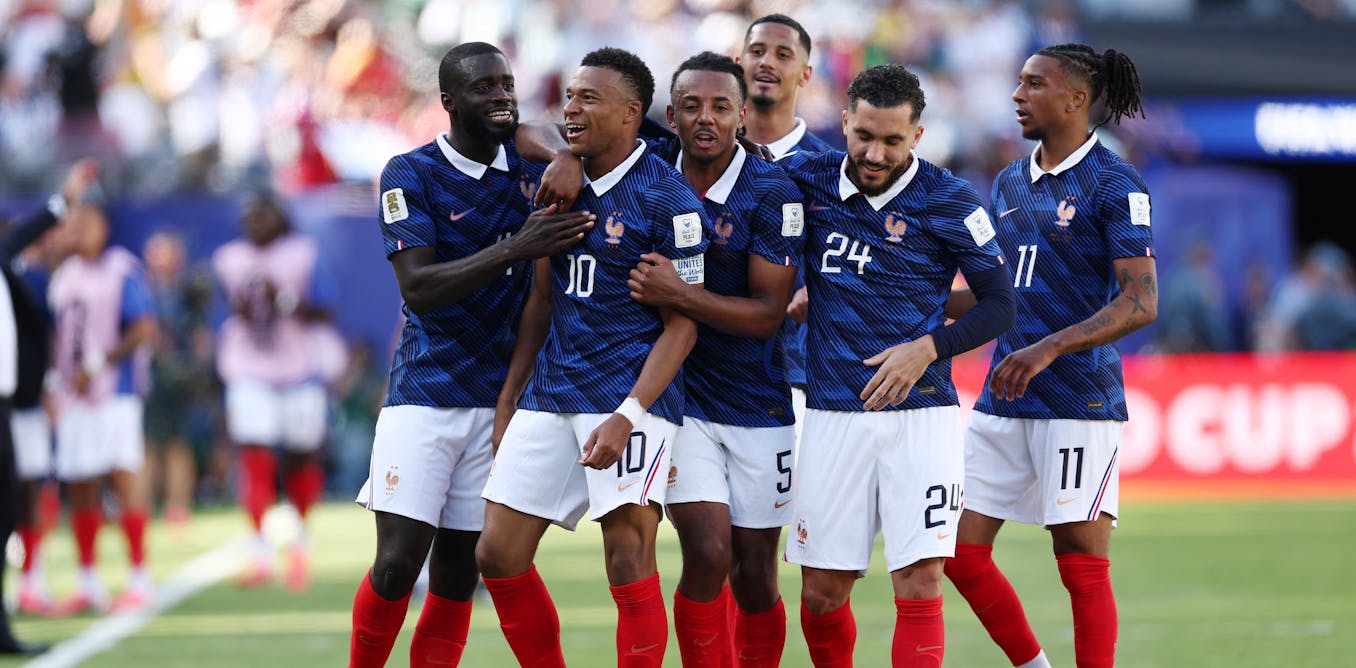
At every Football World Cup and any other major football tournament, it is not only Les Bleus performances on the pitch that come under scrutiny, but also the players’ identities, their migrant backgrounds and the extent to which they represent France and French society. This recurrent question speaks to unresolved issues and questions about France’s collective national identity, long-standing debates about immigration, and how France views itself. Above and beyond the team’s line-up, the unresolved question of the country’s postcolonial identity and what it means to be French in the 21st century is replayed at every tournament.
When head coach Didier Deschamps unveiled the starting XI for France’s 2026 World Cup campaign, one of the first questions he was asked concerned the inclusion of players from France’s overseas territories in the official squad. In response, Deschamps emphasised that the national team reflected both French society and its history. This statement quickly sparked widespread debate, particularly on social media, where it became apparent that, for many, the team’s composition did not match their vision of France. Like many of his predecessors, Didier Deschamps had, in fact, just announced a squad predominantly made up of players from immigrant backgrounds. And, like his predecessors, he found himself confronted with a question that has long dogged the French national team: do Les Bleus truly represent France and French society?
When France won its first World Cup in 1998, the celebrations were widely interpreted through the prism of national identity. The slogan “Black-Blanc-Beur” (“Black, White, Arab”) emerged as a symbol of a multicultural France. Conversely, when things went wrong for Les Bleus, for instance, during the 2010 World Cup scandal in South Africa, marked by a players’ strike, criticism was also framed in terms of identity, French values and what constitutes an authentic representation of the nation.
The reason this question resurfaces at every World Cup is that it goes far beyond football. Why does a team, most of whose players were born in France, continue to be questioned about its ability to represent the nation? To answer this question, we must look back at France’s long history, from its colonial empire to the model behind its broader sports training programme.
A team shaped by history
Why do Les Bleus have so many players from migrant backgrounds? The answer lies, in particular, by looking at several intertwining historical trends.
Waves of migration from France’s former colonies have tended to form clusters in deprived neighbourhoods.
At the same time, the French government and the French Football Federation developed, particularly from the 1980s and 1990s onwards, sports facilities in these areas to provide young people with structured activities and combat marginalisation, which sometimes took the form of youth crime in these neighbourhoods. Football therefore became an affordable pastime for children from working-class areas, many of whom came from immigrant families from former French colonies.
More than just a hobby, for many it became a path to empowerment, offering a chance to escape poverty, social exclusion and marginalisation. For many young people, it provided a space for social integration, but also an opportunity for economic mobility and a way out of poverty.
Goal on Instagram
It is therefore not surprising that French football’s main talent pool is now largely concentrated in these areas.
This reality is reflected in the line-ups of the national team and many other European countries with a colonial past, such as England and the Netherlands.
However, within the French national team, issues relating to identity and representation appear to remain unresolved. France is currently producing an exceptional number of world-class players across France’s suburbs.
With 99 players born and trained on French soil among the 1,248 players taking part in the 2026 World Cup, France is the tournament’s leading exporter of talent. While 23 of them wear the Les Bleus’ shirt, the other 76 represent other national teams, including Haiti, Senegal, Morocco and Algeria.
The influence of the national imagination
Taken together, France’s colonial legacy, migration patterns and the training policies implemented by the French Football Federation since the 1990s have helped to create one of the world’s most successful incubators for developing football talent.
These factors help to explain why the French national team looks the way it does today. They do not, however, explain why its composition continues to be contested. To answer this question, we must shift our focus from the pitch to representations of the nation.
Colonisation did not merely transform the identity of colonised peoples; it also profoundly reshaped the identity of the colonising societies, which today continue to grapple with their legacies and contradictions. In France’s case, ingrained tensions remain over what truly represents France.
On the one hand, there remains a pre-colonial or nostalgic view of the nation, according to which a symbolically “correct” representation of France would be that of a country that is essentially ethnically white. On the other hand, there’s the view that France’s imperial history has helped shape a multicultural nation, diversified by migration, while remaining founded on the universalist principles of the Republic. These two standpoints continue to coexist and are sometimes at odds with one another. This tension, which remains largely unresolved, pops up again during events like the World Cup, with the recurrent and sensitive question of who can truly claim to represent France.

Emmanuel Macron on Instagram
Understanding contemporary identities requires recognising the forms of cultural hybridity that are a result of the colonial experience. France is a hybrid society: a nation shaped by its colonial history, but which remains, at times, uncomfortable with portrayals of the nation that deviate from a traditionally white image of France.
Thus, the problem seems to lie less with the French team than with the national psyche. This mindset sometimes appears to be stuck in a pre-colonial image of a “white France”, without fully recognising that contemporary France is the product of a complex, multicultural history.
Are Les Bleus French? Without a doubt. Do they represent a France shaped by its colonial history? Yes. But do they represent the idealised image that some continue to associate with the French nation? Probably not.
Ultimately, the recurring debate over whether Les Bleus truly represent France perhaps says less about those who wear the French national team’s shirt than it does about the persistent tensions between France’s colonial legacy and the enduring national narrative based on a white identity.

A weekly e-mail in English featuring expertise from scholars and researchers. It provides an introduction to the diversity of research coming out of the continent and considers some of the key issues facing European countries. Get the newsletter!