IN BRIEFClick here for the key takeaways
Marine Le Pen has announced she will run for president for the fourth time in 2027.
The Paris Appeals Court upheld the far right figurehead over misusing EU funds, but shortened her sentence and reduced her ban on holding public office.
While France’s highest civil court examines Le Pen’s appeal, she will be able to campaign without an electronic tag. When the ruling is issued (unlikely to be before 2027) will determine whether Marine Le Pen will be able to see her campaign through or whether she will hand the reigns over to Jordan Bardella.
Replier
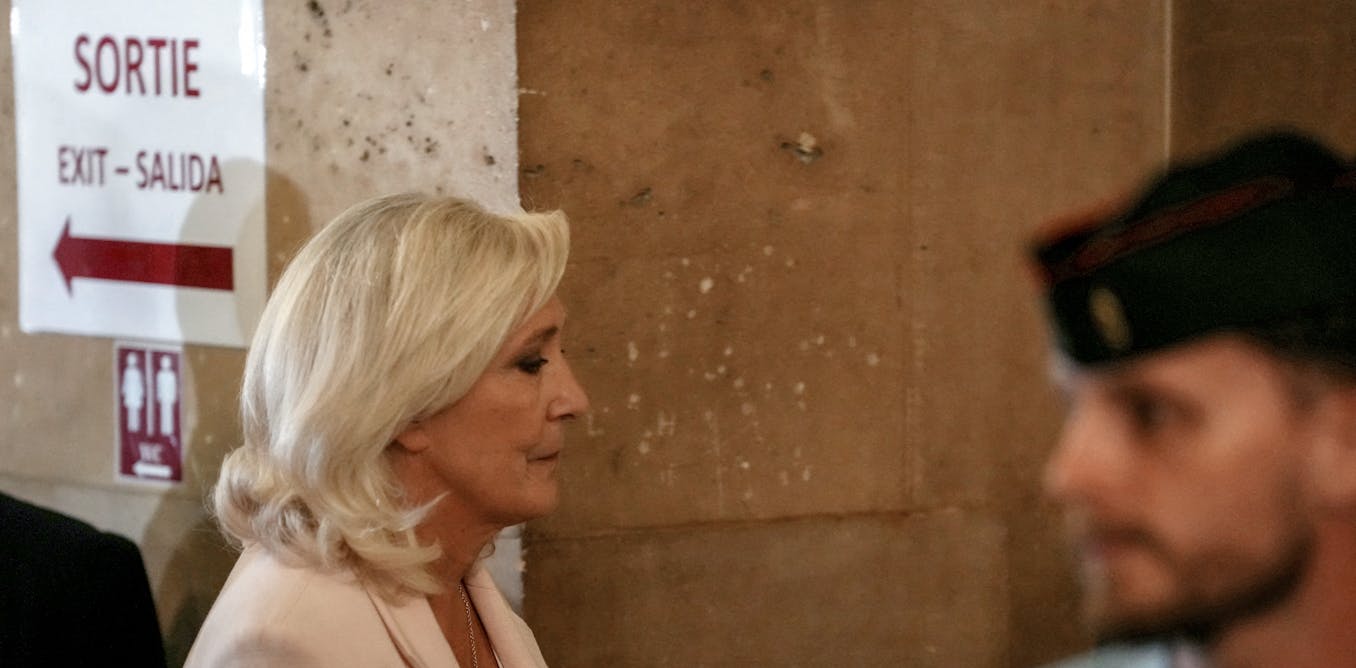
The leader of France’s far right party Rassemblement national (RN), Marine Le Pen, was sentenced on appeal on Tuesday 7 July 2026 to three years’ imprisonment, including one year to be served without parole whilst wearing an electronic tag, and a fine of 100,000 euros in the case concerning the National Front’s parliamentary assistants.
The parliamentary RN leader in the National Assembly was also handed a 45-month ban on standing for election, 30 months of which are suspended. Having already served the fifteen months since the first-instance judgement, she is eligible to stand as a presidential candidate and confirmed her intention to do so on national television hours after the verdict. Marine Le Pen also announced that she would appeal to the Court of Cassation “to exhaust all legal remedies”.
Luc Rouban, Emeritus Research Director at the Centre for Political Research at Sciences Po (Cevipof), shares his analysis on the verdict.
The Conversation: In a press release, the Paris Appeals Court explained its ruling by stating that the disqualification from standing for election, which had been imposed, must be seen in the context of “the voter’s freedom of choice, which is a prerequisite for the exercise of democratic suffrage”. Does this amount to acknowledging that the verdict of the ballot box takes precedence over that of the courts?
Luc Rouban: No, I don’t think so, because it is clear from this case that the judges sought to distinguish between two very different spheres: legal and political. The legal sphere, recently strengthened by all manner of measures concerning transparency in public life – notably the High Authority for Transparency in Public Life – now exercises strict control over politicians and the funding of political parties. And alongside this, you have the political sphere, which has also evolved towards greater expectations of moral conduct on the part of citizens, centred on what the Romans called auctoritas, that is to say, the ability to set an example, endowed with a certain moral strength.
Ultimately, the sentencing guidelines contain provisions which, whilst certainly serving to condemn the offence, do so without direct political consequences and by transferring the political decision to the general public. And it is a sign of the judiciary’s wisdom to have separated these two spheres, particularly at a time when it is facing heavy criticism for its own failings, notably in connection with the Lyhanna case.
Marine Le Pen announced on French television that she would be appealing to the Court of Cassation, claiming that this procedure would suspend the sentence handed down. How does this decision complicate the case?
LR: The question that remains unanswered is when the Court of Cassation will hand down its ruling. The later in the campaign this ruling is issued, the more difficult it will be to issue a ruling that would invalidate Marine Le Pen’s candidacy. And if that were to happen, the campaign would already have begun, and Jordan Bardella would then simply have to see it through to the end.
It is also reasonable to assume that the Court of Cassation’s ruling will not be handed down before May 2 2027, the date of the second round of the elections. If Marine Le Pen is elected, she will be granted presidential immunity. If she is not elected, the ruling will no longer be relevant.
Can someone stand as a candidate for a party that has made integrity one of its key campaign issues whilst having been convicted of embezzling public funds? Could this decision by the Appeals Court cost her a significant number of votes?
LR: This is an argument that will be used against her, of course, but when it comes to integrity, voters tend to apply a degree of nuance. In this particular case, there was no personal enrichment, unlike, for example, in the Fillon affair. Here, it is a question of the fraudulent use of European Parliament funds to pay for assistants. Morally reprehensible, but less shocking than other cases. Marine Le Pen ultimately emerges as the winner from this legal episode, as she can demonstrate that she is pursuing her goal despite all the difficulties and trials. As she said when she appeared on television, she feels she has a mission to fulfil and is adopting a self-sacrificing stance. But this strategy is an indicator of a definite political acumen that her political opponents fear.
What we need to take into consideration here is that the 2027 election is unique and unlike any that has gone before it: it comes at a very critical juncture where the French people will have to choose between very different socio-political outlooks. The National Rally’s sovereignist, nationalist vision, focused on remembrance and identity… That of La France insoumise (LFI, led by Jean-Luc Mélenchon) and its “New France” built on diversity, direct democracy and social welfare. Post-Macronism, now championed by Édouard Philippe since his rally on Sunday, which centres on adapting to globalisation. And in a way, it doesn’t matter who espouses these visions. It is from this standpoint that Marine Le Pen is positioning herself.
Marine Le Pen explained that she would not have run for the French Presidency if she had had to wear an electronic tag. Was this a real obstacle during the campaign?
LR: Obviously, it is difficult to campaign under these circumstances, and the probation officer, in deciding on the specific terms of this sentence, would have played an important role. The ankle monitor would have served as a reminder of her conviction, but she could also have used it to her advantage, turning it into a symbol of the “chained resistance fighter” who, “from the depths of her cell”, cries out “justice for the people”. Even with her movements restricted, she could have presented herself as a victim who, though shackled, calls on the people to bring about a radical change to the socio-political system. In the current climate, marked by numerous convictions of French political figures, particularly at local council level, it seems, in any case, less shocking than if it had happened twenty or thirty years ago.
Having been touted, amid uncertainty in recent months, as the RN’s likely 2027 presidential election candidate, can Jordan Bardella resume his role as second-in-command in this campaign?
LR: Perhaps more easily than the role of frontrunner, actually. In my view, the RN’s real rival today will be Édouard Philippe, who is positioning himself as a post-Macronist with an unapologetically right wing leaning. He is, in a sense, the candidate of a somewhat authoritarian liberal right. However, Jordan Bardella, in a sort of French-style Trumpism, is also positioning himself on an authoritarian-liberal platform, but with less experience than his opponent, Édouard Philippe. He has not been prime minister, he is not the mayor of a major city, and he is unfamiliar with the workings of government… Whereas Marine Le Pen, who describes herself as neither right-wing nor left-wing but “from the grassroots” – in a sort of reverse Macronism – may well attract a section of the left-wing electorate and those who usually abstain. She is far more of a threat to Édouard Philippe than Jordan Bardella. In this scenario, France will have an opposition that will amount to little less than a class conflict…
Interview by Laurent Bainier.