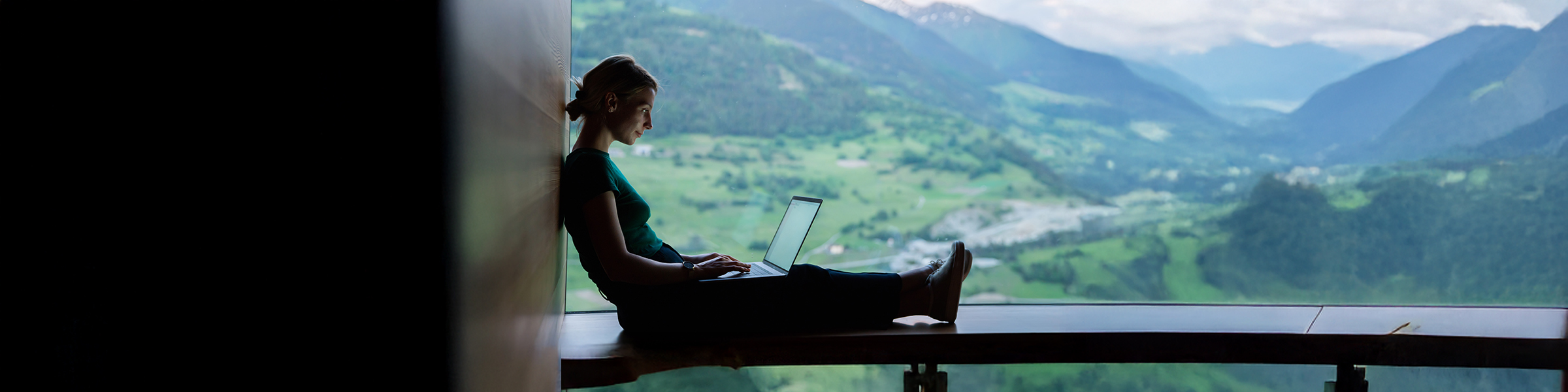
Mandy Fransz was working a nine‑to‑five office job in Dublin for a big American tech firm when she made a life‑changing switch. In 2018, the Dutch tech worker quit her office job to try remote work in search of a better quality of life.
She travelled to Bali, southeast Asia, for a month as a digital nomad. “I started freelancing as a consultant, providing digital products and services to clients worldwide,” Fransz recalled.
Back in Dublin, she gave up her lease to become a full‑time nomad and joined a LinkedIn community for remote workers.
Stories like hers are becoming increasingly common, raising questions about where people live, work and pay taxes, and what that means for cities and the countryside.
These questions are being explored by an EU‑funded group of researchers. Their three-year research project, called R‑Map, is examining how remote working arrangements affect Europe’s urban–rural divide. Their work is due to conclude in January 2027.
Remote work boom
Remote working expanded rapidly during the COVID‑19 pandemic. Thousands of people asked to join the LinkedIn group for remote workers that Franz was then helping to build – rebranded as Remote Workers Worldwide.
According to the European Central Bank, the share of employees working from home at least occasionally rose from 12% in 2019 to 22% in 2024. A 2024 survey found that around one‑third of employees work from home several times a week.
“
When we asked where people would like to work, 80% chose rural or suburban areas.
For governments and regional authorities, the shift is reshaping where people live, how local services are used and how evenly development is spread between urban and rural areas.
“We want to understand the meaning of remote working in Europe and the differences between countries,” said Stratos Stylianidis from Aristotle University of Thessaloniki in Greece, who leads the research.
The team has surveyed over 20 000 individuals, analysing how remote work in urban and rural areas influences regional imbalances.
Working with local partners from six EU countries, as well as Türkiye and the UK, the researchers are building an evidence‑based picture of how remote work is reshaping societies, economies and the environment.
Back to the country
For decades, people have moved towards cities. Now, many remote workers say they would rather live elsewhere.
“When we asked where people would like to work, 80% chose rural or suburban areas, but when we asked where they actually live, most are still in cities,” said Fransz, now a remote work advocate, entrepreneur and community builder recognised internationally in the “future of work” space.
This gap lies at the heart of the R‑Map research. Remote work could support rural and suburban development, but only if regions can attract and retain workers. Otherwise, it risks reinforcing existing inequalities.
Across Europe, fully remote and office‑only roles are increasingly giving way to hybrid arrangements. In countries such as the Netherlands, Ireland, Finland and Germany, many employees still work from home at least part of the week.
R-Map examines how policy frameworks, working arrangements and digital infrastructure shape these patterns. Its goal is to provide policymakers with a simple dashboard to test scenarios and guide investment.
At the core is the R-Map model, which combines survey data, regional indicators and local insights to assess the long-term impacts of remote work.
Attracting remote workers
After becoming a full‑time digital nomad, Fransz spent two years working remotely in the United States, Colombia, Croatia and Portugal.
Croatia was among the first EU countries to introduce digital nomad visas, allowing stays of up to 18 months without local income tax. Estonia, Portugal and Greece have since introduced similar schemes.
Such initiatives are of particular interest to the R‑Map team because they illustrate how policy choices can shape the geography of remote work.
Remote work could help counter rural decline in parts of Europe. As Stylianidis noted, migration to cities can leave rural areas increasingly isolated.
This can trigger a downward spiral, with fewer people in villages, leading businesses to close and public services to become less viable. EU projections suggest most rural regions will face population decline.
Some see remote work as a way to reverse this trend. The R‑Map team is testing that assumption, examining when it supports regional development and when it exacerbates existing pressures, such as rising housing costs.
The EU has already recognised this challenge in its Rural Vision Action Plan, which aims to make rural areas stronger, more connected and more resilient by 2040.
Practicalities matter, though, if working in rural areas is to be sustainable.
“Imagine moving to a Mediterranean island for the lifestyle,” said Stylianidis. “You also need to consider things like internet connectivity, social life, roads and access to healthcare.”
The researchers are therefore including social and environmental factors in their analysis, to build a fuller picture of the trade-offs involved when work moves online.
Answers for policymakers
The R‑Map team is focusing on six main areas: Thessaloniki, Istanbul, Milan, Surrey and two cross-border locations between Germany and the Netherlands and Austria and Switzerland.
These diverse settings – from major cities to suburban areas and rural and cross‑border regions – allow the researchers to compare how remote work plays out under different local conditions.
“
We want to identify policies that can both benefit remote workers and inform future EU action.
“We want to identify policies that can both benefit remote workers and inform future EU action,” said Stylianidis.
The R-Map dashboard will allow authorities to explore what-if scenarios, testing the impact of different policies and investments.
Preferences vary widely depending on age and life stage. Younger people may prioritise co-working spaces or cafés with reliable WiFi, while families may look for larger housing, childcare and schools. Access to healthcare is also a key factor for many.
“You might prefer a co-working space or work-friendly café in a vibrant city as a young digital nomad,” said Fransz. “Later on, you may appreciate other attractions, such as access to nature, childcare or a bigger house.”
Her own choices reflect this shift. She has settled 45 minutes outside Lisbon, in a suburban area renowned for its natural beauty.
“When we moved here two years ago, there were few work-friendly cafés or shops with international products,” she said. “That has changed, and more amenities are emerging to attract international residents.”
For the R‑Map team, these lived experiences feed into a broader story. As remote work becomes more regulated, the choices made by workers, employers and policymakers will determine whether it narrows the urban–rural gap, or widens it further.
Research in this article was funded by the EU’s Horizon Programme. The views of the interviewees don’t necessarily reflect those of the European Commission. If you liked this article, please consider sharing it on social media.