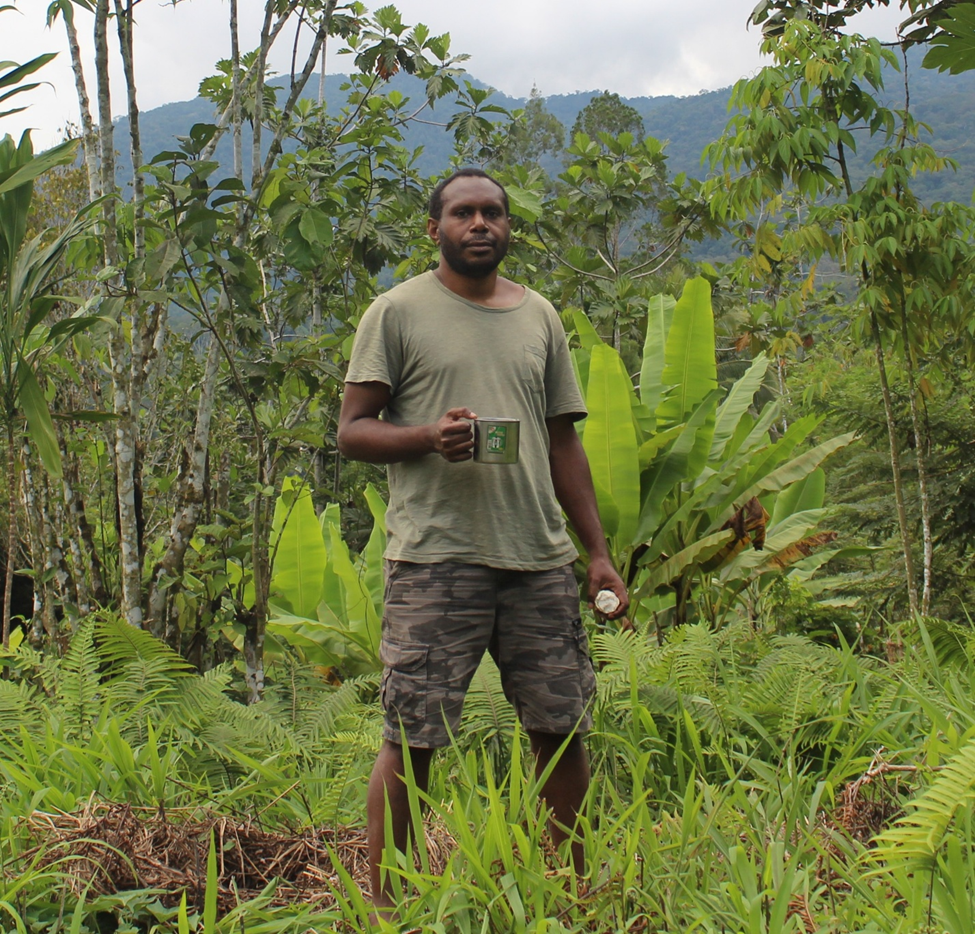
Kari Sogera Iamba, University of South Bohemia and the Institute of Entomology of the Czech Academy of Sciences, discusses his article: Insects and non-woody plants slow down tropical forest succession: A community-wide experiment in Papua New Guinea
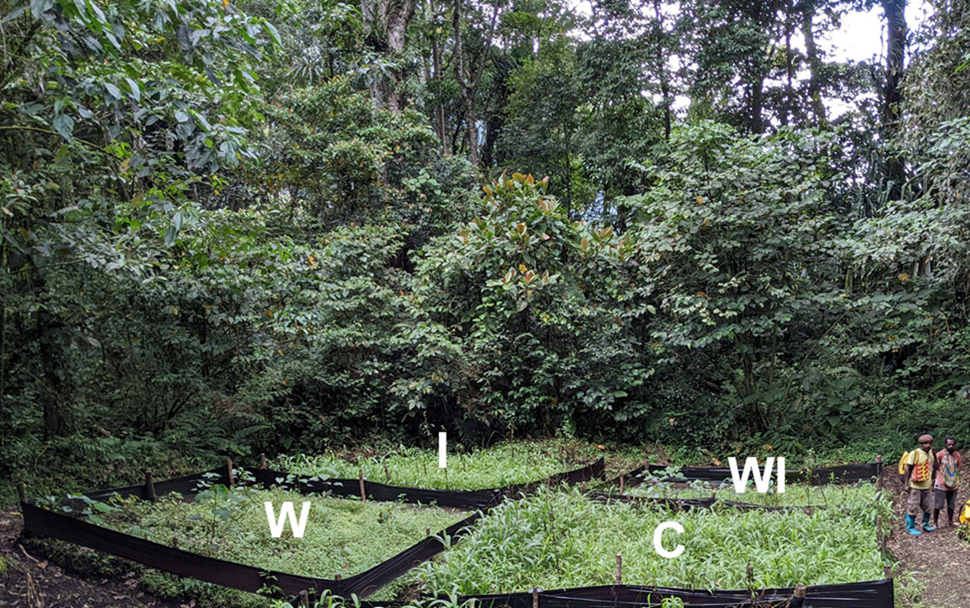
We investigated the factors driving rainforest regeneration in canopy gaps created by tree falls or selective logging. Ecological succession can be influenced by competition among plants for resources such as soil nutrients or light, as well as by natural enemies of plants, including herbivores. The relative importance of these processes may shift with environmental changes, for example, between lowland and montane forests. Our study was experimental and took place in tropical forest gaps in Papua New Guinea. We established 25 m² plots in which we manipulated the natural process of vegetation succession by removing insects (using insecticides), removing non-woody plants such as grasses and herbs, or removing both insects and non-woody plants simultaneously. The experiments also included control plots and were replicated at 700 and 1700 m above sea level.
We found that removing insects increased plant biomass at low elevation, but this effect diminished with increasing elevation. Removing insects also reduced plant diversity at both elevations. When we removed non-woody plants, the biomass and diversity of woody plants increased at both elevations, particularly at high elevation. Overall, our results show that early tropical forest recovery is shaped by insect herbivores, which maintain vegetation diversity at low elevations, but by competition from non-woody plants, which slows succession at high elevations.
Expectations and challenges
We expected native pioneer plants to benefit more from insect removal than alien species, because the latter had largely escaped their native herbivores and should therefore experience an enemy-free space. Surprisingly, this was not the case at lower elevations, where alien plants benefited most from insect removal. At higher elevations, however, alien plants behaved as predicted, with insect removal benefiting native plants instead. We conducted our research in a completely forested landscape with indigenous communities who cared for our experiments throughout the year. This created challenges in accessing our study sites, because we had to fly in a small plane to an airstrip and then walk to our field camp. There are no roads in the entire area, and local children have never seen an automobile.
Broader impacts and implications
The proportion of early successional vegetation in tropical landscapes is increasing, driven by intensifying human disturbance. It is therefore important to understand how tropical vegetation responds to disturbance and how we could quickly restore forest ecosystems. Our study highlights the importance of non-woody vegetation in slowing this process, particularly at higher elevations in montane forests. Furthermore, the role of insects in lowland forest succession is considerable, which is notable given current concerns about the global decline in insect abundance and diversity.
Next steps
This is ongoing research, and the next phase examines the impact of repeated disturbance, invasion biology, and climate change. It aims to simulate how climate change may influence the impact of insects and the distribution of both alien and native plants along elevational gradients in tropical forests. I will analyse the composition of insect communities and how they are affected by different treatments. I am also analysing details of the successional dynamics that led to the final results after 1.5 years of succession examined in our current paper. I am using structural equation models to investigate the direct and indirect effects of insects and non-woody plants, and their roles in shaping woody plant succession towards forest development.
About me
As a Papua New Guinean, I have always been fascinated by insects and their diversity in our tropical forests. I developed a keen interest in ecology when I attended research training organised by the New Guinea Binatang Research Centre, a local NGO, as this was the first time I could observe and experience the process of scientific research in practice. However, it was only during my PhD studies that I began to understand the complex roles these diverse insects play in forest ecosystems.
During my studies I have learned that real ecology exists in the field and must be studied there, not only on your desktop screen. I recommend to be curious and openminded: spend time in the field, observe, ask questions, be ready to go in unexpected directions, and work diligently in the pursuit of answers.