
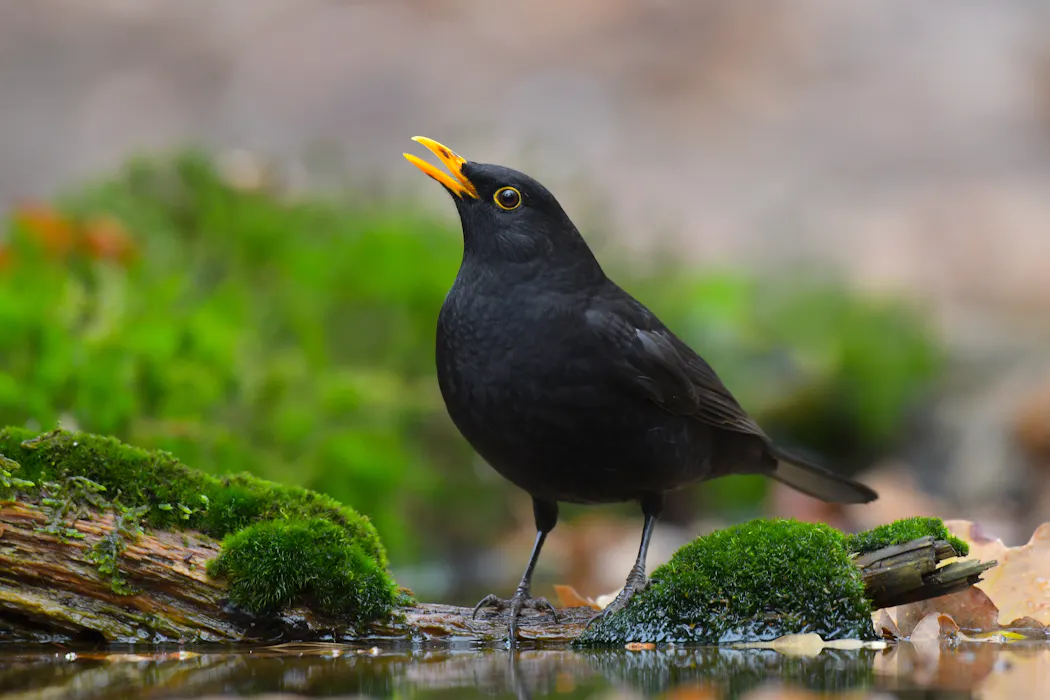
Each May, nature lovers get out of bed early to experience the seasonal wonder of birds singing, as the sun rises above the horizon to take part in International Dawn Chorus Day.
In Europe you may hear blackbirds, chiffchaffs and nightingales. In the US, cardinals, chickadees and blue jays. In East Africa, morning thrush, hornbills and wood doves. Each with their own song.
There is no single dawn chorus, but the harmonies of hundreds of bird voices at first light change from place to place in a huge wave that surfs around the world as the planet rotates.
A dawn chorus is part of a wider soundscape – the interaction between biological sounds from birds and other animals (biophony), natural physical sounds such as wind or water (geophony) and human‑generated sounds like traffic (anthrophony). The dawn chorus is often the most prominent component of the soundscape at sunrise, but it never exists in isolation.
Scientists believe that birds structure their early morning singing in a way that prevents overlap and masking of each other’s vocalisations. They use different pitches and timings to partition and share the acoustic space. Birds in open landscapes such as grasslands use shorter, scratchier sounding song phrases, while birds in woodlands use longer whistling notes – each evolved to allow the best transmission of their song in their own habitat. So birdsong is filtered by trees, grasses, across water and through urban areas, to create a soundscape phenomenon that differs very clearly from region to region.
In the Caledonian pinewoods of northern Scotland, the first morning sounds are often geophonic: wind moving through tall pine canopies. Typically before first light, male western capercaillies gather together to vie for females. The males fan out their tail feathers, puff out their chests and produce a series of clicks, pops and wheezing notes. These are short‑range sounds, shaped by the open understorey and the resonant qualities of the forest.
Fieldwork in these woods has shown how these vocalisations are tied to group mating activity (known as lekking) and can be used to assess the populations of this rare and declining species. These sounds indicate a specialised habitat that has remained untouched for a long time? and without much human disturbance, where the secretive birds can go about their lives, while contributing to the distinctive acoustic character of the pinewoods.
Move to a lowland heath in southern England though, and the differences are immediate. The geophony shifts to the dry hiss of wind across heather and scattered gorse. The dawn biophony is dominated by an assemblage of species that are rare across Europe. The nightjar might have been producing its continuous churring since well before first light. Woodlarks add clear, falling song phrases, while Dartford warblers deliver rapid, scratchy calls from gorse clumps. Research on heathland species has shown how these calls are useful indicators of local habitat quality and structure.
In urban areas, birds have to compete with the noises made by people and their machines. Cars, motorbikes, trains. Sirens and alarms. Nightclubs and pubs. The urban architecture often makes this worse, with reflective hard surfaces bouncing these noises around the streets, instead of absorbing them as natural spaces would.
Birds have to adjust their behaviour around this. Some advance or delay the timing of their singing; others increase volume or shift pitch to higher frequencies. Large‑scale studies indicate that spring soundscapes across Europe and the US are becoming quieter and less varied, due to changes and declines in bird communities, linked to climate change and habitat loss.
Because many people hear birds more often than they see them, changes in soundscape complexity can be one of the earliest signs that local biodiversity is under pressure. Long‑term listeners of bird song – whether through formal monitoring or casual early‑morning walks – may be detecting real ecological change.
Listen up
Understanding soundscapes can help make sense of these changes. A chorus lacking high‑frequency elements may indicate the loss of particular warblers; reduced low‑frequency components may point to declines in larger bird species.
Changes in the geophony, such as increased wind noise in fragmented woodland, can alter how well birds communicate. And increasing man-made noise can mask quieter species entirely, leading to an impression of silence even where birds are still present.
In the UK, pinewoods and heaths both depend upon active vegetation management for conservation and long‑term habitat stability. Maintaining these landscapes means maintaining the conditions that support their characteristic sounds.
Paying attention to how different places sound at first light can be a reminder that biodiversity is something we can hear as well as see. You can even compare it with the sounds that accompany sunrise from other places. Arts cooperative SoundCamp’s Reveil project offers a 24‑hour broadcast that relays sunrise sounds from microphones around the world, allowing us to track the soundscape as the Earth rotates through one full day each spring.
A dawn chorus is more than an aesthetic experience: it is a summary of local ecology, habitat condition and the pressures shaping both.

Carlos Abrahams is director of Naturesound Ltd, an ecoacoustics consultancy. He is a Fellow of the Chartered Institute of Ecology and Environmental Management.