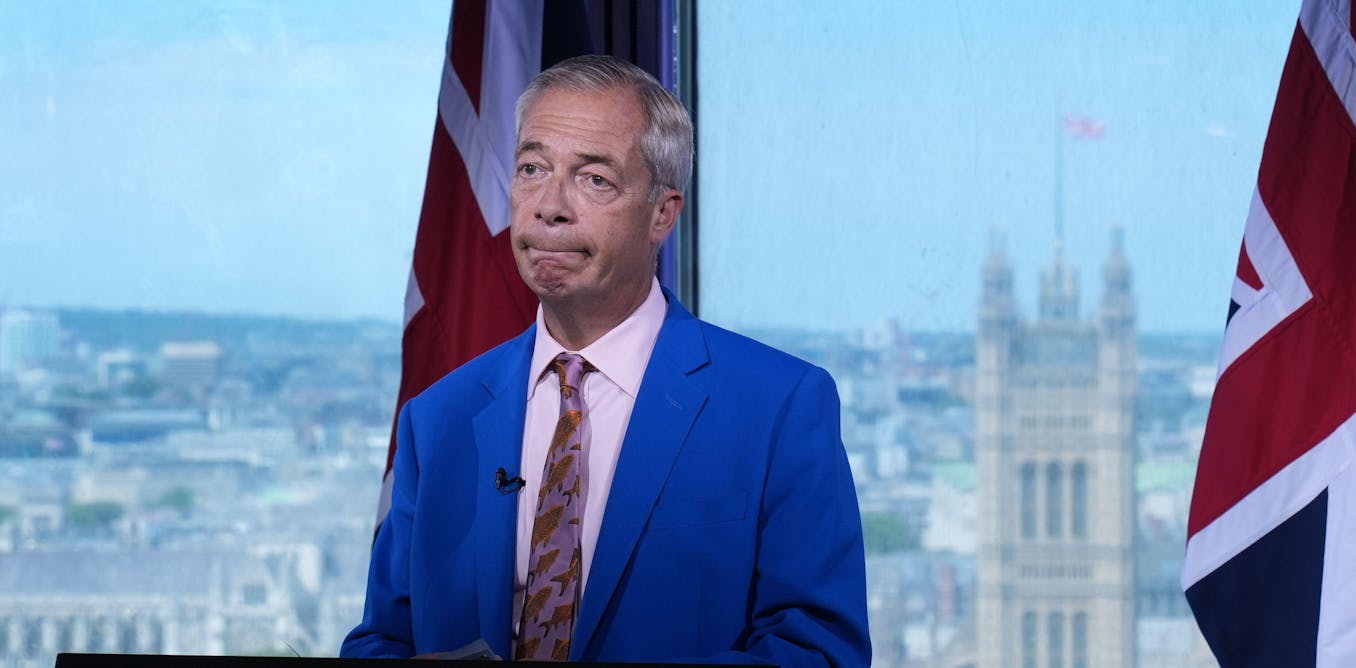
Speaking from the Reform UK party headquarters in Milbank, London, Nigel Farage revealed that he will be stepping down as MP for Clacton – only to stand again for the same seat. Farage referenced allegations about his finances and insisted that he has “done nothing wrong”. Academic experts examine the motivations behind this move.
Self-pity and self-obsession
Tim Bale, Professor of Politics, Queen Mary University of London.
In what must rank as one of the most self-pitying, self-obsessed pieces of political rhetoric we’ve heard from a politician since Boris Johnson’s myriad attempts to justify himself back in 2022, Nigel Farage surprised absolutely no-one by triggering a by-election by resigning as MP for Clacton. He is supposedly going to take on “the establishment” in this by-election by restanding and, in so doing, clear his name.
Even if Farage’s anger about media intrusion was real, his recorded video message still felt a little confected. And I’m not sure there’s much sympathy out there for a politician who’s not only telling us he’s enormously wealthy thanks to all sorts of second jobs but that he could be even more wealthy if he quit parliament. As for the nonsense about Britain being a “broken” – indeed a “communist” – country where “men can’t wear watches and women can’t wear jewellery” in the streets, that was presumably for an American audience. And the plug for his investment tips making people impressive returns was simply grifting of the highest order.
Although, there will be voters in Clacton who’ll see the whole thing for what it is (namely, an expensive sideshow which appears to be designed to distract from the allegations Farage is facing), I don’t doubt that he stands a good chance of winning this by-election. The only real option would be for the other main political parties to surprise us all by agreeing to field a joint candidate – a 2026 version of Martin Bell, the former war correspondent who took on cash-for-questions MP Neil Hamilton in a 1997 by-election and won as an independent with the backing of Labour and the Liberal Democrats.
More importantly, none of this will help Farage wriggle out of the allegations he’s facing. As soon as he makes it back into parliament, the investigation will restart where it left off. He can run – but he can’t hide.
Classic ‘Faragism’
Parveen Akhtar, Senior Lecturer in Politics and International Relations, University of Aston.
Farage’s resignation as MP for Clacton, followed by his announcement that he will seek re-election and “let the British people decide” his future rather than “the media” or “the establishment”, is perhaps best understood through the lens of Faragism. As my recent research argues, Faragism is more than simply the politics of one individual – it is a political project that constructs a populist common-sense narrative of Britain as a nation constrained by political elites and unresponsive institutions. Within this logic, the establishment is portrayed as negating the democratic will of the people.
The way events around Farage’s statement unfolded reflects that strategy. At midday, Farage posted on X: “I will make a statement on my future in public life at 2pm.” Within two hours, the post had been viewed approximately 4.4 million times – an illustration of his unparalleled ability to garner public attention and set the political agenda. Rather than allowing the debate to focus solely on the allegations against him, Farage sought to frame the episode as part of a broader struggle against political and media elites. He presented himself as someone willing to bear personal political costs in pursuit of what he portrays as the national interest and his mission to “fix” a broken Britain.
This is characteristic of Faragism. The political contest is reframed from one concerning individual conduct into a wider struggle between an insurgent movement and a corrupt establishment. In doing so, Farage reinforces the populist distinction between “the people” and those portrayed as seeking to delegitimise their political voice.
The episode also illustrates why Reform UK remains so closely identified with Farage personally. Although the party has become considerably more professionalised and organisationally developed in recent years, its ability to capture public attention still rests overwhelmingly on Farage’s unique political authority. That remains both Reform UK’s greatest strength and its greatest vulnerability.
Populist storytelling
Lone Sorensen, Associate Professor of Political Communication, University of Leeds.
Farage relies on storytelling, and spent a lot of this speech setting up his own character and position as a victim. He spoke of constant demonisation by the press – “the way I’ve been treated” – and cast himself as the most attacked person by the media in modern times. He also detailed in-person attacks and threats on his life, such as a mob attacking his car.
At the same time, he characterised himself as a saviour – if he hadn’t “done what he’d done” then Brexit would not have happened.
By making an attempt to delegitimise Labour’s position, emphasising that Andy Burnham is due to become prime minister unelected, Farage aimed to set up a good-guy-bad-guy storyline.
What’s really interesting is how Farage conflates the mainstream media and the political establishment into one entire, biased entity. He said “it’s not just the media, it applies to other political parties too”, as if the media are a political party. This is a recognised and established populist move, such as Trump’s famous “fake news” line. Populists tend to attack established media, legacy media, and especially public service media and then establish their own media ecosystem that they’re able to control more. When they present the media as the bad guy, any negative reporting becomes a bonus point to be used to their advantage. Any rule-based legal action against him, or action that parliament is taking to scrutinise him, becomes equated with a biased and politicised attack.
This came across as a very calculated move, one that he had likely done polling on and feels secure in. He will continue framing the by-election as a mini-election — the people versus the establishment — much like Burnham’s campaign in Makerfield.