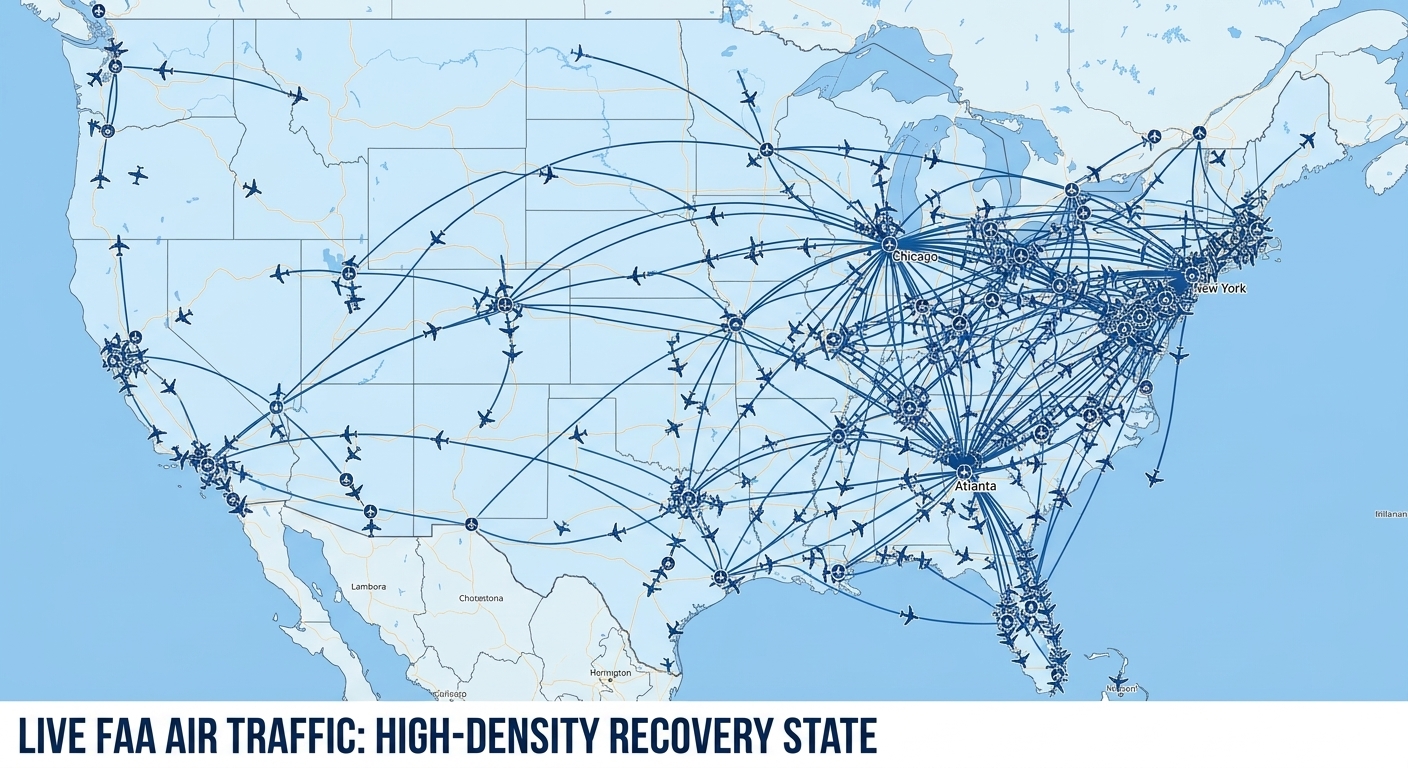
WASHINGTON — A nearly five-hour nationwide shutdown of the United States aviation system that has disrupted more than 20,000 flights since Friday may have been triggered by a single router installed by government contractor L3Harris, federal officials announced on Saturday, November 14, 2026.
Speaking at a Saturday briefing, U.S. Transportation Secretary Sean Duffy confirmed that L3Harris was performing routine daytime maintenance on Friday to transition telecommunications lines from legacy copper wiring to optical fiber at remote facilities, with investigators examining problematic routers installed in Arkansas and Texas.
Key Findings from the FAA and L3Harris Investigation
US Aviation Shutdown & Technical Failure Overview (Nov. 13–14, 2026)
+--------------------------------------------------------------------------+
| SUSPECTED CAUSE:   L3Harris router flooding network (1,000+ reqs / 4-5s) |
| AFFECTED CENTERS:  17 of 22 FAA Air Route Traffic Control Centers        |
| FLIGHT DISRUPTION: Over 20,000 flights disrupted since Friday            |
| SYSTEM COST:       $1B/year copper upkeep; $50B additional upgrade sought|
+--------------------------------------------------------------------------+
- Network Overload Across 17 Centers: According to Duffy, the newly installed hardware began flooding connected equipment with more than 1,000 connection requests every four to five seconds. The data surge destabilized links between facilities, radar feeds, and aircraft across 17 of the FAA’s 22 en route air traffic control centers, forcing regulators to issue Friday’s nationwide ground stop.
- Probe Into Equipment vs. Installation Error: “This was an FAA system that didn’t meet the moment,” Duffy said. “We’re working to determine whether we had incompetence, meaning was it user error or installer error from L3Harris, or did they install a faulty router?” Technicians stabilized the network after isolating the affected connections and disabling similar functions on roughly 60 routers nationwide.
- L3Harris Response: L3Harris stated it is actively supporting the FAA’s investigation into the November 13 ground stop, noting that it has completed more than 70 percent of the planned airspace conversion from copper wiring to fiber optics. Federal officials also confirmed there is no evidence of a cyberattack or AI-related malfunction.
Systemic Vulnerabilities in Aging US Airspace Infrastructure
Friday’s shutdown—the longest nationwide flight suspension since September 11, 2001, and the third in U.S. history following a 90-minute NOTAM outage in January 2023—has renewed scrutiny over the FAA’s reliance on obsolete hardware.
- Outdated Equipment: Duffy noted that the routers slated for replacement are roughly 25 years old and were originally scheduled for retirement in 2006, while the agency still spends $1 billion annually maintaining legacy copper lines.
- Funding Request: Although Congress previously approved $12.5 billion for air traffic control modernization, Duffy plans to ask lawmakers for an additional $50 billion to accelerate the overhaul of vintage systems—some of which rely on replacement parts sourced from online marketplaces and 1980s floppy disks not scheduled for phase-out until late 2028.
Airlines continue to work through residual cancellations and crew repositioning throughout Saturday, with the FAA expecting full flight schedules to stabilize by Sunday night.