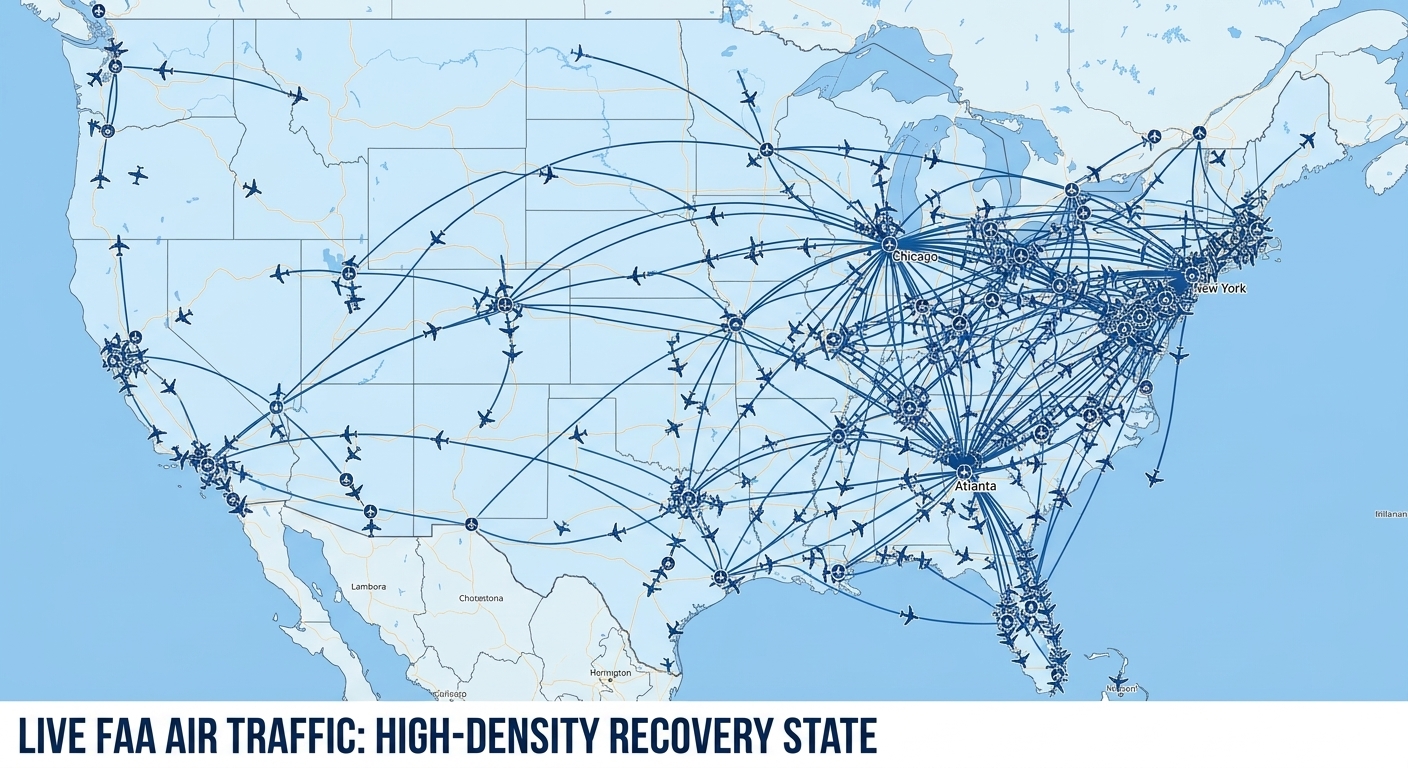
WASHINGTON — United States flight operations are slowly resuming after the Federal Aviation Administration (FAA) lifted a historic, hours-long nationwide ground stop that paralyzed air travel across the country on Friday. Despite the lifting of the order, travelers are facing cascading chaos, with nearly 10,000 flights already cancelled or delayed through Saturday.
US Transportation Secretary Sean Duffy confirmed that the ground stop, which began around 3:54 p.m. ET, was issued due to a critical communications failure that impacted all 22 Air Route Traffic Control Centers in the country. Duffy described it as a “legacy network problem” involving “old switches and old routers.”
The Scale of the Disruption: Friday and Saturday
The FAA began clearing flights to depart at 8:15 p.m. ET on Friday after “thoroughly testing” their systems to confirm stability and reliability. However, resetting the nationwide operation—which includes positioning aircraft and crews—is a monumental task that will take days.
Flight Disruption Statistics (Estimate at time of report)
+-------------------------------------------------------------+
| Time Ground Stop Lifted:    8:15 p.m. ET, Nov. 13, 2026    |
| Friday Cancellations:       Over 4,700 flights               |
| Friday Delays:             Over 10,000 flights              |
| Saturday Cancellations (Pre): Over 700 flights                |
| Est. Total Affected Flyers: 1.5 million people              |
| Est. Economic Cost (Daily): $350 million to $500 million    |
+-------------------------------------------------------------+
(Source: Estimates from FlightAware, Flightradar24, Cirium, and industry analysts.)
- Total Disruption: Airline sources and data analysis indicate that over 15,000 flights were impacted on Friday alone. Data firm Cirium estimated that 1.5 million people were affected by the mass cancellations.
- Saturday Outlook: While major carriers like United, Delta, American, and Southwest announced they were resuming operations, American warned that it expects “residual delays and cancellations tonight and into tomorrow.” By Friday evening, Flightradar24 data indicated that an additional 700 Saturday flights had already been preemptively cancelled.
- A “Slow” Restart: Travelers are advised to confirm their flight status before heading to the airport. The process will be slow. Secretary Duffy remarked, “Now, does that mean every flight is going to fly right now? It’s going to be slow… as we come into the heat of travel” during the upcoming Thanksgiving holiday later this month.
What Caused the Historic Ground Stop?
Initial White House statements emphasized there was no indication of a “nefarious act” or cyberattack. The focus remains on an internal FAA infrastructure failure. Secretary Duffy renewals calls to Congress for modernizing the legacy air traffic control system, noting the critical role of “legacy network problems” in this and previous outages.
The only previous nationwide ground stops occurred on September 11, 2001, and in January 2023 due to a failure in the vital NOTAM (Notice to Air Missions) system. This third instance of the extreme safety measure highlights deep-seated technical issues within the national airspace architecture.
The Cost of the Incident
While the FAA has not provided an official cost, industry analysts suggest the economic impact of a prolonged nationwide shutdown will be immense. Daily economic costs for major US flight disruptions are estimated to range from $350 million to over $500 million, which includes airline revenue losses, operational cost increases, and the broader productivity impact on delayed or stranded business and leisure travelers.