The mission found “indicators of a genocidal path” in a report released in February. The new report builds on the earlier findings by providing additional evidence on sexual violence, forced disappearances, detention and mass killings.
“The patterns we documented in El Fasher – including encirclement, attacks on civilian infrastructure, restrictions on humanitarian access, and widespread abuses against civilians – serve as a stark warning,” said Mohamed Chande Othman, Chair of the UN Fact-Finding Mission for Sudan.
“The international community must heed these lessons and act to prevent further catastrophe.”
Cost of war
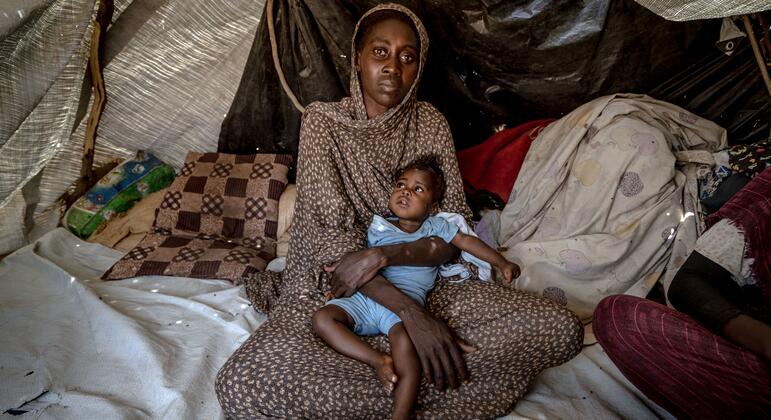
Two years into the war between the Sudanese Armed Forces of the military government (SAF) and the RSF, the conflict has killed at least 59,000 people and displaced at least 14 million more.
With 33.7 million people requiring humanitarian assistance and access to people in need severely restricted, the UN considers Sudan the worst humanitarian crisis in the world.
The Human Rights Council-appointed investigators warned that the RSF is currently deploying tactics used in El Fasher around El Obeid, where its forces have encircled the city, attacking critical infrastructure and restricting access to essential services.
Following a 6 July resolution adopted by the UN’s Human Rights Council, the mission will investigate alleged violations and abuses of international human rights law and humanitarian law in El Obeid.
Alarm grows
El Obeid, the capital of the North Kordofan state, is currently under SAF control, but the city has faced “siege-like conditions” for 18 months, UN human rights chief Volker Türk said on 3 July.
The situation in El Obeid could deteriorate even further, as attacks on critical infrastructure such as power stations have caused blackouts, disrupted water supplies and hampered hospitals’ ability to operate.
In three weeks in June, the UN verified 15 drone strikes killing at least 45 civilians El Obeid and the surrounding area.
In response to the situation in El Obeid, Mr. Türk called for a range of measures to prevent further atrocities and a repeat of El Fasher, including urgent Security Council action, a pause in hostilities to allow humanitarian aid and cooperation by the International Criminal Court (ICC).
Lessons from El Fasher
As they took control of El Fasher in October after an 18-month siege, RSF forces carried out door-to-door executions, identity-based targeting, aerial drone bombardments and indiscriminate shootings, killing more than 6,000 people in three days.
Before the RSF took the city, it spent months systematically cutting off civilians’ access to food, water, medical supplies and humanitarian assistance, according to the Fact-Finding Mission’s February report.
The mission noted that the UN repeatedly warned about the risk of atrocities in El Fasher before the city fell, but that those warnings were not heeded.
Now, investigators are raising the alarm over El Obeid to encourage prompt action to prevent further casualties.
“At a moment when serious concerns are being raised about the risks facing civilians in El Obeid, the findings from El Fasher underscore the need for urgent protection measures before more lives are lost,” expert mission member Joy Ngozi Ezeilo said.
“The international community still has a window of opportunity to prevent further atrocity crimes,” expert mission member Mona Rishmawi said. “El Obeid must not become the next crime scene.”