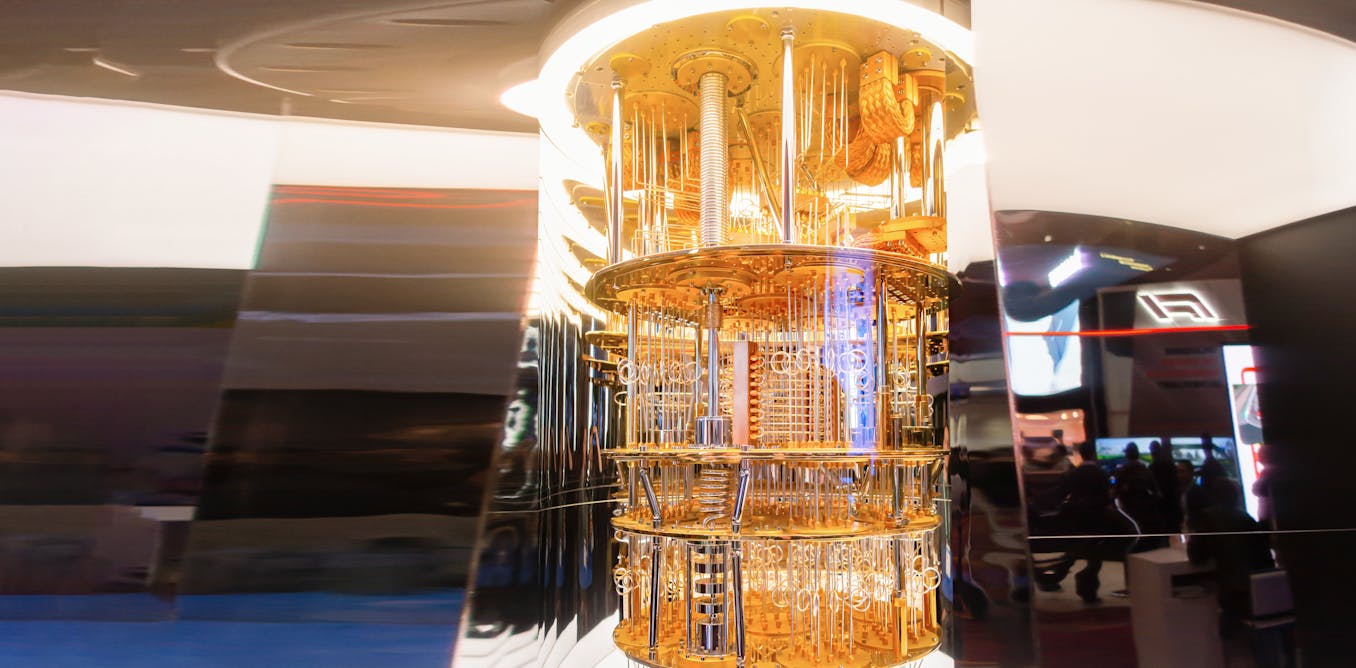
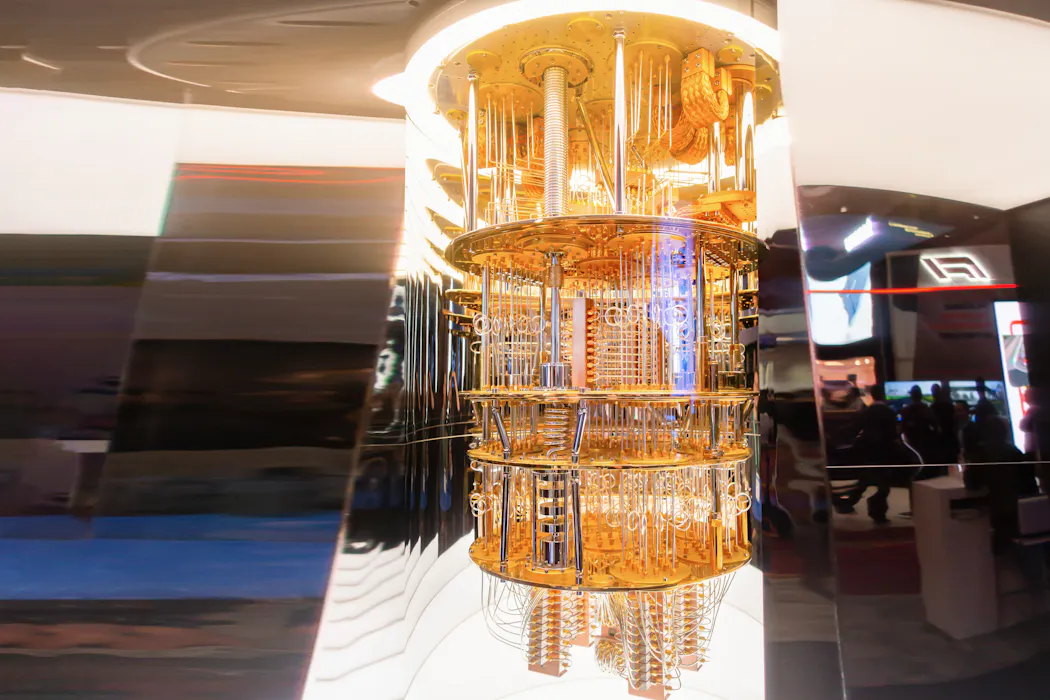
In the global race to build bigger and better quantum computers, researchers have taken a step forward. A new machine called Helios is a radically different system compared to other quantum computers.
Quantum computers harness the power of quantum mechanics, the laws that govern how physics operates at atomic and sub-atomic scales. Among various designs for such machines, Helios is a trapped-ion quantum computer, which means it uses charged atoms suspended in free space using electromagnetic fields.
It operates using 98 qubits – the units of information that a quantum computer uses to process data. This number of qubits makes it the largest trapped-ion quantum computer built so far. Quantinuum, the company behind the device, which is based in Cambridge, UK and Broomfield, Colorado, demonstrated earlier machines operating on 32 qubits in 2023 and 56 qubits in 2025.
Helios and its predecessors use an architecture (or operational structure) with separate regions for storing and processing quantum information. The architecture is called a QCCD (quantum charge-coupled device) and was invented in 2002. This is akin to the architecture of classical computers that have a memory for storage (hard disk drives, solid state drives) and a separate processor (CPU, GPU).
The specific geometry of Helios resembles a rosette, with the ring for storage and two streamers for processing. The crucial element is the four-way X junction where they meet. A QCCD physically transports the charged objects (the ions) from the storage to the processing regions electrically.
The processing is done using laser pulses. This requires a quantum algorithm to be broken up into ion transport and quantum processing. This differs substantially from other quantum computing architectures such as superconducting qubits, where the qubits are fixed in space, and processing is executed by electrical signals switched on and off in time.
Error correction
Classical charge-coupled devices, the template for the types now used in Helios, were the central component in early digital cameras. There are three main advantages to now using these in quantum computation.
Gates are the fundamental building blocks of quantum circuits, which operate on qubits. One advantage of the QCCD approach is that gates operating on certain qubits do not affect their neighbours. This reduces a phenomenon known as “crosstalk”, leading to better quality performance.
The second advantage is the ability to measure and reset qubits during a computation. This enables inevitable errors in the computation to be detected and corrected at the earliest possible time, again improving performance.
Finally, as qubits can be accessed from and returned to very different parts of
the memory after processing (within limitations), distant qubits can be connected, leading to more efficient operation.
The Helios device demonstrated all the above advantages. It relies on two major advances – one in hardware and one in software. First, the four-way X junction lets the system handle several tasks at once rather than one at a time, which is much faster. That was impossible in earlier QCCD machines, which could only move data back and forth in a single line or loop.
Secondly, judicious use of the freedom offered by the two dimensions of the X junction relies on a new classical control software called Helios runtime which plans the smartest, fastest route for moving and processing the data.
Together, these represent a substantial advance in the engineering of quantum computers. An important consequence is that Helios can perform computations that cannot be performed even on the largest supercomputers using known methods within reasonable amounts of time and power consumption.
Computational prowess
It shows the ability of this device, and its successors, in surpassing the computational prowess of classical computers – albeit their algorithms and hardware are rapidly advancing too.
Having said that, Helios’ computations have just been random benchmark tests, so the practical importance of this leap forward is still limited. To perform quantum computations of practical importance from areas of science and commerce, even the most optimistic estimates suggest that quantum computers must be
enormously bigger and better – of the order of a million qubits.
The UK National Quantum Strategy Mission 1 proposes to have a fault-tolerant quantum computer (FTQC) with a trillion operations. For reference, the longest computation Helios ran had about 4,000 operations operating on 98 qubits.
Building FTQCs out of the Helios device, or any other known architecture or system for that matter, remains a formidable challenge. As the numbers suggest, it would require connecting thousands of QCCD devices, each with thousands of qubits, via quantum links.
Visions exist for QCCD devices with a two-dimensional grid layout resembling city streets that can operate on thousands or more qubits. The inevitable challenge of engineering and operating such a system with an immense number of junctions and concomitant qubit-jams – akin to traffic jams – is yet to be encountered, let alone overcome. The physical transporting of qubits is also a very slow process because it uses very precise voltages, and this will only grow with larger devices and more qubits.
As of now, the Helios device is an exciting advance in the field of quantum computing. Whatever form the FTQCs of the future take, they will involve imaginatively engineered quantum hardware devices assisted by smart software.

Animesh Datta receives funding from the UKRI, Horizon Europe programme, UK Space Agency, and European Space Agency.