The scientists have demonstrated a practical route to dramatically boosting the intensity of high-power laser light for the first time.
The results, published in Nature, could unlock the path towards creating the most intense light ever produced in a laboratory.
This could open the door to experiments that probe the fundamental laws of physics by directly interacting light with the quantum vacuum.
The plasma mirror effect
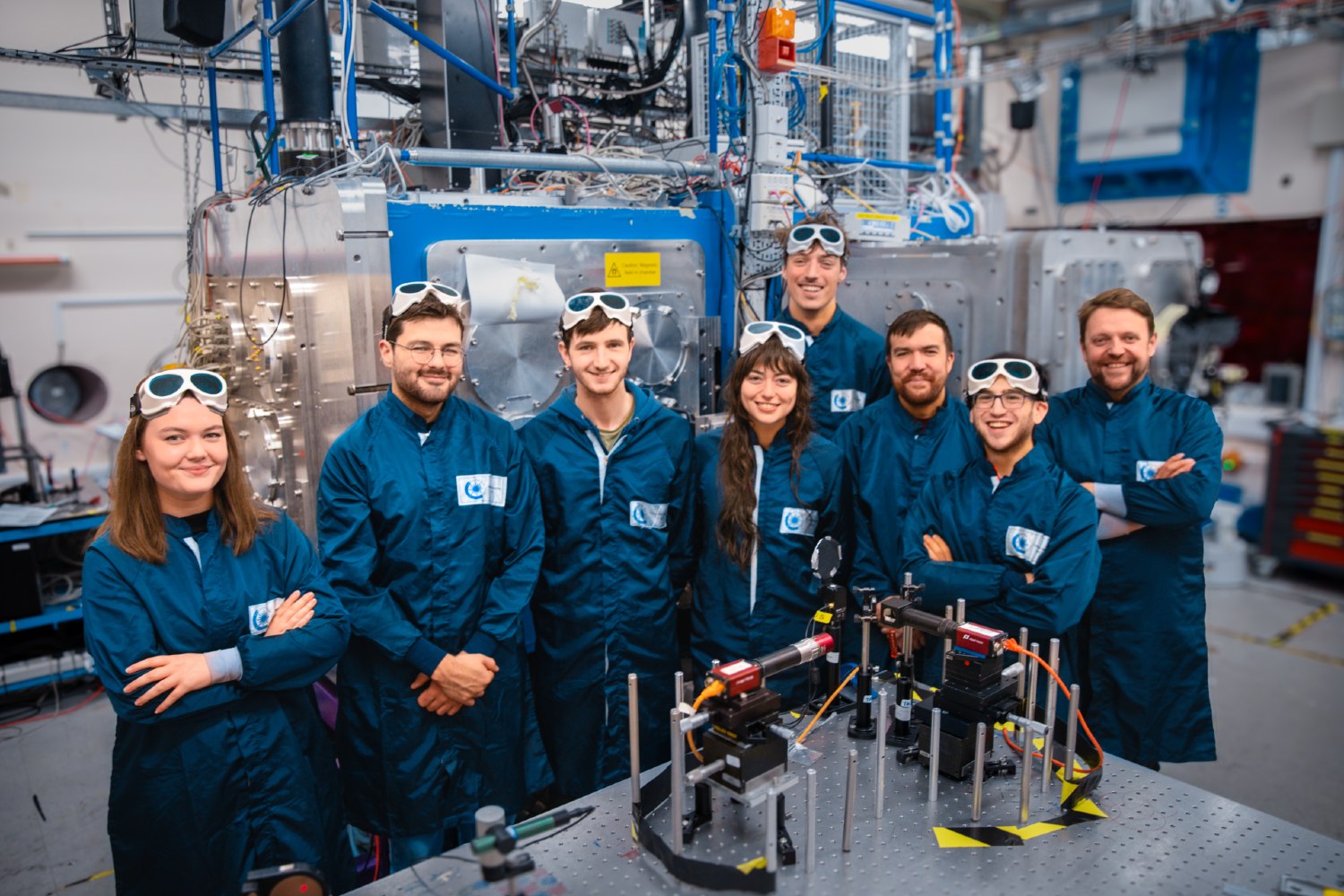
The work was led by Professor Peter Norreys and Dr Robin Timmis (University of Oxford), in collaboration with Professor Brendan Dromey and Dr Mark Yeung (Queen’s University Belfast), and scientists from the STFC CLF.
Coherent harmonic focus (CHF) generation. The laser is focused on a target, the reflected
purple beam forms a CHF of extreme intensity that generates matter from light. Photos of
the interaction are combined with an artist’s interpretation of the CHF. Credit: Timmis et al.
2026.
Using the Gemini laser at the CLF, the team created extremely bright ultraviolet light through an unusual process.
In simple terms, they fired an intense laser at a cloud of charged particles (a plasma), causing it to behave like a rapidly moving mirror.
This can be likened to shining a flashlight at a mirror that is rushing toward you at enormous speed.
The reflected light becomes compressed and more energetic, similar to how the pitch of a siren rises as an ambulance speeds past.
Because the ‘mirror’ is moving so fast that Einstein’s theory of relativity comes into play, the light is boosted to much higher energies.
This effect is known as relativistic harmonic generation.
Concentrating light
The team also demonstrated a way to concentrate this light even further, in what they call a Coherent Harmonic Focus.
An analogy is using a magnifying glass to focus sunlight on a tiny point so intense it can burn paper.
Here, instead of sunlight, many different colours (wavelengths) of laser light are brought together and focused into an extremely small region, creating a huge concentration of energy.
Pioneering research
Professor Rajeev Paramel Pattathil, Head of Novel Accelerator Science and Applications at the Science and Technology Facilities Council (STFC) CLF, said:
This milestone work paves a new path towards extreme intensities, significantly beyond what’s achievable using conventional laser technologies available today.
Realising this interaction regime required significant improvements in understand and controlling the temporal contrast of high-power laser pulses – something the Gemini facility and the CLF in general pioneered over the past several years.
I am excited to see that this work has paid off in such an extraordinary manner, opening a new door to extreme science.
Probing the quantum vacuum
This advance could eventually allow scientists to explore one of the most extreme frontiers of physics: how light and matter interact at the most fundamental level, described by a theory called quantum electrodynamics.
Until now, experiments in this area have required smashing high-energy particle beams into powerful lasers and then carefully translating the results between different perspectives.
This is a bit like trying to understand a car crash by switching between multiple moving cameras.
This new method avoids that complexity.
Because everything happens within the laser system itself, scientists can observe the results directly, without needing complicated conversions, making future experiments much easier to interpret.
Researchers’ reactions
Lead author Dr Robin Timmis, Department of Physics at the University of Oxford, said:
The discoveries we have made so far are fascinating and it feels like we are just getting started in terms of understanding the rich and complex physics of this mechanism.
The simulations suggest that we may have made the most intense source of coherent light ever.
I hope we get a chance to return to Gemini soon to confirm this but also to take what we have learnt to larger facilities where we can generate even brighter light.
Extraordinary results
Senior author Professor Peter Norreys, Department of Physics at the University of Oxford said:
We are excited to have realised this extraordinary result in the laboratory.
It is a testament to Robin’s exquisite mastery of the subject for her to have obtained the precise experimental conditions that have eluded us for decades.
Resolving frustrations
Co-author Professor Brendan Dromey from Queen’s University Belfast said:
This work is a blend of laser technology, plasma physics and ultrafast materials science finely tuned to resolve a persistent mismatch between theory and experiment that has frustrated the field for more than two decades.
Funding and partners
The research was carried out in 2024 and 2025 and involved a broad international collaboration.
This included:
- Dr Ed Gumbrell’s team from AWE plc
- Professor Karl Krushelnick’s group at the University of Michigan’s Center for Ultrafast Optics
- Professor Matt Zepf’s Research Group for High Field Physics and Laser Acceleration at the University of Jena, Germany
Funding support was provided by UKRI Engineering and Physical Sciences Research Council, including:
- the Ultrafast Nanodosimetry grant (EP/W017245/1)
- the HEC Plasma Physics Consortium grant for access to the ARCHER2 national supercomputer
- UKRI-STFC supported access to the SCARF supercomputer facility at Rutherford Appleton Laboratory
Additional support came from:
- AWAKE2 and John Adams Institute for Accelerator Science grants
- Oxford Clarendon Scholarship Fund
- Living Optics Ltd
Supporting grants from US and German funding bodies contributed through the Michigan and Jena groups respectively.
Read the study ‘Efficiency-optimized relativistic plasma harmonics for extreme fields‘.