MOORESVILLE, N.C. — In October 2025, Lowe’s Companies Inc. completed its $8.8 billion purchase of Foundation Building Materials (FBM), alongside a $1.3 billion deal for Artisan Design Group. Spearheaded by Chairman and CEO Marvin Ellison, the massive capital outlay—backed by $9 billion in bridge financing—marked a decisive pivot away from relying primarily on do-it-yourself (DIY) retail towards capturing a slice of the $250 billion professional construction market.
The deal absorbed 370-plus distribution sites and over 40,000 professional accounts overnight. The integration of FBM has shifted Lowe’s growth driver from individual homeowners to large-scale commercial and residential builders.
Financial and Operational Impacts
The acquisition provided immediate top-line expansion, though macroeconomic headwinds in residential construction have tested short-term margins:
- Top-Line Growth vs. Organic Sales: Lowe’s total revenue expanded—reaching $26 billion in Q2 2026, an 8.3% increase year-over-year—driven largely by the inclusion of FBM. However, comparable same-store sales remained essentially flat (up 0.2%), highlighting that new acquisitions are carrying the weight of the company’s current revenue growth.
- Expanding Ticket Sizes: Average transaction values among Pro customers increased by 2.3% in mid-2026, demonstrating increased adoption of bulk materials—such as wallboard, suspended ceilings, and framing systems—that FBM specializes in.
- Integration Overhead: Lowe’s absorbed non-GAAP acquisition-related expenses through early 2026, including pre-tax charges of $96 million in Q2 2026 related to intangible asset amortization.
Headwinds and Strategic Pivot
While the deal positioned Lowe’s to compete directly with rival Home Depot for large-scale enterprise contractors, high interest rates and sluggish housing turnover have created near-term friction. Continued softness in discretionary home improvement spending by DIY consumers has made the Pro segment Lowe’s primary buffer against wider market drops.
Company leadership has noted that while core contractor project backlogs remain stable, overall project scale has temporarily compressed due to broader macroeconomic uncertainty.
Future Prospects
Despite short-term market pressures, the long-term rationale behind the FBM acquisition remains intact as Lowe’s builds out its “Total Home” strategy:
- Supply Chain Integration: By combining FBM’s specialized distribution hubs with Lowe’s traditional retail footprint, the company aims to offer end-to-end fulfillment, trade credit, and job-site delivery for large-scale commercial builders.
- Margin Expansion: As integration costs fade, higher-volume, recurring orders from enterprise contractors are expected to drive margin recovery once residential and commercial construction rebounds.
- Market Share Advantage: By broadening its scope to include large-scale contractors alongside small-to-medium Pros, Lowe’s is structurally diversified to capture rapid upside when housing starts and major renovation activity accelerate.
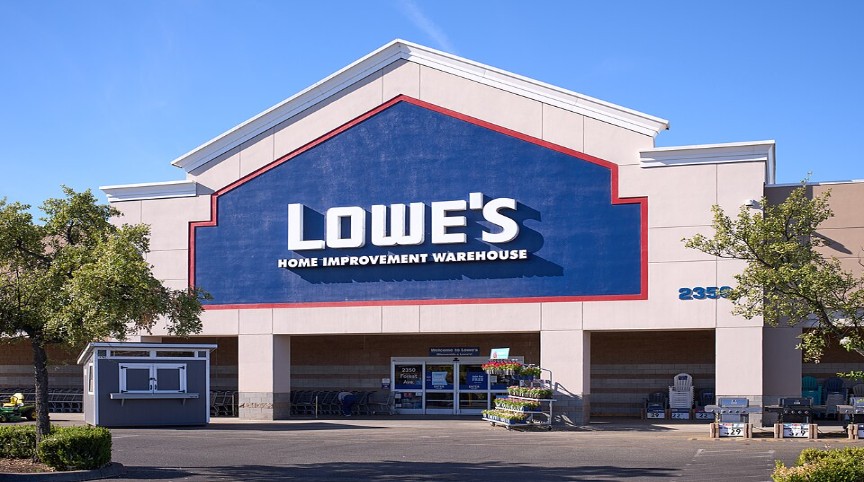
Lowe’s in Chico, California on Wikimedia by Frank Schulenburg