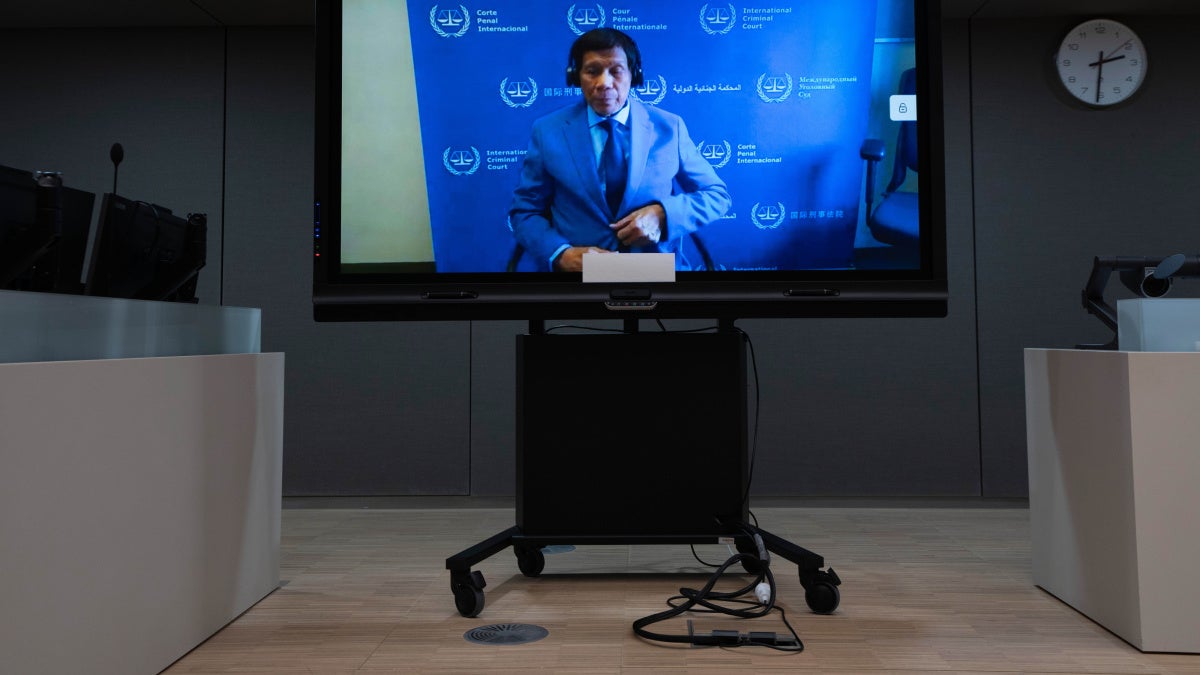
(The Hague) – The International Criminal Court (ICC)’s confirmation on April 23, 2026, of all crimes against humanity charges against former Philippine President Rodrigo Duterte is a major step toward justice for the victims of the country’s “war on drugs,” Human Rights Watch said today.
Three pretrial judges unanimously found substantial grounds to believe that Duterte committed the crimes against humanity of murder and attempted murder when he was mayor of Davao City and then president in the context of the “war on drugs” campaign between November 2011 and March 2019. ICC judges will later announce the starting date of Duterte’s trial.
“The ICC decision to send Duterte to trial opens the door to long awaited justice for the families of ‘drug war’ victims and is an important acknowledgment of their suffering,” said Maria Elena Vignoli, senior international justice counsel at Human Rights Watch. “Duterte’s trial will send a powerful message to those responsible for grave crimes in the Philippines and elsewhere that no one is above the law, and that justice will eventually catch up with them.”
The decision to confirm the charges against Duterte follows a hearing on February 23-27 in which the pretrial judges heard from the Office of the Prosecutor, Duterte’s defense counsel, and victims’ representatives to determine whether to send the case to trial. At the time, the prosecutor’s office presented evidence to support three counts of murder and attempted murder allegedly committed in 49 specific incidents against 78 victims. However, the office also indicated that these were non-exhaustive lists, and that it may seek to present at trial evidence of additional incidents and victims within the framework of the confirmed charges.
The full decision on the confirmation of the charges against Duterte can be appealed with pretrial chamber authorization.
Duterte was arrested in Manila on March 11, 2025, by Philippine authorities acting on an arrest warrant issued by ICC judges and sent to Interpol, the International Criminal Police Organization. He has been in detention in The Hague ever since.
The Office of the Prosecutor opened an investigation into crimes in the Philippines within the jurisdiction of the court in September 2021. The investigation is ongoing and covers alleged crimes committed from November 2011 until March 16, 2019, a day before the Philippines’ withdrawal from the Rome Statute, the ICC’s founding treaty, took effect. On April 22, 2026, the ICC appeals chamber issued a decision confirming that the court retains jurisdiction in the situation in the Philippines for alleged crimes committed until the withdrawal from the Rome Statute entered into force.
The current Philippine president, Ferdinand Marcos Jr., has never repudiated the “war on drugs” as a government policy and has yet to rescind the orders, and other policy statements, issued by then-President Duterte. President Marcos should formally announce an end to the “drug war” and order investigations into the police and other officials implicated in unlawful killings. Marcos should also begin the process of the Philippines’ rejoining the Rome Statute to demonstrate a commitment to international justice and accountability for atrocity crimes, Human Rights Watch said.
The decision to send the case against Duterte to trial comes at a time when the ICC is facing extreme pressure and attacks on its independence. In December 2025, a Russian court convicted in absentia the ICC prosecutor and eight of the court’s judges and sentenced them to prison terms in retaliation for the court’s arrest warrant against Russian President Vladimir Putin.
In February 2025, US President Donald Trump issued an executive order authorizing sanctions on ICC officials and others supporting the court’s work. The order makes clear that the Trump administration seeks to shield US and Israeli officials from facing charges before the ICC. Since then, the US government has imposed sanctions on the ICC prosecutor, the two deputy prosecutors, eight of the court’s judges, a UN expert, and three leading Palestinian human rights organizations.
“Moving the Duterte case to trial reaffirms the ICC’s critical role as a court of last resort to investigate and prosecute the most serious crimes,” Vignoli said. “ICC member countries should redouble their efforts to protect the court and those supporting its work, so it can deliver on its essential mandate in the Philippines and beyond.”