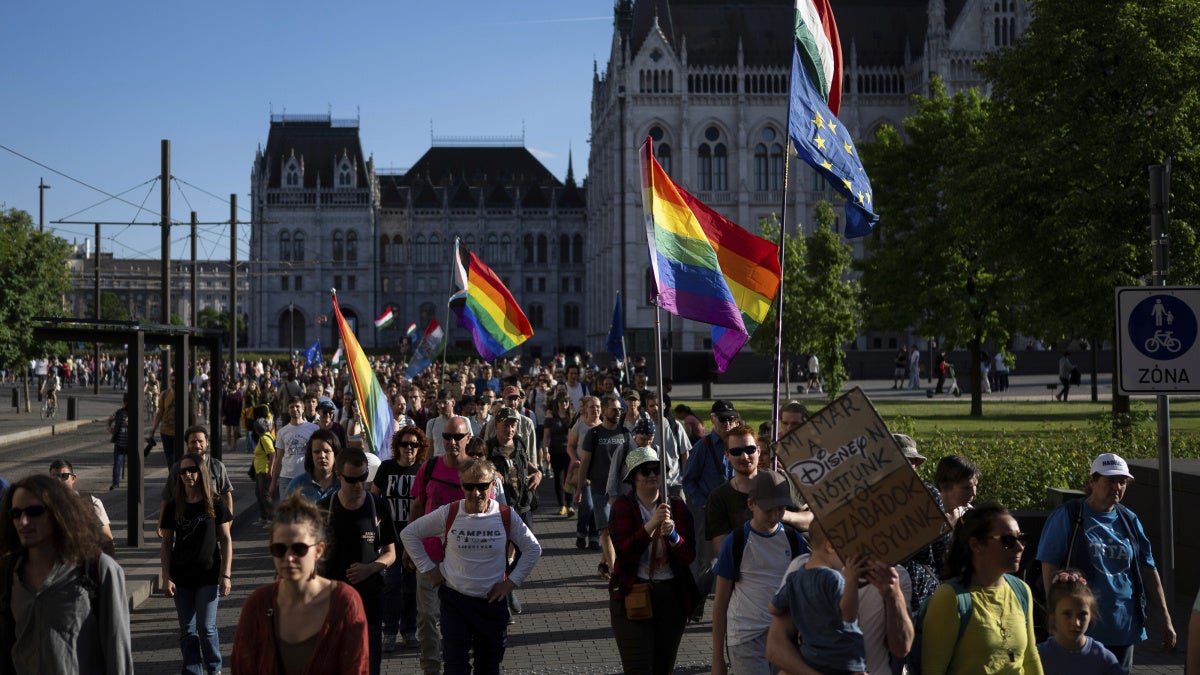
(Budapest) – The Court of Justice of the European Union (CJEU) ruling on April 21, 2026, against Hungary’s 2021 anti-LGBT law is an important rejection of efforts to stigmatize lesbian, gay, bisexual, and transgender (LGBT) people, Human Rights Watch said today. The court found that the 2021 law, which attempts to stigmatize LGBT people under the guise of “child protection,” breaches EU law and underscored that such discrimination has no place in the EU.
“This is a landmark ruling making clear that Hungary’s anti-LGBT law has no place in the European Union and should be repealed,” said Lydia Gall, senior Europe and Central Asia researcher at Human Rights Watch. “Hungarian authorities have used this legislation to censor information, stigmatize LGBT people, and restrict fundamental rights, and the court has now confirmed that these actions violate EU law.”
The court found that Hungary’s legislation, which prohibits or restricts the “portrayal or promotion” of sexual orientation and gender identity to children and adolescents in education, media, and advertising, breaches EU law, including fundamental rights protections and values enshrined in the EU founding treaty. The ruling confirms long-standing concerns raised by Human Rights Watch and other organizations that the law is discriminatory and incompatible with fundamental EU values.
Hungary’s new government should act without delay to repeal the discriminatory anti-LGBT law and ensure that all legislation respects equality, freedom of expression, and access to information. The authorities should also drop charges against Pride organizers, Human Rights Watch said.
Hungary adopted the law in June 2021 under the Fidesz government of Prime Minister Viktor Orbán, leading to a ban or limit on content addressing sexual orientation or gender identity in materials accessible to children and adolescents. The changes affected school curricula, advertising, and media content, and stifled comprehensive sexuality education. Human Rights Watch warned at the time that the law would fuel discrimination and silence discussion of diversity and equality.
The European Commission initiated infringement proceedings against Hungary shortly after the law’s adoption, saying that it violated EU internal market rules, fundamental rights, and the EU’s founding values. The EU court’s judgment is one of the most significant rulings to date addressing breaches of EU founding values by a member state in adopting legislation that violates LGBT rights.
The law has had a far-reaching impact beyond formal legal restrictions in Hungary. It has contributed to a chilling effect on educators, journalists, and civil society organizations, discouraging open discussion of LGBT rights, and creating an increasingly hostile environment for LGBT people and those working to support them.
The authorities have also relied on similar “child protection” arguments to justify broader restrictions on freedom of assembly, including bans on Pride-related events, and bringing criminal charges against Pride organizers, including the mayor of Budapest.
The court’s ruling requires Hungary to bring its legislation into compliance with EU law. Failure to do so could lead to further legal action and financial penalties. The judgment comes at a critical moment, following Hungary’s recent elections and the formation of a new government with a two-thirds parliamentary majority. The ruling provides a clear legal and political mandate to reverse years of rights abuses targeting LGBT people and presents a clear opportunity for the authorities to show their commitment to restoring respect for the rule of law and human rights.
The European Commission should closely monitor Hungary’s compliance with the judgment and take further enforcement action if it is not implemented, such as maintaining the existing freeze on EU funds based on rule of law concerns and considering further financial and other penalties. EU member states in the Council of the European Union should continue scrutiny through article 7 proceedings as long as breaches of EU fundamental treaty values persist in the country.
“This decision sends an important message across the European Union that there are consequences for member states that undermine fundamental rights,” Gall said. “Equality and human dignity are core EU values that need to be upheld in practice and not dismissed using vague and discriminatory pretexts.”