Autistic people are so rarely depicted in media and entertainment, it’s no wonder most people don’t really understand much about the neurotype.
So we were pleased to see the launch of autistic Barbie.
Autism is a life-long neurodevelopmental difference, meaning autistic children grow into autistic adults. As autistic researchers, who advocate for the increased meaningful representation of our community, it was a good sign that multinational toy company Mattel worked with an autistic-led advocacy organisation based in the US, the Autistic Self Advocacy Network, in creating this new toy.
We have seen mixed reviews from autistic people since the launch, with some praising representation while others have been more critical of the doll.
Here are some considerations about her features to help you make up your own mind.
The tablet
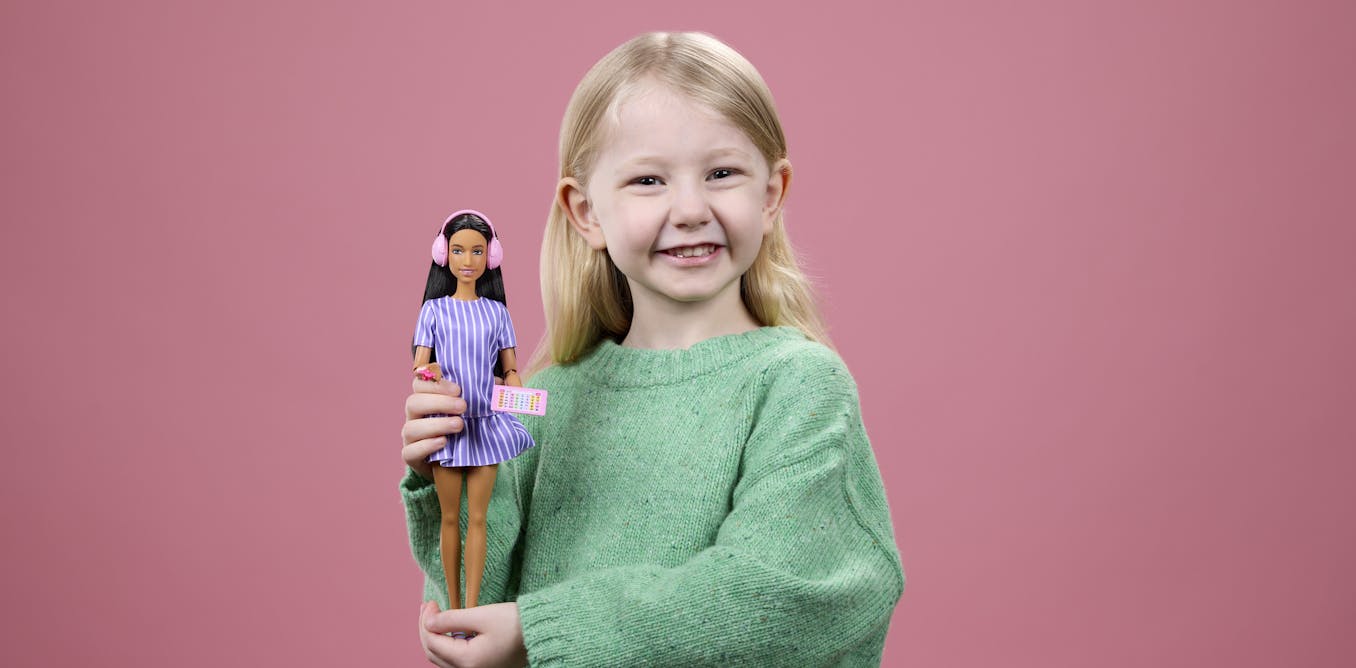
Autistic Barbie is shown with a tablet with an augmented and alternative communication (AAC) application, which speaks aloud when buttons are pressed.
Some autistic people find communicating extremely challenging, and around a third cannot communicate reliably by speaking. This leads to needs going unmet, feeling misunderstood and often significant distress.
That is, unless an alternative mode of communication is available. Applications available on tablets, such as Proloquo2Go and Coughdrop, are helpful for some autistic people to communicate their needs and preferences.
Although some non-speaking autistic people find it easier to communicate with non-digital options such as printed cards, or using a low-tech signboard with letter tiles alongside a skilled communication partner, we think it’s great that this Barbie comes with a tablet.
The headphones
Sensory sensitivities are a core element of autistic lived experience. Autistic people are commonly sensitive to noise, light, smells, textures and taste. To represent this, autistic Barbie comes with noise-cancelling headphones which can be vital for some autistic people with noise sensitivities. However, other autistic people may find them too uncomfortable to wear and prefer in-ear options. For this reason, autistic people should be allowed to wear ear protection any time it is safe.
Eye contact
The development team reportedly gave Barbie a sideways glance, which aimed to show that eye contact may be uncomfortable and thus avoided in autistic people. An additional way to strengthen autistic Barbie could be to show the potential of visual distress, and to provide her with a coloured glasses accessory. Coloured lenses are a helpful tool to reduce the pain some autistic people feel in response to light, movement and colours. In reality, a specialist test can be used to help autistic people figure out what colour is best for them.
The outfit
Mattel seem to have invested thought in making Barbie’s outfit comfortable from a sensory point of view. Her outfit does not come with labels sewn in – a common cause of irritation to autistic people.
Her dress is loose and flowing, which may appeal to those with tactile hypersensitivity. We didn’t have an autistic Barbie to hand, so we aren’t sure what the fabric is like, but soft and comfortable fabric is a must for many autistic people.
It is worth noting that autistic people often have individual clothing preferences, and some may prefer tight – or even restrictive – clothing as it provides proprioceptive feedback, which can be comforting. It can also support hypermobile joints, which are at least three times as common in autistic people compared to non-autistic people. Furthermore, many autistic people are gender non-conforming, so may not see themselves represented in this outfit.
Autistic Barbie is wearing Mary Jane-style flat shoes, rather than Barbie’s typical high heels. Many autistic people struggle with shoes and rigid slim shoes may be uncomfortable for some. Almost half of autistic young people also walk on their tiptoes as a way of stimming, so allowing a movable ankle would have allowed this to be visible.
The stim tool
Stimming is an important way for autistic people to stay comfortable and regulated. It can undo some of the pain and discomfort of an unsuitable sensory environment. For this reason, we were really pleased to see that Barbie has two opportunities to stim. First, she has bendable elbows and wrists – many autistic people do some form of repetitive movement of their arms and hands as part of stimming. Also, Barbie holds a fidget spinner. This is a small toy that creates an interesting tactile and visual response.
Although not all autistic people will like fidget spinners, most engage in stims with their hands, so this is a good representation of one object that autistic people use to stim.
So how did Mattel do?
Social science researchers have claimed that Barbie – regardless of neurotype – has historically been reductive and problematic. Barbie is unachievably thin, extremely feminine and all too often white. It is important not to ignore these criticisms, however, Barbies are very popular toys and have a reach beyond other brands, and their range of disabled Barbies feels important to raise awareness.
There is no single “look” to being autistic, so the Barbie Mattel created can’t represent everyone, especially as her design is limited to visual elements. Despite these issues, we think, in general, that Mattel and the Autistic Self Advocacy Network have done a great job of creating the autistic Barbie doll.
Her existence is an overall positive. Her inclusion creates a much-needed opportunity for representation, education and normalises the use of disability accommodations.

Aimee Grant receives funding from The Wellcome Trust and UKRI.
Rebecca Ellis does not work for, consult, own shares in or receive funding from any company or organisation that would benefit from this article, and has disclosed no relevant affiliations beyond their academic appointment.