KEY TAKEAWAYS
-
Interactive digital clones of deceased people feed off a person’s digital footprint which is comprised of messages, photos, videos, voice recordings and social media, enabling the living to simulate conversations with the dead.
-
These mind-bending subscription services are becoming part of a burgeoning commercial “digital afterlife” industry that raises emotional and ethical concerns about how we process grief.
-
This article offers food for thought on who has the final say on how the deceased’s identity should be represented, who has access to these services and how companies make money from them.
Thanabots (or griefbots), artificial intelligence (AI) trained based on the deceased’s social media and other personal data, turn these traces of a human being’s life into an eerie speaking identity shaped by families, algorithms, and companies.
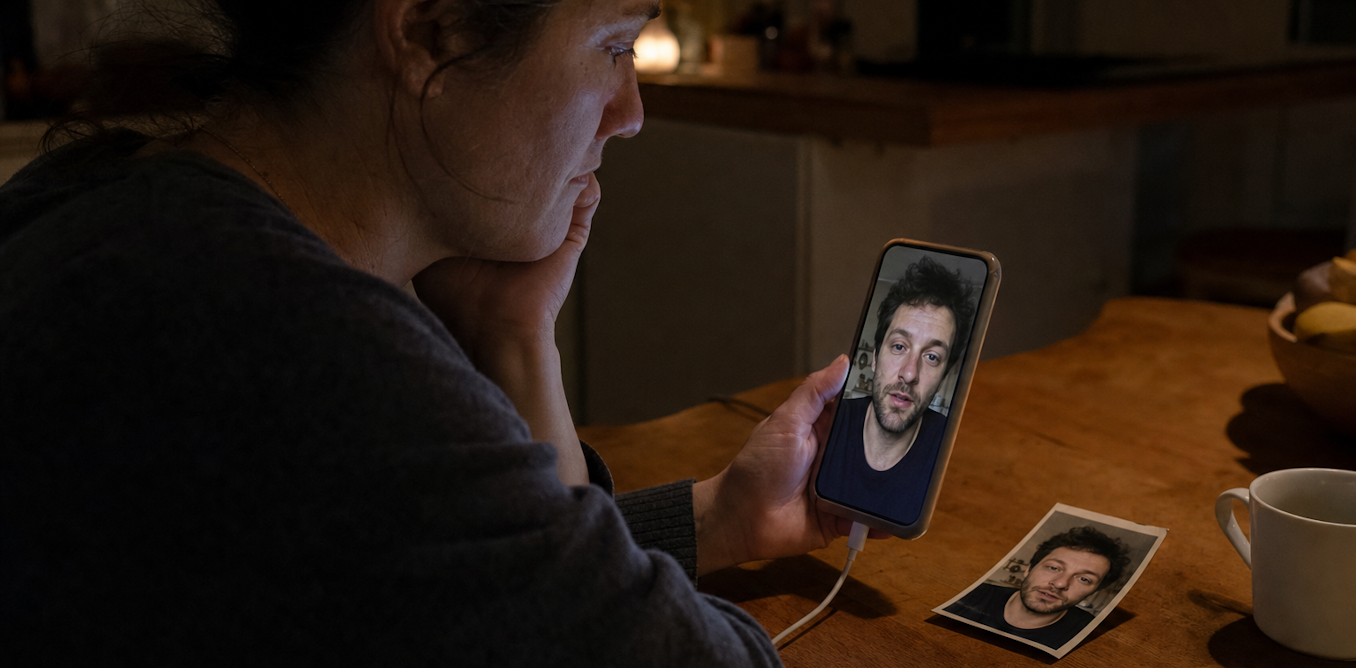
A phone lights up. A dead friend answers. A dead son remembers our birthday.
What once belonged to seances, prayer, and science fiction is edging towards an ordinary consumer service. In the Black Mirror episode Be Right Back, Martha loses her partner, Ash, and turns to a service that rebuilds him from his digital “footprint”. It starts with messages, then moves to a familiar voice, and ends with a synthetic body. The replica knows Ash’s catchphrases and jokes. While it can reproduce what he left behind, it cannot recover what it was like to be him.
Shutterstock AI, CC BY
One early, real-world case came when Replika co-founder Eugenia Kuyda used messages from her dead friend Roman Mazurenko to build a conversational bot in his style. Today, thanabots, griefbots, and deathbots use messages, photographs, videos, voice recordings, and social media posts to simulate a dead person’s speech and behaviour. They are part of a growing Digital Afterlife Industry that turns the traces of a life into interactive recreations.
The concept has moved well beyond fringe experimentation. Microsoft holds a patent, granted in 2020, for “creating a conversational chatbot of a specific person” using social data such as messages, voice data, images, and other personal material. The patent explicitly says that the “specific person” may be a past person, including a friend, relative, celebrity, or historical figure. The pricing makes the commercial logic clear. One recent report described HereAfter AI (which announced it was shutting down earlier this month) plans priced around US$199, while South Korean company DeepBrain AI was said to offer premium 3D avatar recreations for up to US$50,000, with maintenance fees on top of that.
From souvenir to speaking identity
People have always used objects to sustain relationships with the dead. A coat can keep a smell. A recipe can evoke the voice of someone who was close. A saved voicemail can collapse years into seconds. But older memorial objects carry something of the person without claiming to be the person. A thanabot changes that arrangement. It speaks in the first person: “I remember,” “I miss you,” “I still believe,” even though these are new sentences generated after death. A photograph says, “This person was here.” A thanabot says, “I am still here.”
That shift in pronoun may produce problems. The system is assembled from what others can collect, such as messages, recorded habits, photographs, jokes, and remembered actions. It then performs a point of view, as though these fragments had recovered the inner life that once gave them meaning. What looks like preservation is already production. Each reply combines the dead person’s data with a family’s selections, a mourner’s prompts, a model’s predictions, and a company’s design choices. The answer sounds as if it comes from one person, but its authorship is potentially spread across many.
The dead are not the only people being recreated
The question “Is it healthy to keep talking to the dead?” sounds straightforward. But grief has never required silence. People speak at graves, write letters to the dead, repeat shared rituals, and imagine what a loved one might say. Continuing a bond can be part of mourning. The harder question is not whether people should maintain a relationship with the dead. It is exactly what the service keeps “alive”. Relationships help make us who we are. We become partners, parents, children, and friends through the ways other people recognise and address us. Death removes a person, but it also unsettles part of the survivor’s own identity. A parent loses a child, but also loses the voice that made their parenting into a living exchange.
A thanabot can restore some of that recognition. It can remember the anniversary, repeat the family joke, or call someone “Mum” again. In that sense, the service does not just recreate a version of the dead. It can also preserve a version of the living person who existed inside that relationship. This, of course, may offer comfort at first. But it may also hold the mourner close to an earlier version of oneself, organised around a relationship that death has changed. Companies may be selling access to the dead and, with it, access to a former version of the customer.
Who decides who the dead become?
A thanabot can say things the dead person never said. This can be appealing but ethical difficulties may begin at the same point. In 2025, the father of Joaquin Oliver, a 17-year-old killed in the 2018 Parkland school shooting, created an AI version of his son and allowed a journalist to interview him. The avatar answered new questions using Joaquin’s voice and publicly advanced his anti-gun activism. The same issue appears privately within families. Who gets to authorise a recreation: a spouse, a parent, all siblings, or only the actual person before their death? Love may motivate the reconstruction, but it does not grant unlimited authority over another person’s identity. And consent is only the beginning. A thanabot may change over time. A software update can alter its vocabulary, humour, “memories”, or political tone. Relatives may upload new material, allowing it to grow beyond the life on which it was trained. At some point, preservation gives way to interpretation.
Interpretation then becomes invention. Ownership, then, is divided from the start. The family may supply the archive. The company controls the model, interface, and servers. The dead person provides the identity that gives the product its emotional and commercial value, but can no longer renegotiate the arrangement. Companies can decide which version appears, what it remembers, and how long it remains available. Better memory may sit behind a premium tier. A familiar voice may change after an update. The clone may vanish when the company shuts down.
Psychoanalyst Jacques Lacan distinguished biological death from symbolic death, when a person disappears from collective memory. Subscription-based resurrection, we suggest elsewhere, introduces a third possibility: digital death happens when payment stops, the provider closes, or the model is removed.
Here, the ethics are not abstract. They are built into the service itself: whose consent counts, who answers for distortion, how grief is priced, and whether a family can pause, export, or permanently remove a recreation without being forced to rent it forever. The dead have always spoken through possessions, rituals, and the people who remember them. What is new is the generated animated reply, together with a company’s power to edit, interrupt, and invoice it. Once grief depends on server uptime, someone owns the next sentence.