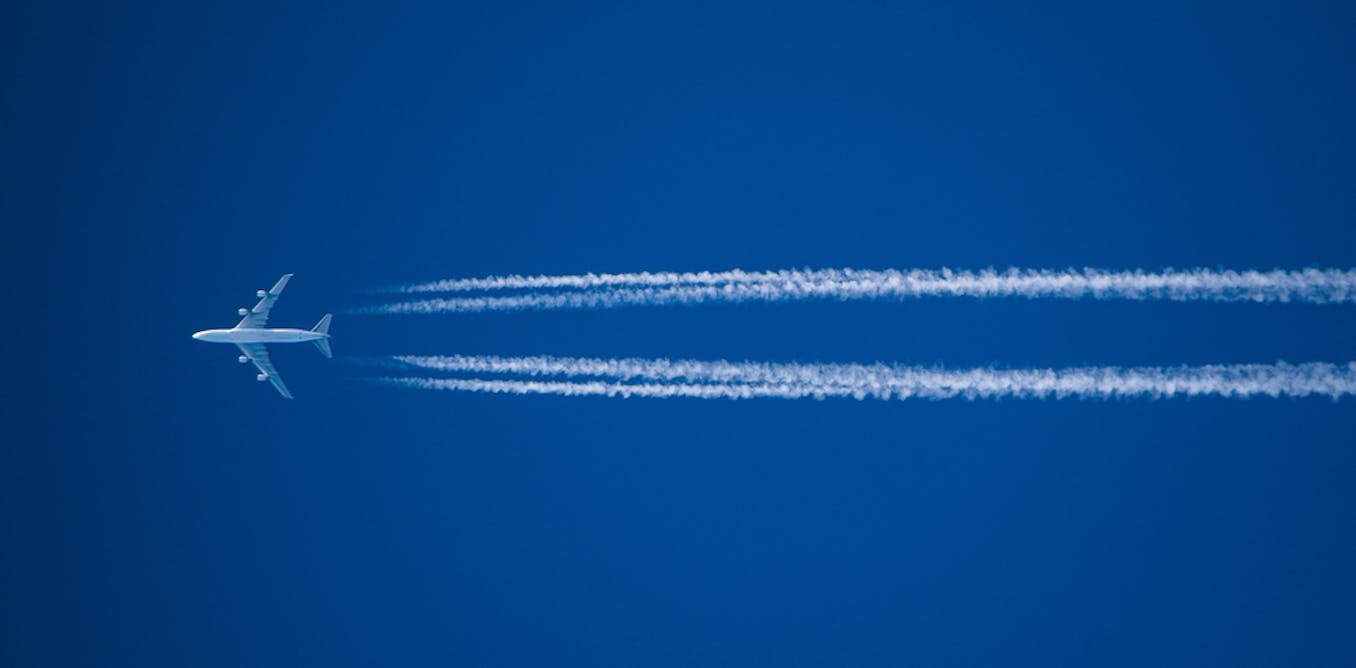
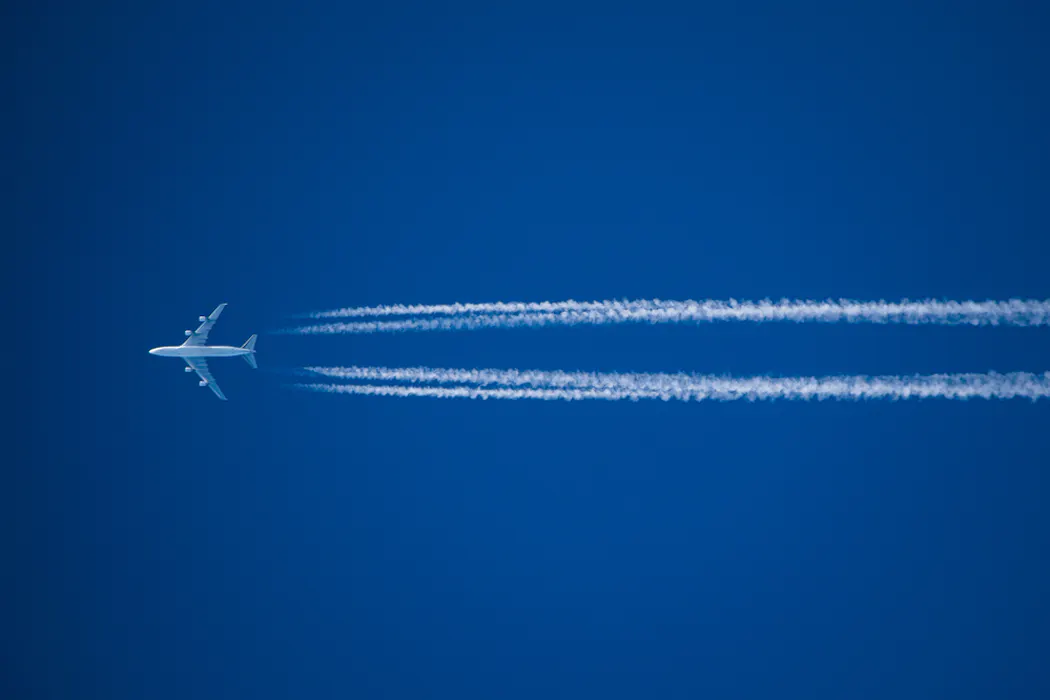
Contrails, short for condensation trails, are the white streaks often seen in the sky behind aircraft. The international cloud atlas, which classifies clouds, has a category just for them: cirrus homogenitus, an example of man-made clouds.
Contrails contribute to climate change, adding to the warming by the carbon dioxide emitted by aviation. Although the exact amount of warming caused by these wispy-looking clouds is uncertain, what is understood now suggests that reducing the number of contrails has the potential to reduce the climate impact of flights.
Contrails are made of ice crystals. These reflect sunlight, causing the Earth’s surface to receive less energy, but at the same time trapping some of Earth’s outgoing infrared radiation. Depending on the balance between those two opposite effects, a net loss of energy or a gain of energy, individual contrails can be either warming or cooling over their lifetime, but warming dominates once averaged over the global, annual contrail population.
How are they made?
Contrails form behind aircraft at around an altitude of 10-11km. They only form in sufficiently cold and humid regions of the atmosphere, where water vapour condenses on to the soot particles emitted by aircraft engines to form liquid droplets, which freeze into ice crystals. The regions with the most contrails are over Europe, the North Atlantic, and eastern North America. They are rarer in Asia.
Soot particles are needed to form contrails, yet even engines that emit very few soot particles still generate contrails. Other particles, often formed in the engine plume, take over and lead to contrail formation. But some combinations of fuel and engine technology may yet provide a way to form fewer contrails, or at least contrails with a smaller climate impact.
The characteristics of a contrail depend initially on the size, shape and engine position of the aircraft that created it, but atmospheric conditions are ultimately more important.
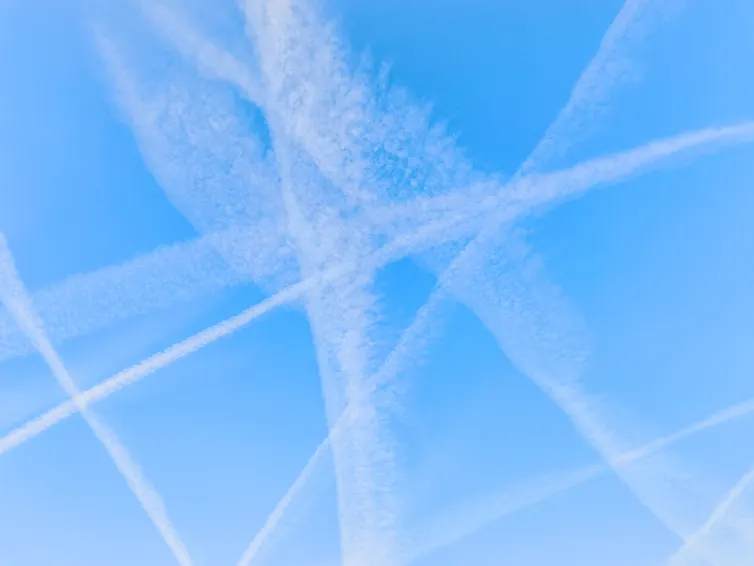
In a dry atmosphere, contrails only last a few minutes and cover a tiny surface area: their climate impact is negligible. But if the atmosphere remains cold and moist enough, many contrails form, grow, and come together to form fields of ice clouds, called contrail cirrus.
Contrail cirrus impact the climate because they last for several hours and can cover large areas, sometimes spanning entire countries, as has been observed over the UK and France, for example.
we12e/Shutterstock
Some contrail cirrus clouds can exert the same climate impact as tens, even hundreds, of tons of carbon dioxide.
Two effects make contrails particularly potent. Although they initially form from the few hundred kilograms of water vapour and the
dozens of grams of soot released every minute of flight, contrails then gain mass from the humidity of the atmosphere. Also, ice crystals absorb infrared radiation at virtually all wavelengths, while carbon dioxide only absorbs in narrow wavelength ranges.
However, contrail cirrus strongly affect the flow of energy in and out of the Earth for a few hours. This is in contrast to the comparatively weaker changes caused by carbon dioxide, which last for centuries. So the warming caused by a flight will initially be dominated by contrails, but carbon dioxide will dominate a few years after the flight.
Routing aircraft to avoid flying in the regions where contrails form may slow down the climate warming caused by a growing aviation sector. But there are still many things scientists need to understand about how to predict which flights would see their climate impact reduced the most using this kind of planning.
Weather forecasts of humidity at flight altitude need to improve, and one way to do so is to have more accurate and more frequent measurements of humidity. This is the aim of the Mist research project, where I work with Honeywell Aerospace UK and Boeing UK to develop a humidity sensor to detect contrail formation, see how the sensor can be integrated on commercial aircraft, and evaluate how better humidity measurements affect the predicted climate impact of contrails.
Many research projects are seeking to better quantify the climate impact of contrails and find ways to form fewer warming contrails. Changing fuel or engine technology is slow. But optimising flight trajectories with weather forecasts to avoid the cold, moist regions of the atmosphere where contrails form might be achievable more quickly.

Nicolas Bellouin has received and receives funding for aviation non-CO2 climate research, which includes contrail research, from the UK National Environment Research Council, Innovate UK and the Aerospace Technology Institute, the European Union's Horizon programme, the SESAR Joint Undertaking, and the French Civil Aviation Authority. He is a member of the Aviation Non-CO2 Expert Network (ANCEN) of the European Aviation Safety Agency.