Category: Finance

  • Six conversations to have with daughters to ensure financial wellness

    Six conversations to have with daughters to ensure financial wellness

    [ad_1]

    Financial literacy is key to a successful financial future

    Article content

    By Louise Stevenson

    Advertisement 2

    Article content

    We all want our daughters to grow up to be strong and independent, but children often model the behaviour of their parents.

    Article content

    “The results of the triennial worldwide survey of 15-year-old students found that teens who talked about finances with their parents, even just once a week, scored 33 points higher in financial literacy than those who did not,” according to the Financial Consumer Agency of Canada.

    Article content

    “Higher levels of financial literacy in students are associated with confidence in keeping track of their account balance and planning their spending with consideration of their current financial situation. Both are key factors in building a financially secure future.”

    Do you remember watching your mom balance her chequebook? I do. The advantage of technology is that we now have access to great apps and data, but the downside of our tap culture is that it’s so easy to tap away without paying real attention to our purchases.

    Advertisement 3

    Article content

    The next time you find yourself with your daughter safely tucked into the seat beside you in the car (a.k.a. trapped with nowhere to go), here are six topics you may want to discuss.

    To make budget management easier, set up two accounts

    Once you’ve established your monthly budget, transfer the monthly total to the “spending” (likely a traditional chequing account), keeping any excess in the second (likely a savings account). This helps make a decision to review your monthly budget a more mindful one, and, in the process, helps establish better spending habits and ideally to live within your budget.

    Don’t ignore the power of compounding

    We’ve all heard the advice to “pay yourself first.” There’s future financial wellness in that statement. If at age 20, your daughter started saving and investing $361.04 per month, or roughly $12 per day, based on a five-per-cent rate of return, she could be a millionaire by 65.

    Advertisement 4

    Article content

    If she balks at that amount, I am not going to be patronizing and ask her to forgo her latte (thank you, Sallie Krawcheck, co-founder of robo-advisor Ellevest Inc., for clearing that up), but I am going to suggest that investing in herself and her future is absolutely worth it and the earlier she starts, the better. That monthly amount increases to $698.41 if she waits until she is 30.

    Encourage your daughter to maintain some financial independence

    It’s nice to see our daughters in a loving relationship, but maintaining some financial independence has its merits.

    Establishing and maintaining a healthy credit rating could become very important if she finds herself on her own in the future. Trying to borrow money at 50, post-divorce without a credit rating could create unnecessary challenges during a difficult time. If you are fortunate to help your daughter purchase her home, you might suggest she consults with a lawyer to understand the impact if she chooses to live there with her partner.

    Advertisement 5

    Article content

    Our social media feeds bombard us with YOLO (you only live once). I find this is especially the case in our 20s. And while there is some truth in it, we can use it as a justification to make some pretty bad financial decisions. I have a handbag in my closet as a constant reminder of one of my YOLO decisions.

    Talk to your daughter about your YOLOs and why you wished you had invested that money

    I don’t want to think what the Apple Inc. stock would be worth if I bought it instead of that darn handbag.

    I have often heard women described as being risk averse. I prefer to think that we are “risk informed,” but to become that you have to educate yourself. I remain baffled that money management is not considered a core part of the school curriculum, but there are many online tools and books to fill the gap.

    Advertisement 6

    Article content

    As a mother, I realize you can fill a child’s room with books, but can’t force them to read. We’re each motivated differently and there are some good options out there to develop your financial literacy skills.

    Lifelong learning in financial literacy

    Try some digestible books (The Wealthy Barber: The Common Sense Guide to Successful Financial Planning by David Chilton; Prince Charming Isn’t Coming: How Women Get Smart About Money by Barbara Stanny), a podcast in the car — again, they’re trapped beside you with a seatbelt.

    Or match your child’s contribution to an investment account (perhaps a tax-free savings account if they’re over 18) and use this as an opportunity to discuss their investment choices or suggest they complete the Canadian Securities Course. This is the entry level course required in the investment industry and provides a good overview of everything from investment products, family law (what happens in a divorce) and estate law.

    Advertisement 7

    Article content

    You seek the advice of a dentist when you have a toothache, and a doctor when there is unexplained pain in your body. You may visit Dr. Google, but you’ll soon realize it’s almost impossible to develop an appropriate plan without a proper diagnosis.

    There is a lot of misinformation regarding investments. The true benefit comes from having a comprehensive financial plan with regular check-ins towards financial goals that help people make smarter financial decisions along the way.

    Encourage her to develop a list of questions, interview and seek the advice of an investment professional

    Advertisement 8

    Article content

    Aside from the questions one would ask regarding educational credentials, experience and investment approach, research has shown that working with a good adviser can have a significant impact on future wealth.

    I would encourage your daughter to pick an adviser with whom she feels comfortable asking questions and one who wants to partner with your daughter, thus instilling confidence to own and lead her own journey to wealth.

    Louise Stevenson is an investment adviser at RBC Wealth Management.

    _____________________________________________________________

    If you liked this story, sign up for more in the FP Investor newsletter.

    _____________________________________________________________

    Advertisement

    Comments

    Postmedia is committed to maintaining a lively but civil forum for discussion and encourage all readers to share their views on our articles. Comments may take up to an hour for moderation before appearing on the site. We ask you to keep your comments relevant and respectful. We have enabled email notifications—you will now receive an email if you receive a reply to your comment, there is an update to a comment thread you follow or if a user you follow comments. Visit our Community Guidelines for more information and details on how to adjust your email settings.

    [ad_2]

    Source link

  • Canadian billionaire Stephen Smith has common name, uncanny talents

    Canadian billionaire Stephen Smith has common name, uncanny talents

    [ad_1]

    Financial services tycoon has an uncommon talent for making vast quantities of money while generally staying out of the spotlight

    Article content

    Stephen Smith is a remarkably common name in Canadian business. There is Stephen Smith the marketer; a Stephen Smith in structured finance; Stephen Smith the chartered financial analyst; and Stephen Smith the applications team lead.

    Advertisement 2

    Article content

    Of course, there is also Stephen Smith the Canadian billionaire and financial services tycoon, who has an uncommon talent for making vast quantities of money while generally staying out of the spotlight.

    Article content

    So much so that when Smith, whose middle initials are J.R., donated $50 million to Queen’s University and the Kingston, Ont.-based institution renamed its business school after him, navy blue t-shirts with the words — “Get to know Smith” — were produced in his honour, because no one at his alma mater really knew that much about him.

    “Stephen is as modest as they come,” John Ruffolo, the venture capitalist who cycles with Smith and knows him socially, said. “You would never know that he was a billionaire. But I do have to tell you — and I don’t know how old he is — but that guy is tough as nails, and he is a very good cyclist.”

    Advertisement 3

    Article content

    For the record, that guy is in his early seventies and is very good at many things, including building and buying companies. Smith is the Smith in Smith Financial Corp., which is acquiring mortgage lender Home Capital Group Inc. for $44 a share in a deal valuing the company at $1.7 billion.

    He is also co-founder of First National Financial Corp., a mortgage lender and mortgage-backed securities industry disruptor, started in 1988. He is chair and part-owner of Canada Guaranty Mortgage Insurance Co., as well as the largest shareholder in alternative lender, Equitable Bank.

    Smith donated $50 million to Queen’s University and the Kingston, Ont.-based institution renamed its business school after him.
    Smith donated $50 million to Queen’s University and the Kingston, Ont.-based institution renamed its business school after him. Photo by Queen’s University

    Just in case that is not enough to keep a fellow busy, he is chair of Historica Canada, the not-for-profit behind the Canada Heritage Minutes. Anthony Wilson-Smith, chief executive of Historica Canada, has known Smith for more than a decade, but has never known him to rest on his laurels, or, for that matter, rest at all.

    Advertisement 4

    Article content

    “He has never actually said this to me, but I would say his biggest fear is that he doesn’t want to get bored,” Smith said. “He has got all the money he could ever need, and yet here he is making this very big deal right now.”

    The billionaire is certainly all business at Historica Canada board meetings. Meetings start when they are scheduled to start and end when they are scheduled to end, and, without fail, all the agenda items are ticked.

    This thoroughness could, plausibly, have something to do with Smith’s childhood. He was a ham radio hobbyist and a computer geek back when computers were the size of small buildings. He got into coding, studied electrical engineering at Queen’s, and then studied some more at the London School of Economics before working a series of jobs at Philips Electronics, Canadian Pacific Ltd. and aircraft manufacturer Hawker Siddeley.

    Advertisement 5

    Article content

    Smith has said the experience of working for someone else taught him that he was smarter than his bosses and better suited to being an entrepreneur. That is the path he took when he started buying and flipping houses in Toronto in the early 1980s, before it became the cool thing to do.

    Unfortunately, rising interest rates and bad decisions would wipe him out. Smith declared personal bankruptcy, moved in with his sister and brother-in-law, and wondered if he would ever regain his confidence.

    Advertisement 6

    Article content

    “When everything is gone, you wonder if you’ll ever have the confidence to make the right decision about anything again,” he once told a Queen’s alumni event. “But the only way to deal with it is to just find a job, get up each morning, and go to work, and, bit by bit, rebuild your self-confidence.”

    Smith and his partner, Moray Tawse, started First National in 1988 as a mortgage lender, but they spotted an opportunity early on to expand into mortgage-backed securities. By putting the computer geek’s coding skills to good use, they were able to stay ahead of the competition amid the technology revolution in financial services.

    First National today has a market cap of more than $2 billion. Its co-founder, meanwhile, has a new purchase on his hands, Home Capital Group. His name might be common, but his accomplishments are anything but.

    “You would never know how successful Stephen is,” Ruffolo said. “He is not a greedy guy, he does this for the intellectual stimulation, and he is incredibly shrewd.”

    • Email: [email protected] | Twitter: oconnorwrites

    Advertisement

    Comments

    Postmedia is committed to maintaining a lively but civil forum for discussion and encourage all readers to share their views on our articles. Comments may take up to an hour for moderation before appearing on the site. We ask you to keep your comments relevant and respectful. We have enabled email notifications—you will now receive an email if you receive a reply to your comment, there is an update to a comment thread you follow or if a user you follow comments. Visit our Community Guidelines for more information and details on how to adjust your email settings.


    [ad_2]

    Source link

  • CRA challenging real estate transactions ahead of anti-flipping rules

    CRA challenging real estate transactions ahead of anti-flipping rules

    [ad_1]

    Jamie Golombek: CRA is challenging perceived real estate ‘flips’ through the court system, with mixed results

    Article content

    Canada’s new anti-flipping rules for residential real estate are scheduled to come into force on Jan. 1, 2023, and are designed to “reduce speculative demand in the market place and help to cool excessive price growth.”

    Advertisement 2

    Article content

    The new tax law will disallow the use of the principal residence exemption to shelter the capital gain realized on the sale of your home if you’ve owned it for less than 12 months, allowing for certain exceptions such as death, disability, separation and work relocation. Instead, the gain will be 100 per cent taxable as business income.

    Article content

    But the Canada Revenue Agency isn’t waiting around for this new legislation to come into force. It’s currently challenging perceived real estate “flips” through the court system, with mixed results, depending on the facts of the case.

    The most recent example involved a Toronto homeowner who went to Tax Court to challenge the CRA’s denial of her principal residence claim.

    The taxpayer was reassessed by the CRA for her 2011, 2015 and 2016 taxation years in connection with the sale of four properties she owned at various times during that period. But it was the 2011 sale of her Toronto property that was most contentious, because the CRA assessed the taxpayer beyond the normal three-year reassessment period and imposed a gross negligence penalty for that year.

    Advertisement 3

    Article content

    In court, the taxpayer explained she experienced “tumultuous relations” with her now ex-husband from 2010 through 2014. She said this resulted in an off-again/on-again cohabitation, culminating in a final separation and divorce in 2015. The taxpayer testified that during 2010 and 2011, she was frequently at the house in question “as a refuge from the acrimonious and abusive relationship with her now ex-husband.” She argued this house was her principal residence, so it should have been exempt from capital gains tax when she sold it in 2011.

    The CRA disagreed, maintaining the property was acquired and disposed of as “an adventure in the nature of trade” and so its sale should be classified as 100 per cent taxable business income. It argued the taxpayer never changed her primary address, employer T4 address or other mailing addresses to this property, so its position was that she “flipped” the property after completely reconstructing it, in a relatively short period of time, for a large profit.

    Advertisement 4

    Article content

    The Tax Court was ultimately tasked with deciding four basic questions with respect to the 2011 disposition of the home.

    Should the sale be properly classified as an adventure in the nature of trade and, therefore, taxable as business income or as capital property, thereby affording it capital gains treatment? If it was capital property, was it the taxpayer’s principal residence, thus allowing the gain to be tax free? Was there sufficient misrepresentation on the taxpayer’s 2011 tax return (that is, the non-reporting of the property’s sale) to even allow the CRA to reopen the 2011 tax year, which would have otherwise been statute-barred and beyond the normal three-year reassessment period? And, finally, was the taxpayer grossly negligent in filing her 2011 tax return and thus subject to a gross negligence penalty?

    Advertisement 5

    Article content

    After analyzing the facts and circumstances of the case, the judge concluded the taxpayer “hardly fits the factual mould of usual ‘flippers’ of real properties.” She was a teacher, not a real estate agent, and she had other circumstances that explained the “less-than-measured tenure of ownership,” namely her abusive, on-again/off-again marriage that she was trying to leave physically and legally.

    “This was not a late-breaking story,” the judge noted. “It figured prominently in the file during CRA’s audit and file notes and it explained away her literal ‘comings’ and ‘goings.’”

    Ultimately, the judge found that the nature of the property, length of ownership, the taxpayer’s limited frequency of real estate endeavours up to that point, work expended, motive and, most importantly, circumstances dictating the property’s sale all led to the conclusion that the property was acquired as a capital property, rather than to flip it.

    Advertisement 6

    Article content

    Once the judge determined the home was capital property, the next question was whether it could be considered her principal residence at the time, and thus exempt from tax upon sale. The judge noted the property was never occupied with any regularity and there were “no identifiable changes of address, permanent hallmarks or other domestic expenses and touches, beyond mandatory utilities.”

    The judge, in ruling the gain was taxable because it was not her principal residence, concluded that “while she may retrospectively believe (the property) to have been her permanent domicile, her present belief cannot assuage the (CRA’s) assumptions without some additional evidence.”

    Advertisement 7

    Article content

    The judge then turned to the question as to whether there was a misrepresentation on her 2011 return owing to “neglect, carelessness or wilful default” in not reporting the sale of the home. The judge found the taxpayer lacked any “details and material to show reasonably that she may have been correct” in her filing position, so the CRA was within its right to reopen and reassess the 2011 tax year, even beyond the normal reassessment period.

    Finally, the judge turned to the issue of gross negligence, and concluded the taxpayer should not be held to be grossly negligent in adopting her filing position that the home was her principal residence so she believed the gain need not be reported on her 2011 return.

    He cancelled the gross negligence penalties, noting “(the taxpayer), while educated, is clearly unfamiliar with the ways of business and tax. Her belief she could navigate the tax laws because it related to personally held real property was ill-founded. However, based on all the facts, it was not tantamount to a deliberate act, refined to indifference of compliance with the law.”

    Jamie Golombek, CPA, CA, CFP, CLU, TEP, is the managing director, Tax & Estate Planning with CIBC Private Wealth in Toronto. [email protected]

    _____________________________________________________________

    If you liked this story, sign up for more in the FP Investor newsletter.

    _____________________________________________________________

    Advertisement

    Comments

    Postmedia is committed to maintaining a lively but civil forum for discussion and encourage all readers to share their views on our articles. Comments may take up to an hour for moderation before appearing on the site. We ask you to keep your comments relevant and respectful. We have enabled email notifications—you will now receive an email if you receive a reply to your comment, there is an update to a comment thread you follow or if a user you follow comments. Visit our Community Guidelines for more information and details on how to adjust your email settings.

    [ad_2]

    Source link

  • Five pieces of recession-proof financial advice for new graduates

    Five pieces of recession-proof financial advice for new graduates

    [ad_1]

    There is hope and opportunity even in times of economic shakiness

    Article content

    For the second time in a bit more than a decade, another crop of post-secondary graduates is entering the job market just as companies enact hiring freezes and layoffs in response to the ongoing economic malaise.

    Advertisement 2

    Article content

    As a parent of a new graduate, I understand the questions and concerns many young people have: What if I don’t land a well-paying job in my field? How will I make my rent or pay off my student loans? How will I save and invest for my future? I shared those same questions after graduating from university when my job offer was rescinded during a recession.

    Article content

    Article content

    But there is hope and opportunity even in times of economic shakiness. Here are a handful of tangible pieces of advice to help position new graduates for long-term financial and professional success while navigating current market conditions.

    Learn and earn

    Securing a job — any job (even if it is not your “dream” job) — is the critical first step for those seeking financial and professional success. A job will provide a source of income and it will introduce you to a professional network ripe with opportunities to build long-lasting connections and learn about different careers you have yet to explore.

    Advertisement 3

    Article content

    Although your first job out of college or university may not be your ideal job, every employment opportunity will teach you new skills and help you identify what you enjoy — and do not enjoy — doing at work.

    Consider entertaining offers that may not be in your field of study in order to make professional connections, learn new skills and begin laying the foundations for financial independence. Gaining these skills and insights will allow you to focus your efforts on long-term goals and aspirations while making money and working towards the dream job that you will one day have.

    Become financially literate: net worth thinking

    If securing a job will make you money, becoming financially literate will help you keep it.

    Advertisement 4

    Article content

    Net worth thinking refers to having a complete understanding of your entire net worth: liabilities (such as student loans), savings and income. Start by writing down a spending plan to understand what you spend your money on (for example, subscriptions, entertainment, dining out, etc.) and what changes you can make to better align these with your values and long-term goals.

    A spending plan will not make you wealthy overnight, but it will help you assign a task for each dollar you make, identify where and how you can save, and — most importantly — build invaluable money habits critical for long-term financial independence and wealth building.

    Gone are the days when money was an off-limit topic, so you can have open conversations about money with family and friends. Money is not a dirty word and speaking about it does not have to be invasive or uncomfortable. Asking those whom you trust how they made and managed their money will be helpful when tailoring your own plan.

    Advertisement 5

    Article content

    Invest in yourself

    One of the best decisions you can make as a new graduate is to continue investing in yourself. By developing a hobby, joining a book club, participating in team sports or volunteering, you will gain skills, knowledge and a network to complement your education. These opportunities will diversify your personal and professional network, increasing your visibility to potential connections and employers.

    Save, invest and strategize

    As you stick to your spending plan and establish healthy financial habits, it is important to save money with the goal of having an emergency fund to cover three to six months of expenses. Saving 10 per cent of your paycheque for this would be ideal, but any amount — no matter how small — is a terrific start.

    Advertisement 6

    Article content

    Take your savings to the next level by exploring all the benefits your job provides. From work-from-home subsidies to retirement, health and wellness benefits, don’t leave free money on the table.

    It is also important to consider the potential return on investment compared to the interest rate on your debt when weighing the option to pay down debt (such as student loans, credit cards, etc.) or invest. For example, if you have student loans, find out the interest rate on them and if there has been any change. This information will help inform your plan to pay it off.

    Advertisement 7

    Article content

    Investing the money you’ve saved will grow your net worth over time. Familiarize yourself with the power of compound interest and a long-term investment horizon to understand the benefits of investing early and often, no matter the amount.

    Remember this, too, will pass

    Economic downturns and recessions are difficult to navigate, especially for young graduates, but they’re also cyclical. This means the current situation will pass with time and if you start now and set tangible goals, a world of opportunity will present itself.

    Susan O’Brien is a wealth adviser at Richardson Wealth.

    _____________________________________________________________

    If you liked this story, sign up for more in the FP Investor newsletter.

    _____________________________________________________________

    Advertisement

    Comments

    Postmedia is committed to maintaining a lively but civil forum for discussion and encourage all readers to share their views on our articles. Comments may take up to an hour for moderation before appearing on the site. We ask you to keep your comments relevant and respectful. We have enabled email notifications—you will now receive an email if you receive a reply to your comment, there is an update to a comment thread you follow or if a user you follow comments. Visit our Community Guidelines for more information and details on how to adjust your email settings.

    [ad_2]

    Source link

  • Why it’s time for borrowers to accept the new normal of higher rates

    Why it’s time for borrowers to accept the new normal of higher rates

    [ad_1]

    Interest rate normalization is causing the cost of debt to go up — and likely stay up

    Article content

    Mortgage interest rates have spiked in 2022, in some cases more than tripling from the lows of 2021. Five-year fixed and variable rates were in the 1.5 per cent range or less last year and are currently well over five per cent at the Big Six banks. So, what does this mean for young borrowers, rental property investors and older homeowners?

    Advertisement 2

    Article content

    Borrowers with variable-rate mortgages have in many cases already been contacted by their lender to increase their mortgage payments. The Bank of Canada estimates that 50 per cent of variable mortgages — or a staggering 13 per cent of all mortgages in Canada — hit their trigger rates after they increased rates by fifty basis points in October. Variable rates have risen by 3.5 percentage points since March and are expected to rise another 25 to 50 basis points at the Bank’s December interest rate announcement. The central bank estimates payments for borrowers who took out variable-rate mortgages in 2021 had risen by 20 per cent on average by the end of October.

    Article content

    For younger people who finally managed to get into the housing market in recent years, the rise in rates is a particularly bitter pill. They are less likely to have extra savings kicking around to make a lump sum payment against their variable-rate mortgage, an option open to those who hit their trigger rates who want to avoid increased monthly payments. An important new year’s resolution for many young borrowers will be to look at their spending and plan for how to reduce costs in other categories to absorb the hit to their cash flow.

    Advertisement 3

    Article content

    CIBC and TD have variable-rate mortgages that allow some borrowers to add some of their interest cost to their mortgage principal if their monthly payment is insufficient. This results in a negative amortization mortgage where the balance grows instead of declines. Most lenders do not allow this option for their mortgages. But even CIBC and TD borrowers will only have a temporary reprieve from higher payments. When their mortgages renew, their payments will likely rise.

    Fixed-rate borrowers have breathing room for now. But many who took out mortgages over the past four years at 1.5 per cent to 2.5 per cent can expect higher payments when they renew in 2023 through 2026. A $500,000 mortgage at 1.5 per cent amortized over 25 years has a monthly payment of $1,999. At a 5.5 per cent mortgage rate, that payment would need to increase by 42 per cent to $2,836 per month to maintain the same repayment time horizon.

    Advertisement 4

    Article content

    In retrospect, the mortgage stress test introduced in 2018 may not have been so unreasonable after all. Imagine how much higher home prices and debt levels would have risen in the absence of those measures?

    A five per cent mortgage rate may have seemed unrealistic to many borrowers, especially young people, until the past few months. However, many people forget that the prime rate peaked at 6.25 per cent in Canada in 2007, just prior to the onset of the subprime mortgage crisis and resulting real estate collapse in the U.S. Many millennials were not old enough to have experienced six per cent interest rates firsthand fifteen years ago. The Bank of Canada also told Canadians that interest rates would stay low until at least 2023 when the COVID pandemic began in 2020. Combatting inflation with higher interest rates has proven more important than staying true to that statement, so some young people might be feeling surprised as well as misled.

    Advertisement 5

    Article content

    Whether you have a variable-rate mortgage with increasing payments, or a fixed-rate mortgage that may require a higher payment at renewal, the key thing to do is plan for it now. Inflation may be causing the cost of living to go up, but interest rate normalization is causing the cost of debt to go up — and likely stay up. It means you need to re-evaluate your spending to stay on track financially. If you sacrifice saving for retirement to maintain your current standard of living, you may be short-changing your future self in your golden years.

    Many rental property investors have been happy to buy properties with negative cash flow in recent years. A mortgaged rental property with more expenses than income is not necessarily a bad investment given part of the monthly cost is going to mortgage principal repayment, which is more saving than expense. But now that rates are such that some mortgage payments are not even covering the interest, the dynamics are changing. Some investors have ignored the cash flow for their rental property and relied upon perpetual appreciation. The national average real estate price declined 9.9 per cent year over year in October according to the Canadian Real Estate Association.

    Advertisement 6

    Article content

    The International Monetary Fund reports that Canada’s home price to income ratio is the eighth highest out of 58 countries it tracks as of the end of 2021. Canada ranks tenth for home-price-to-rent ratio, reflecting relatively high prices and relatively low rental income. The Czech Republic takes the top ranking in both categories with countries such as Hungary, Iceland, Latvia and Turkey also showing signs of irrational exuberance as well.

    Rental property investors should be more cautious about their capital growth expectations for properties they buy or already own. For those who are getting squeezed on cash flow as mortgage payments rise, they should consider increasing their mortgage amortization when their mortgage renews. This will reduce their mortgage payment and boost their cash flow (or at least decrease their loss).

    Advertisement 7

    Article content

    Older homeowners who are expecting to downsize to fund their retirement should recognize the headwinds that could slow or stall real estate price growth, or even cause prices to fall further in 2023 and beyond. All homeowners, regardless of age, should be reminded that when home prices peaked in Canada in 1990, it took about 12 years to recover. Canada was in a recession for two full years during a time of high inflation and high interest rates due in part to the Iraqi war and an oil price shock.

    Canada’s immigration target has risen significantly to 465,000 for 2023 and 500,000 by 2025. For the previous 30 years, the number of immigrants has been relatively steady in the 250,000 range. Housing bulls point to this boost in new Canadians as a reason for continued strong appreciation in home prices.

    Advertisement 8

    Article content

    Despite the planned increase in immigration, intended to strengthen the economy, the Organization for Economic Co-operation and Development just forecasted Canada’s GDP growth at only one per cent for 2023, which is 19th amongst OECD countries, and 1.3 per cent for 2024, which is 25th. World GDP growth is projected to be 2.2 per cent and 2.7 per cent respectively.

    My crystal ball is no clearer than anyone else’s, but the point is the high rate of real estate price growth in Canada for the past 25 years will be tough to build upon.

    Advertisement 9

    Article content

    Savers should reconsider the choice to invest in their TFSA or pay down debt. They will need to earn a higher return on their investments than their mortgage rate. If they leave $100 outstanding on their line of credit at six per cent interest, the balance would be $134 after five years. If they invest in their TFSA at a six per cent return, the balance would be an equivalent $134 after five years. Conservative investors may do well to pay down debt instead of investing in their TFSA. Both debt repayment and investing will increase your net worth (calculated as assets minus liabilities). Aggressive investors may still benefit from investing over debt repayment, as long as their debt is mortgage debt and not higher-rate consumer debt, especially given stocks are on sale right now.

    Advertisement 10

    Article content

    Young millennials may be too young to remember mortgage burning parties, which were a more common phenomenon in the 1980s when interest rates were higher. The near-constant decline in borrowing rates of the past generation made debt a more acceptable concept but rising rates may lead to more debt aversion. That, and the fact the meme stock bubble has burst and crypto is crashing, highlighting that wealth creation is typically a slow and steady race for some young people (and old people) who may have thought otherwise.

    If a retiree is considering taking RRSP withdrawals or extra RRIF withdrawals to pay down debt, they should factor in the tax implications. If you withdraw $100 from a tax-deferred account, there is tax to pay on the withdrawal. You may be left with as little as $38 after tax, depending upon the province where you live and if you are a moderate to high-income retiree subject to OAS clawback.

    Advertisement 11

    Article content

    Canadians have had to contend with increasingly higher mortgages for many years as real estate prices have risen. Now they have to budget for higher mortgage payments at a time when real estate prices are falling. Borrowers have grown complacent with debt aversion over the past 15 years, but all that has changed. Young borrowers, real estate investors, and older homeowners all need to find a way to manage their mortgage payments and real estate price expectations and accept the new normal of higher rates.

    Jason Heath is a fee-only, advice-only certified financial planner (CFP) at Objective Financial Partners Inc. in Toronto. He does not sell any financial products whatsoever. He can be reached at [email protected].

    Advertisement

    Comments

    Postmedia is committed to maintaining a lively but civil forum for discussion and encourage all readers to share their views on our articles. Comments may take up to an hour for moderation before appearing on the site. We ask you to keep your comments relevant and respectful. We have enabled email notifications—you will now receive an email if you receive a reply to your comment, there is an update to a comment thread you follow or if a user you follow comments. Visit our Community Guidelines for more information and details on how to adjust your email settings.

    [ad_2]

    Source link

  • Here’s how you can get Canada’s new dental benefit and housing top-up

    Here’s how you can get Canada’s new dental benefit and housing top-up

    [ad_1]

    Jamie Golombek: To receive benefit payments, you must have filed a 2021 tax return with the CRA

    Article content

    Eligible parents with kids under age 12 who don’t otherwise have dental care coverage can go online as of Dec. 1 to apply for the new Canada Dental Benefit (CDB), one of two new benefits contained in Bill C-31, which received Royal Assent last month, the other being a one-time top-up to the Canada Housing Benefit.

    Advertisement 2

    Article content

    “By making sure children under 12 can see a dentist and by delivering important relief to low-income renters, we’re ensuring our support is compassionate, targeted, and fiscally responsible” Deputy Prime Minister and Minister of Finance Chrystia Freeland said when the bill became law last month. “And for those who need it most, it is coming at exactly the right time.”

    Article content

    The CDB provides eligible parents (or guardians) with up to $650 tax free, per year for two years, to cover dental expenses for children under the age of 12. The CDB, which is estimated to benefit 500,000 children, is exclusively available to families without access to private dental insurance.

    Depending on your adjusted family net income, a tax-free payment of $260 (for family income between $80,000 and $89,999), $390 (for family income between $70,000 and $79,999) or the full $650 (for family income below $70,000) is available for each eligible child.

    Advertisement 3

    Article content

    The CDB is only available for two periods, and you can get a maximum of two payments for each eligible child. The first benefit period is for children under 12 years old as of Dec. 1, 2022, who receive(d) dental care between Oct. 1, 2022, and June 30, 2023.

    To receive benefit payments, you must have filed a 2021 tax return, and must currently be receiving the Canada Child Benefit. In addition, the government indicated you should book a dental appointment for your child before applying, since details about your child’s dental provider and expected appointment date must be provided online when you apply. If your child fails to see the dentist by June 30, 2023, then you will be required to repay any CDB received.

    In a media technical briefing on Nov. 30, the Canada Revenue Agency walked through the online application process, which will begin receiving applications and processing payments for the CDB as of Dec. 1.

    Advertisement 4

    Article content

    Notably, the online application process includes real-time income verification to determine program eligibility in order to avoid sending CDB payments out to non-qualifying parents. The move to upfront verification is in stark contrast to the rollout of COVID-19-benefits, which relied on a self-attestation system where applicants had to confirm that they qualified, including whether they had earned a minimum of $5,000 of net income in a prior 12-month period.

    Advertisement 5

    Article content

    The CRA is now seeking to reclaim $3.2 billion in COVID-19 financial aid benefit overpayments, from 825,000 Canadians it suspects received ineligible or excess payments from any number of the COVID-19 programs for individuals as of Nov. 18.

    Meanwhile, the one-time top-up to the Canada Housing Benefit (CHB) will provide a tax-free payment of $500 to an estimated 1.8 million low-income renters with an adjusted net income of less than $35,000 for families (or below $20,000 for single Canadians), who pay at least 30 per cent of their adjusted net income towards rent.

    The CRA will begin receiving applications and processing payments for this top-up online on Dec. 12, 2022.

    To apply for the CHB top-up, applicants will need to provide the address of their principal residence(s), the total rent paid in the 2022 calendar year for that residence, as well as the name and contact information of the persons to whom the rent was paid.

    Advertisement 6

    Article content

    Asked whether this latter piece of information could then be used by the CRA to track potentially unreported rental income by landlords, a CRA spokesperson would only say the information can be used for verification purposes for the top-up payment.

    Jamie Golombek, CPA, CA, CFP, CLU, TEP, is the managing director, Tax & Estate Planning with CIBC Private Wealth in Toronto. [email protected]

    _____________________________________________________________

    If you liked this story, sign up for more in the FP Investor newsletter.

    _____________________________________________________________

    Advertisement

    Comments

    Postmedia is committed to maintaining a lively but civil forum for discussion and encourage all readers to share their views on our articles. Comments may take up to an hour for moderation before appearing on the site. We ask you to keep your comments relevant and respectful. We have enabled email notifications—you will now receive an email if you receive a reply to your comment, there is an update to a comment thread you follow or if a user you follow comments. Visit our Community Guidelines for more information and details on how to adjust your email settings.

    [ad_2]

    Source link

  • Cut taxes owed to CRA by checking RESP withdrawal strategy in December

    Cut taxes owed to CRA by checking RESP withdrawal strategy in December

    [ad_1]

    Jamie Golombek: If you’re strategic, you may be able to get all the funds out of the plan tax free

    Article content

    Most Canadians likely associate the month of April with taxes, but it’s actually the month of December that should get all the attention.

    Advertisement 2

    Article content

    This is especially true if you’re a post-secondary student and currently the beneficiary of a registered education savings plan (RESP), or the parent of someone who is. That’s because if you’re strategic each year in the timing and amounts of your RESP withdrawals, you may be able to get all the funds out of the plan tax free. This is true even for larger plans, given the new guidance from the Canada Revenue Agency on what is considered a “reasonable” expense for educational purposes.

    Article content

    Before reviewing my end-of-year RESP withdrawal strategy as well as the new CRA guidance, let’s briefly recap the RESP basics. An RESP is a tax-deferred savings plan that allows parents (or others) to contribute up to $50,000 per child while saving for post-secondary education. The addition of government money in the form of matching Canada Education Savings Grants (CESGs) can add another $7,200 per beneficiary to the plan.

    Advertisement 3

    Article content

    Contributions made to an RESP, which were not tax-deductible when contributed, can generally be withdrawn tax free when it comes time for postsecondary education. These are called “refund of contributions,” or ROCs. If not withdrawn for education, however, CESGs may need to be repaid.

    Any other funds coming out of the plan for post-secondary education are referred to as “educational assistance payments,” or EAPs. This includes the income, gains and CESGs in the RESP. These are taxable when paid out to the student, who may end up paying little or no tax based on the availability of various tax credits and whether they had other income in the year.

    At first glance, it might seem attractive to only withdraw ROCs, since they are simply non-taxable, if the goal is to minimize the family’s taxes throughout the entire course of the kids’ studies, but it’s probably better to create some income each year in the form of EAPs to fully utilize the student’s annual basic personal amount (BPA) and, potentially, other available credits.

    Advertisement 4

    Article content

    The enhanced federal BPA for 2022 is $14,398 (increasing to $15,000 in 2023). That means a student can have taxable income from all sources up to this amount before paying any federal tax.

    December, therefore, is the ideal time for post-secondary students to take a look at their total estimated 2022 income, whether it be from a part-time job, a summer job or even an investment account. They can then use this information to determine how much in EAPs to receive before the end of the year, taking into account the enhanced basic personal amount and the tuition tax credit, as well as any other credits the student may be entitled to such as donation, medical expense or disability tax credits.

    For example, a student who had zero income in 2022 could withdraw approximately $21,000 in EAPs with no federal tax by claiming the 2022 enhanced federal BPA of $14,398 and assuming they paid undergrad Canadian tuition fees of about $6,800 (the current average), which are eligible for the federal tuition tax credit.

    Advertisement 5

    Article content

    In most provinces, the provincial tax would also be zero, since students can claim a non-refundable provincial BPA, along with provincial tuition tax credits in all provinces other than Alberta, Saskatchewan and Ontario.

    Alternatively, the student may only wish to take EAPs up to the federal BPA of $14,398, allowing the tuition to be transferred to a (grand)parent, spouse or partner (up to the $5,000 maximum transfer limit).

    That said, there is no requirement that the money taken out of the RESP be specifically used towards the actual strict cost of education, such as tuition, books, etc. As long as the student is enrolled in a qualifying post-secondary program, “reasonable” EAPs can be paid to the student and the student can then choose to use the funds to pay for rent, food or any other expense that assists the student in furthering their post-secondary level education.

    Advertisement 6

    Article content

    For 2022, the CRA allows each beneficiary of an RESP to receive up to $25,268 ($26,860 in 2023) in EAPs without having to demonstrate to the RESP provider whether such a withdrawal request is reasonable. Given this limit, the student could then receive an additional $4,268 on top of $21,000 in EAPs as discussed above, and pay only minimal tax on this EAP, at marginal rates ranging from 20 per cent (Ontario) to 27.5 per cent (Quebec), if the student’s total 2022 income stays in the lowest provincial bracket.

    If, however, the RESP is quite large or the student’s spending needs exceed this annual EAP threshold, the RESP provider must determine the reasonableness of the expenses and can do so by asking for additional information and documentation, including receipts.

    Advertisement 7

    Article content

    Last month, for the first time ever, the CRA provided a list of what it thinks are reasonable and unreasonable expenses. Reasonable expenses include: tuition, course materials, textbooks, student fees; moving expenses to and from school; rent and utilities; a computer/laptop and cellphone; internet and phone bills; basic personal needs while at school, including toiletries, clothing and food; “basic” furniture and housing needs, such as bedding, towels, plates and cutlery; transportation to move in and out from school and during official school breaks; local transportation costs while at school, and even the purchase of a car, if it is in the student’s name and used to transport the student to and from school and school-related activities.

    Advertisement 8

    Article content

    The CRA’s list of unreasonable expenses include: trips for family members to visit the student; arts, culture and entertainment, such as museums, fine dining, movies, plays, sporting events, concerts and festivals; personal care, like hair, spa and wellness treatments; travel unrelated to school, such as vacations; and a down payment on a home.

    At the end of the day, however, it’s up to RESP providers, which have the ultimate responsibility for issuing EAPs, to determine what they consider to be reasonable, and they have the authority to be more restrictive than what’s listed in the CRA’s newest guidelines.

    Jamie Golombek, CPA, CA, CFP, CLU, TEP, is the managing director, Tax & Estate Planning with CIBC Private Wealth in Toronto. [email protected]

    _____________________________________________________________

    If you liked this story, sign up for more in the FP Investor newsletter.

    _____________________________________________________________

    Advertisement

    Comments

    Postmedia is committed to maintaining a lively but civil forum for discussion and encourage all readers to share their views on our articles. Comments may take up to an hour for moderation before appearing on the site. We ask you to keep your comments relevant and respectful. We have enabled email notifications—you will now receive an email if you receive a reply to your comment, there is an update to a comment thread you follow or if a user you follow comments. Visit our Community Guidelines for more information and details on how to adjust your email settings.

    [ad_2]

    Source link

  • Teamwork helps common people achieve uncommon financial results

    Teamwork helps common people achieve uncommon financial results

    [ad_1]

    Here’s who you might need to help you achieve your money goals

    Article content

    Financial wellness or financial well-being are common buzzwords we’ve all heard thrown around when it comes to talking about personal finance, but what do they really mean and how do we achieve it?

    Advertisement 2

    Article content

    If you search online for “financial well-being,” you will find it is the state in which you can manage your bills and expenses, pay your debts, weather unexpected financial emergencies and plan for long-term financial goals such as building college funds and saving for retirement. This may be your standard state of being, but for some it could be a lifelong struggle that always seems just a little out of reach.

    Article content

    Article content

    We aren’t born with the innate ability to manage our money, but we often aren’t taught it at home or at school either, so we are left to figure things out on our own, which can be a very long and bumpy road with some rough lessons from the School of Hard Knocks.

    Whether you believe you can carve your own path in life or that it takes a village and teamwork to find your way, no one is an island. Everyone has something to offer and finding those who have the skills or knowledge that you don’t have can be exactly the support you need in order to thrive.

    Advertisement 3

    Article content

    Of course, that might sound like a great idea, but asking for help can be hard, especially when we think we should know what we’re doing. Having your own system of support, however, makes it much easier to achieve financial well-being.

    Even if you are an expert in finance, you can’t possibly know everything. The network of experts you assemble for yourself will look out for your best interests and consider all aspects of your financial goals. They will bridge your knowledge gaps, share their expertise with you and help you put together the pieces of your plan.

    There are several different types of professionals that most people will want to seek out to be on their team. Hiring a certified financial planner (CFP) is one place to start. They can help you create a roadmap of your financial goals and how to achieve them. Some things a CFP can advise you on include a savings plan, your investments, what to consider when retirement, tax or estate planning, funding post-secondary education for yourself or your children, and figuring out your life insurance needs.

    Advertisement 4

    Article content

    They are a reliable source because they are licensed and have a fiduciary responsibility to work on your behalf toward your best interests. It is important to be aware that not all financial planners or advisers have this level of education, so take your time to find the best CFP for your needs. A financial adviser may not have the trusty CFP designation.

    If you’re not ready to work with a CFP, start with your financial institution. Having a good working relationship with your bank or credit union is important. Knowing how to access your money and who to connect with can be helpful especially in emergency situations.

    Advertisement 5

    Article content

    Your branch will have a group of experts they rely on for help, too. A licensed mortgage adviser might be one such person. Whether independent or working with your financial institution, a mortgage adviser can be an important asset to a homeowner or buyer.

    Death and taxes, as the old saying goes, are unfortunately unavoidable, so we can all benefit from having insurance, a will and an accountant. An insurance agent can shop around for your specific insurance needs, which might include coverage for life, disability or illness. An accountant will help with your annual tax needs and planning. And a lawyer or notary can help write your will to ensure you have adequately planned for your dependants and assets upon your death.

    Advertisement 6

    Article content

    If you’re thinking about how great it would be to make future plans if only you didn’t have so much debt, there’s an expert to help here, too. A not-for-profit credit counselling agency can offer a free review of your finances, help you create a budget and come up with options to deal with your debt. This can free up money in your budget and allow you to start saving for your future goals.

    Your paycheques don’t come with instructions, and neither did your credit cards. No matter where you are on your financial journey, don’t be afraid to ask for help. Many professionals don’t charge a fee to provide you with at least some basic information. The insights you learn from them might be just what you need to head in the right direction to achieve your goals.

    Sandra Fry is a Winnipeg-based credit counsellor at Credit Counselling Society, a non-profit organization that has helped Canadians manage debt for more than 25 years.

    _____________________________________________________________

     If you like this story, sign up for the FP Investor Newsletter.

    _____________________________________________________________

    Advertisement

    Comments

    Postmedia is committed to maintaining a lively but civil forum for discussion and encourage all readers to share their views on our articles. Comments may take up to an hour for moderation before appearing on the site. We ask you to keep your comments relevant and respectful. We have enabled email notifications—you will now receive an email if you receive a reply to your comment, there is an update to a comment thread you follow or if a user you follow comments. Visit our Community Guidelines for more information and details on how to adjust your email settings.

    [ad_2]

    Source link
  • CRA tax instalment payments can incur penalties if you make this error

    CRA tax instalment payments can incur penalties if you make this error

    [ad_1]

    Jamie Golombek: Choosing the wrong payment option can lead to arrears interest and even instalment penalties

    Article content

    Approximately two million Canadians are required to pay their fourth and final 2022 tax instalment on Dec. 15, and while there are three different options to choose from in determining how much you need to pay each quarter, choosing the wrong option can lead to arrears interest and even instalment penalties, as one couple found out in a case recently decided in Tax Court.

    Advertisement 2

    Article content

    But before jumping into the details of the case, let’s review the tax instalment system. Under the Income Tax Act, quarterly tax instalments are required for this tax year if your net tax owing for 2022 will be more than $3,000 ($1,800 for Quebec tax filers) and was also greater than $3,000 ($1,800 for Quebec) in either 2021 or 2020.

    Article content

    The three options that may be used to determine how much you need to pay each quarter are: the no-calculation option, the prior-year option and the current-year option. Taxpayers are free to choose the method that results in the lowest payments. But if you choose to pay less than the no-calculation option, you could face instalment interest and a penalty if your instalment amounts are too low or paid late.

    Advertisement 3

    Article content

    Under the no-calculation option, the Canada Revenue Agency calculates your March 2022 and June 2022 instalments based on 25 per cent of the net tax owing from your 2020 assessed return. The Sept. 15 and Dec. 15, 2022 instalments are then calculated based on the net tax owing from your 2021 return, less the March and June payments.

    The prior-year option bases the calculation solely on last year’s income, so your 2022 instalments are based on your paying one quarter of the 2021 tax owing on each instalment date. This option is best if your 2022 income, deductions and credits will be similar to 2021, but significantly different than 2020.

    Finally, the current-year method lets you base this year’s instalments on the amount of estimated tax you think you will owe for the current year, and you pay one quarter of the estimated amount on each instalment date.

    Advertisement 4

    Article content

    This option is useful if your 2022 income will be significantly less than 2021. But it’s also the riskiest method because if you’re wrong, you can end up being charged instalment interest, compounded daily at the prescribed interest rate (currently, seven per cent for overdue taxes), and even an instalment penalty if the instalment interest is more than $1,000. That’s what happened in this most recent case involving an Alberta couple.

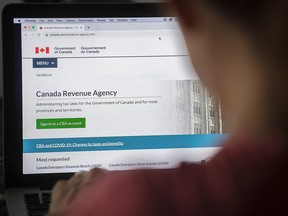
    A person looks at the Canada Revenue Agency homepage in Montreal.
    A person looks at the Canada Revenue Agency homepage in Montreal. Photo by Graham Hughes/The Canadian Press

    The husband and wife were each required to make instalments for the 2019 tax year because their net tax owing exceeded $3,000 in the previous three taxation years. They received written instalment reminders from the CRA, outlining the three instalment options.

    Rather than relying on the no-calculation option, the couple used the current-year method based on an estimate of their 2019 income and estimated tax owing. But in late November 2019, the couple’s holding company declared a dividend in the amount of $600,000, or $300,000 for each of them. They declared this dividend to themselves due to “budget chatter … concerning the possible alteration of (the) tax treatment of Canadian dividend income.”

    Advertisement 5

    Article content

    According to the couple, this pre-budget speculation “created an unforeseen urgency, necessity and desirability to declare the dividend.” This, in turn, “materially increased both (the couple’s) incomes and related tax liability, and correspondingly their respective tax instalments.”

    Although the taxpayers each paid large Dec. 15 instalments to make up for the discrepancy between the no-calculation and current-year options, the CRA assessed arrears interest and an instalment penalty for insufficient instalments in the first three quarters.

    In court, the taxpayers argued that no arrears interest should be applied to the amounts owing for the March, June and September instalments because they did not expect to incur a sudden influx of income later in the year at the time those quarterly payments were made. As a result, it would have been impossible to make payments based on unknown future information.

    Advertisement 6

    Article content

    The CRA argued that by not selecting the no-calculation option, and not paying the ultimate tax payable in equal instalments over the course of the year, the couple “authored a quarterly instalment deficiency divergent from the no-calculation option. As such, interest and the penalty … (were) correctly calculated and assessed.”

    The problem with the CRA’s position, according to the judge, was that “the only safeguard against factually unforeseen or unanticipated increases in income and (tax) liability in the latter part of the year, which skew instalments, is taxpayer choice in the early part of the year of the no-calculation option.” In other words, the no-calculation option essentially becomes the only safe option “unless clairvoyant taxpayer certainty exists.”

    Advertisement 7

    Article content

    The judge said there may be situations when a taxpayer could establish they had a probable reason to believe their total income for the year would be lower than the no-calculation option, and that the event which led to the resulting insufficient quarterly instalments was “beyond foreseeability and impossible to discern until occurrence.” This embraces the maxim “lex non cogit ad impossibilia,” or legislation cannot be interpreted to require the impossible.

    Advertisement 8

    Article content

    Unfortunately for this couple, the above maxim did not apply because they “were not asked to do the impossible.” Rather, they made a deliberate choice to declare the dividend, which was entirely within their control. The sizable year-end dividend was “a textbook, end-of-year provisional tax plan. It was neither unavoidable nor extraneously circumstantial.” In reality, the taxpayer “conceived, effected and completed it, all by his own hand and effort.”

    The judge, in dismissing the couple’s appeal and upholding the arrears interest and instalment penalty, concluded, “While the law may not interpret legislation to require the impossible, it does not accommodate a precautionary step of a tax plan, rendered moot by a legislative path not taken.”

    Jamie Golombek, CPA, CA, CFP, CLU, TEP, is the managing director, Tax & Estate Planning with CIBC Private Wealth in Toronto. [email protected]

    _____________________________________________________________

    If you liked this story, sign up for more in the FP Investor newsletter.

    _____________________________________________________________

    Advertisement

    Comments

    Postmedia is committed to maintaining a lively but civil forum for discussion and encourage all readers to share their views on our articles. Comments may take up to an hour for moderation before appearing on the site. We ask you to keep your comments relevant and respectful. We have enabled email notifications—you will now receive an email if you receive a reply to your comment, there is an update to a comment thread you follow or if a user you follow comments. Visit our Community Guidelines for more information and details on how to adjust your email settings.

    [ad_2]

    Source link

  • How do I invest my inheritance if I’m in a low income tax bracket?

    How do I invest my inheritance if I’m in a low income tax bracket?

    [ad_1]

    Article content

    By Julie Cazzin with Janet Gray

    Article content

    Q: I just sold five paintings from my parents’ art collection. Both my parents are deceased and left the paintings to my sister and I in their will. The money is more than I expected: a $350,000 windfall in total. Considering my parents only paid $10,000 for the art 30 years ago, the family did very well. But what should I do with the money?

    Article content

    I am 63 years old, earn $40,000 annually and will be retiring in the next year or two. I have a small pension that will pay me $1,500 monthly as well as $30,000 in a registered retirement savings plan (RRSP) and $60,000 in a tax-free savings account (TFSA). Also, I will be sharing the money 50-50 with my recently retired sister, who is collecting money from the Canada Pension Plan (CPP) and will be starting Old Age Security (OAS) soon. My assets are about $100,000. I have no real estate, no debt and no dependents. I know that $340,000 of the windfall is capital gains, but how do I minimize the tax I will pay on this while not jeopardizing my sister’s pension income of roughly $20,000 annually? — Lester

    Article content

    FP Answers: Lester, thank you for your question. The first thing to clarify is that your parents’ final estate paid all taxes owing on the value of the paintings at the time of their death. To calculate what, if any, taxes you might owe, you need to confirm the value of the paintings when you received them from the estate, and then the price received when you sold them. The difference between the base cost and the selling cost is the profit, of which 50 per cent is taxable at your marginal tax rate.

    Taxes owing on these capital gains are due in the year of sale, so if the paintings were sold in 2022, you would reconcile the profit on your 2022 tax return and pay taxes owing at your marginal tax rate at that time. Keep in mind it’s possible that both you and your sister may have to pay additional taxes if it causes an increase in your overall taxable income.

    Article content

    With your annual pension of $18,000, as well as your CPP and OAS benefits, your retirement income will be similar to your current working income. I see no benefit in adding more to your RRSP. Instead, consider opening a non-registered investment account to hold income and equity products.

    To help choose the investments, confirm your short-, medium- and long-term goals. If you have short-term goals, then you will want short-term liquidity and safety for those investments so you can use them relatively quickly. It’s a good idea to look at high-interest savings accounts for that money.

    If your goals include medium-term expenses, then choose guaranteed income certificates or other fixed-income products. For long-term goals, choose equity products for their higher growth potential

    Finally, I like to suggest that people who have received an inheritance use a portion of it to do something fun or special in the memory of their loved ones. This may be something you and your sister may like to do together.

    Janet Gray is an advice-only certified financial planner with Money Coaches Canada in Ottawa.

    _____________________________________________________________

    If you liked this story, sign up for more in the FP Investor newsletter.

    _____________________________________________________________

    [ad_2]

    Source link