
Here is a finding that surprises most people, including plenty of regular gym-goers. When researchers tracked nearly 1,900 older adults (aged 70-79) over three years, those who held on to their muscle mass, and even those who gained some, still lost strength. Leg strength declined about three times faster than muscle mass.
That gap matters because it tells you something the mirror does not. Legs can look much the same while the force they produce quietly drains away. It also explains why so much advice about ageing misses the mark. The question is not whether you are losing anything, because you are. The question is which losses you can do something about.
Some things are genuinely non-negotiable. Your maximum heart rate falls steadily with age, and a large analysis of more than 18,000 people found this happens at essentially the same rate whether you are an athlete or entirely sedentary. Training has little effect.
The same goes for much of the plumbing. With age, the large arteries thicken and stiffen as elastic fibres give way to collagen and calcium, which is why systolic blood pressure (the top number in a blood pressure reading) tends to creep up.
The heart’s early filling rate – how quickly it draws in blood in the first moments after each beat – drops by 30 to 50% between the third and ninth decades, though the upper chambers compensate. This means it is not the heart’s pumping volume that limits older people during exercise. It is the falling peak heart rate and the reduced ability of the working muscles in the arms and legs to pull oxygen out of the blood delivered to them.
Peak aerobic capacity, the amount of oxygen your body can use when working hard, declines alongside all this. The Baltimore Longitudinal Study of Aging found the decline is not steady: roughly 3 to 6% per decade in your 20s and 30s, accelerating past 20% per decade after 70. Sobering detail: that acceleration happened at much the same rate in active and inactive people alike.
Where you start from matters
So the rate of decline is largely fixed. What is not fixed is the level you decline from, and that is the whole game. A fitter 60-year-old and a sedentary one may lose capacity at similar rates, but they are falling from very different heights, and across three decades that is the difference between managing your stairs at 85 and not managing them at all. Strength, power, balance and reaction time are all in this category.
Muscle tends to be overlooked until it starts to disappear. From midlife onwards, people gradually lose muscle mass and strength. In some people, this becomes severe enough to be diagnosed as sarcopenia, increasing the risk of frailty, falls and losing independence.
The reassuring part is that muscle stays responsive into very old age. Resistance training reliably improves strength and physical function in people in their 70s, 80s and beyond. This matters particularly after the menopause, when falling oestrogen accelerates bone loss.
Progressive resistance training is one of the few interventions that loads bone and muscle at once, though it is worth being straight here: the evidence that it builds strength and bone density is considerably stronger than the evidence that it prevents fractures.
What counts as enough? The UK chief medical officers’ guidelines ask older adults to work on strength, balance and flexibility on at least two days a week. This is a sensible floor, but a vague one, which is why many people technically meet it while getting no stronger. The principle that matters is progression. If the last two or three repetitions of a set do not feel genuinely hard, the load needs to go up.
The fall-prevention paradox
It is tempting to assume that getting stronger stops you falling. The evidence is more specific.
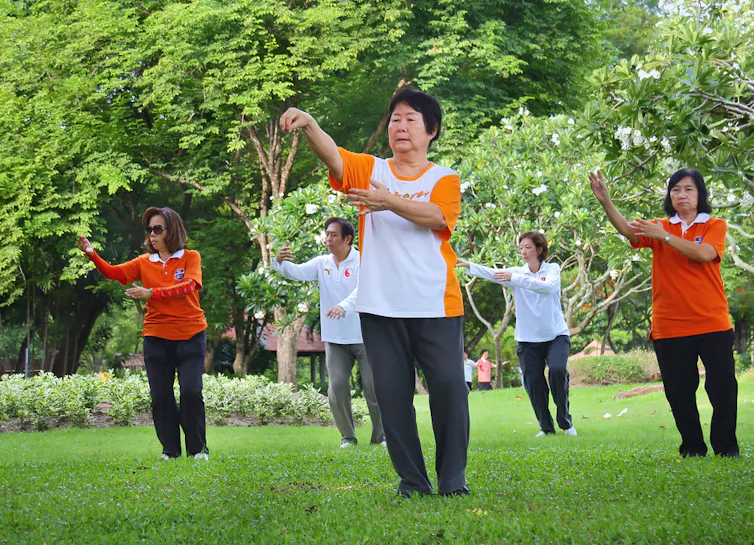
A review of 59 trials found exercise cuts the rate of falls by 23%. Exercises that improved balance and everyday movements were particularly effective, reducing falls by 24%. Programmes combining balance work with resistance training reduced falls by 34%, but programmes built mainly around resistance training had uncertain effects. Strength is necessary, but, on its own, it is not sufficient. You have to practise being unstable. Single-leg standing, heel-to-toe walking and tai chi can all help.
Kanjanee Chaisin/Shutterstock.com
What about stretching? Here the honest answer is that nobody really knows if it helps. A 2024 review looked at 29 studies and found small improvements in balance, but the evidence was weak. And when stretching was compared with other types of exercise, rather than with doing nothing, it showed no benefit at all. Only one of the long-term studies even included people over 65. Stretching might feel good and help you move more easily. But don’t rely on it to stop you falling.
Eccentric strength is a better bet. That’s when your muscles work to control a movement as they stretch out, like when you walk down stairs or slowly lower yourself into a chair. A meta-analysis of 19 trials found this type of training helped people stand up from a chair and walk short distances faster than conventional strength training did.
However, the study didn’t measure falls directly and rated its own evidence as only “fair” quality. Practising slow, controlled stair descents is a free way to train this – and many people can do this at home.
Training your reflexes
When you trip, your muscles don’t have time to build up to their full strength before you need to react – that build-up normally takes a moment. What saves you instead is speed: the ability to get a foot down in exactly the right place within a fraction of a second.
This turns out to be one of the most trainable things on the list. A meta-analysis of seven trials found that step training, whether practising rapid voluntary steps or recovering from deliberate trips and slips, cut the rate of falls by around half and reduced the proportion of people who fell by roughly the same margin. The results were remarkably consistent across trials.
Staying active is also linked to a roughly 20% lower risk of developing dementia. This link held up even in studies that followed people for more than 20 years. That matters because it makes it less likely the link is just backwards – that early, undiagnosed dementia caused people to become less active, rather than the other way round.
None of this needs a gym or an athletic history. It does need honesty about your starting point. The NHS advises speaking to a GP first if you have not exercised for some time or have health problems. That is sensible rather than discouraging, and for most conditions the answer will be yes, with adjustments. Anyone with diagnosed osteoporosis or a previous spinal fracture should get individual advice before adding impact work, such as hopping or skipping.
Begin below what you think you can manage and add a little each week. Standing up from a chair without using your hands is resistance training. Standing on one leg while the kettle boils is balance training. Taking the stairs is both.
The slope is real. Where you sit on it is largely up to you.

The authors do not work for, consult, own shares in or receive funding from any company or organisation that would benefit from this article, and have disclosed no relevant affiliations beyond their academic appointment.