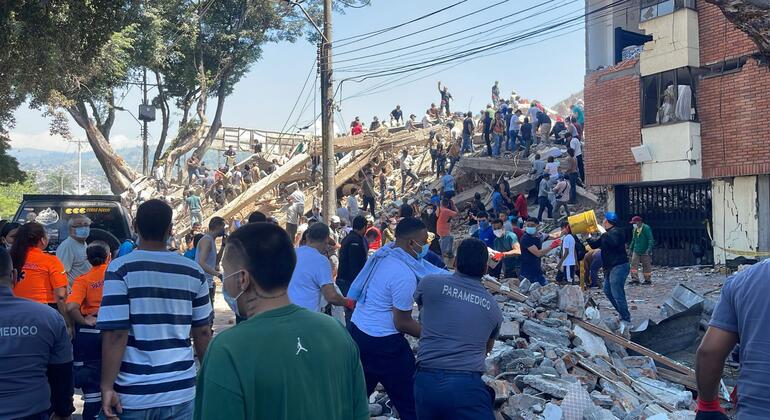
Official data indicated that 1,495 people have been injured and at least 126 died in Monday’s 7.4 magnitude quake, which flattened homes and buildings in the west of the country and caused landslides.
“Nearly 5,000 homes have been damaged and 387 have been destroyed; 61 buildings have collapsed and more than 550 educational institutions, 24 health facilities and more than 350 community centres have [been] affected,” said Jens Laerke, spokesperson for the UN aid coordination office, OCHA.
“Those are official Government figures, we know they are being updated as more information comes in.”
“There has not been any official request for international assistance,” he continued. “Should that happen, the entire UN system and, of course, humanitarians in particular stand ready to support with everything we’ve got.”
The UN system already has teams assessing the situation in the affected areas and is preparing, together with the Government, an initial emergency response meeting to determine needs and what assistance could be mobilized, according to the UN Resident Coordinator in Colombia, María José Torres Macho.
Listen to the top UN aid coordinator’s interview with UN News’s Laura Quiñones below:
Health needs
The UN World Health Organization (WHO) cited official Colombian data from late Monday indicating that damage has been reported in 24 health facilities across six departments.
Valle del Cauca department experienced the “most significant health infrastructure impacts” and particularly the city of Cali, said WHO spokesperson Tarik Jasarevic. Key facilities affected include Hospital Universitario del Valle, where part of a tower housing cardiology and paediatric services collapsed, and Clinica Nuestra, which was fully evacuated.
“Our office in the country in Colombia activated its emergency response and its field teams and teams have been deployed to affected areas, including Cali and Chocó, to support health sector assessment and coordination,” Mr. Jasarevic said, briefing journalist in Geneva.
The earthquake struck at around 7:34am local time, with its epicentre near San José del Palmar, in Chocó department, close to Valle del Cauca.
The tremor was felt across large parts of Colombia and in neighbouring countries, including Panama, Ecuador and Venezuela.
Biggest quake in decades
According to the Colombian Geological Service, the quake’s epicentre was at a depth of about 103 kilometres (64 miles), and was the largest seismic event recorded in the country this century.
Pereira, a city of around 500,000, lies about 35 miles from the epicentre. As emergency teams search for survivors, the city’s mayor reported 18 dead there late Monday.
In Cali, the country’s third largest city, authorities reported multiple landslides with people trapped and requested reinforcements for rescue operations.
Damage has also affected transport infrastructure including at six airports closed for inspections: Quibdó, Pereira, Manizales, Armenia, Cartago and Buenaventura. Popayán airport in Cauca is operating with restrictions owing to an unrelated alert for the possible eruption of the Puracé volcano.
The Government has activated emergency coordination centres in Bogotá, Quibdó, Armenia and Cali, while authorities continue rescue operations and assessments.
Evacuation orders were issued as far away as the capital, Bogotá, which is 250 miles east of San José del Palmar.
The UN Children’s Fund (UNICEF) is monitoring the situation and coordinating with partners and national authorities to assess needs and support affected children and adolescents, while the UN Development Programme (UNDP) is working with government institutions to help analyse damage and needs.
Miroslav Jenča, the head of the UN Verification Mission in Colombia, expressed solidarity with victims and affected communities, particularly in Chocó, Eje Cafetero and Valle del Cauca, and said the Mission was available to support the authorities’ response.