Boreal forest soils are home to diverse fungal communities that break down dead material from plants and fungi. Two key groups drive this process: ectomycorrhizal fungi, which partner with tree roots and receive carbon from trees in exchange for nutrients, and saprotrophic fungi, which break down dead material to acquire both carbon and nutrients. When forests are harvested, ectomycorrhizal fungal communities are disrupted by the loss of their tree partners (and their carbon source), but how they recover over time and what this means for carbon and nutrients stored in the soil remain poorly understood. We investigated whether leaving some trees standing during tree harvesting could help preserve both fungal communities and the carbon and nutrients stored in forest soils.
We studied a slow-growing, old pine forest in northern Sweden where different amounts of trees were left standing after tree harvesting. We had previously sampled this site three years after tree harvest and returned nine years later to follow the development of the fungal community using DNA sequencing and measure how much carbon and nitrogen remained stored in the soil organic layer.
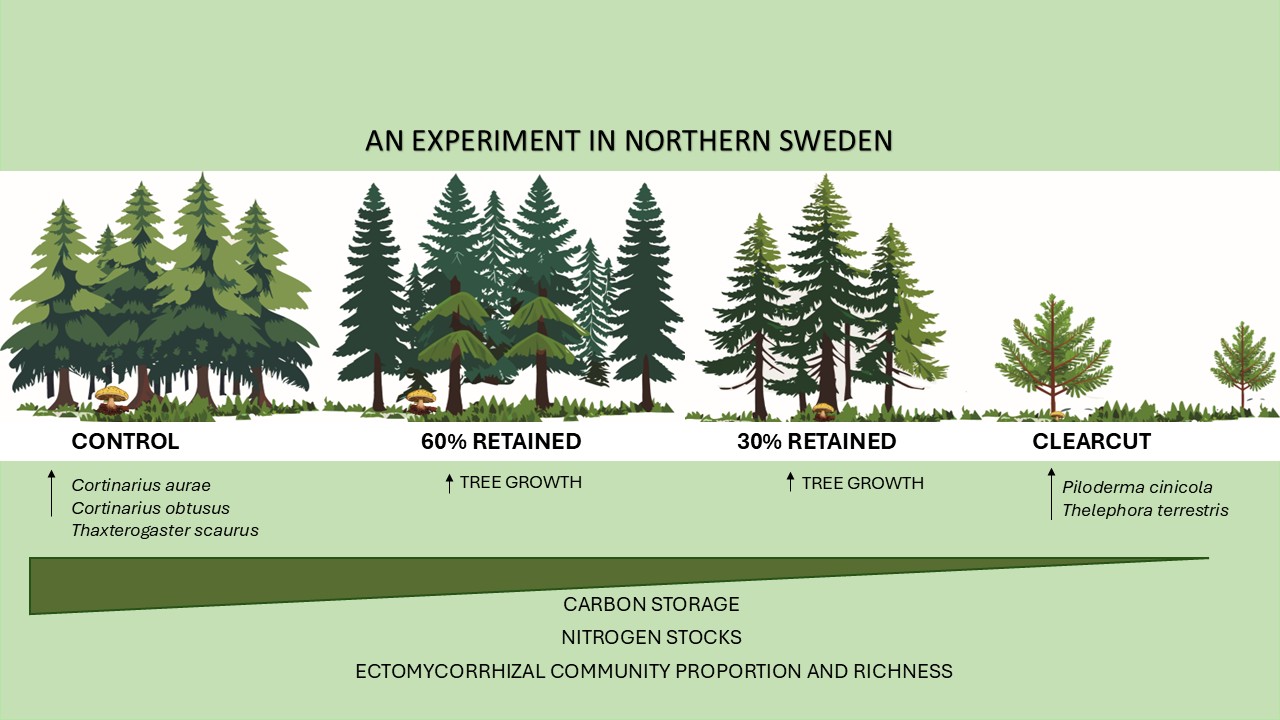
We found that fungal communities shifted substantially over 12 years, and forest stands where fewer trees remained had distinctly different fungal communities. Ectomycorrhizal fungi were strongly affected, particularly a subset of species with high decomposer capacity, which largely disappeared from heavily harvested areas. These shifts were not random: species appeared to be sorted by new environmental conditions created by tree harvesting, rather than disappearing by chance. Furthermore, soils in more heavily harvested areas lost more carbon and nitrogen, consistent with increased decomposition after tree harvesting.
We think that immediately after harvesting, the loss of ectomycorrhizal fungi allowed saprotrophic fungi to take over and accelerate decomposition, releasing stored nutrients that were taken up by surrounding trees and vegetation (although we did not measure an increase in saprotrophs 12 years later). Over time, this likely contributed to the measurable soil carbon losses. Retaining more trees during harvest buffered these effects by maintaining ectomycorrhizal fungal communities and better preserving soil carbon stocks, sustaining the carbon storage potential of forests.