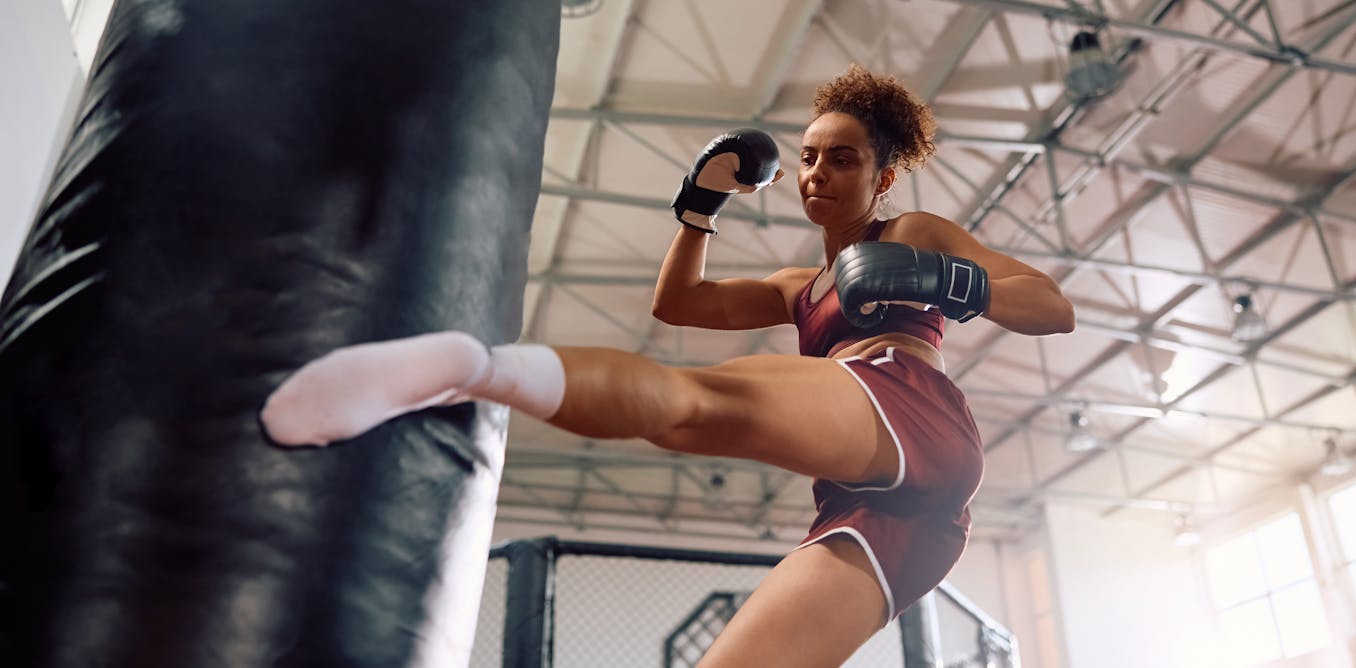
The White House is gearing up to host a UFC event as part of celebrations of 250 years of American independence. The fighters on the card are relying on body conditioning techniques that have been around for centuries to try to emerge victorious. Muay thai, karate and jiujitsu all use ancient practices that condition the body for their field.
The human body over time, and under the right stresses and strains, can become more resilient to physical and physiological challenges. One of the key scientific principles here is Wolff’s law – the idea that bone remodels itself in response to the loads placed on it. Studies have shown that in many sports the dominant limb develops denser bone than the non-dominant side. In martial arts, this effect is seen in both arms and legs.
In muay thai, fighters condition their shins by kicking banana trees – whose soft outer layers and substantial bulk make them ideal for the purpose. The repeated impact gradually adapts the tibia to the forces generated by kicking.
The tibia is the second-longest bone in the body. Like most bones in the body, it has a dense outer shell surrounding a cavity, crossed by tiny structural rods – a design that combines strength with minimal weight.
The thickness of the tibia is greatest at the points between 40-70% of its length from top to bottom, the outer (cortical) layer of bone is, on average, between 4-6mm thick in males and 3-5mm thick in females. No studies have directly compared tibia thickness in combat athletes and non-athletes. But in 2004, UFC fighter Shaun Strickland posted an X-ray image of his legs on Instagram showing noticeably thicker bone cortices – visible evidence of what years of shin conditioning can do.
Kick forces are high enough that opponents are warned against single-arm blocks – the impact can fracture the ulna, the longer bone in the forearm, which accounted for a quarter of all mixed martial arts (MMA) injuries in one study.
Even ancient traditions such as iron arm and wing chun, which exploit Wolff’s law to condition the forearms, may struggle to prevent these high-impact traumatic breaks.
Many athletes in combat sports also train their hands and arms. A popular way to do this is rice gripping: submerging hands in buckets of rice and performing various exercises against the resistance.
This works multiple muscle groups simultaneously, in ways that traditional gym exercises often deal with in isolation. As the forearms and finger muscles grow stronger, they pull hard on the bone, triggering Wolff’s law and causing bone to thicken.
Studies show that combat sport athletes have denser bones and more lean muscle in their limbs than both non-contact sports athletes and inactive people – evidence that this kind of training pays off both for delivering strikes and absorbing them.
Many people assume that combat sports require conditioning of the core muscles, such as the abdominal muscles to protect the organs from trauma. But this is only partly true. The other function is to increase the force generation, impact and accuracy of striking, as many striking blows initiated by the upper body start from the legs. Studies have shown that martial artists in a variety of combats improve in force, impact and accuracy from core strength training.
Not risk free
All this training has its risks. Even with gloves, fighters regularly damage the soft tissue and bones in the hands, these can be from a single heavy blow or repetitive strain or injury. For centuries, practitioners have used dit da jow liniment (bruise wine) in repairing the hands after combat.
One common injury is boxer’s knuckle, where the joint and tendons of the middle finger are damaged, causing inability to straighten the finger or snapping of the tendon across the bone. This knuckle is affected because it protrudes out the furthest in a clenched fist and is often the impact point.
It shouldn’t be confused with a boxer’s fracture, which sees the metacarpal of the little finger in the palm of the hand break due to impact trauma. A chain is only as strong as the weakest link, and in the hand it is always the bones of the little finger, because they don’t contribute the same weight in activities as their larger neighbours.
All this impact also affects the skin, which responds by thickening to protect underlying structures to present as knuckle pads. The skin in conditioned areas also adapts through neural desensitisation, where repeated exposure to painful stimuli causes the receptors in that area to recalibrate what they deem as a painful level of stimulus.
This is a well-studied area in conditions where small amounts of a stimulus cause a hyper-reaction. Strikes from combat or training to specific areas, particularly pressure points, can cause damage that can take years to heal.
For all the conditioning, whether using modern or ancient methods, the human body has its limits. There will always be weak spots. Women suffer more upper limb injuries, while men suffer more lower limb injuries. Head and neck injuries and their long-term effects are becoming a growing concern. If conditioning is something that you are interested in pursuing, slow and steady is the safest way to go, giving the body time to respond to what you are asking of it.

Adam Taylor does not work for, consult, own shares in or receive funding from any company or organisation that would benefit from this article, and has disclosed no relevant affiliations beyond their academic appointment.