Whether through TV crime dramas or cinema blockbusters about dinosaur theme parks, DNA is a staple of modern popular culture – its double-helix structure one of science’s most iconic visualisations.
Yet remarkably, the young Swiss scientist who discovered DNA in the first place is largely forgotten.
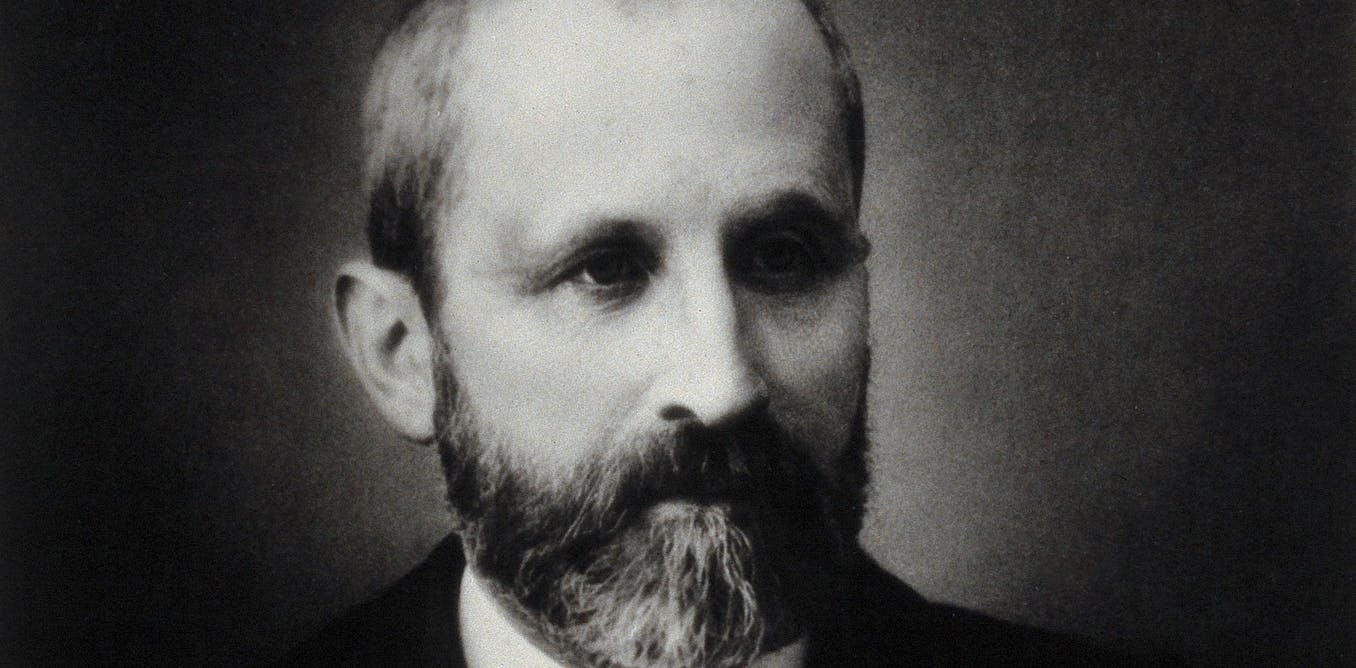
Born in Basel in 1844, Friedrich Miescher only began his career as a researcher after developing a hearing impairment that forced him to shelve plans to be a doctor like his father. Working in the medieval castle that overlooks the old German town of Tübingen, Miescher’s aim was a grand one – to uncover the chemical nature of life itself.
But his working environment was rather different to today’s molecular biology laboratories. The University of Tübingen’s conversion of the castle kitchens into laboratories appears to have involved little more than swapping pots and pans for beakers and alembics used for distillation.
Working in what he likened to the laboratory of a medieval alchemist, the first stage of Miescher’s research was the unsavoury task of scraping pus from discarded surgical bandages, obtained from the local hospital.

Paul Sinner via Wikimedia
Pus offered him a rich source of white blood cells, which were much easier to isolate and prepare than cells from solid human tissue. So, they were particularly well suited for analysing what molecules human cells are made of.
Over the winter of 1868-9, Miescher discovered a novel cellular substance with properties unlike anything else known at that time. Its chemical behaviour was significantly different to proteins, which were by then understood to be key structural and functional components of cells.
Unlike proteins, Miescher’s substance was rich in the element phosphorus. Observing that it was found almost exclusively within each cell’s nucleus, he called it “nuclein” – a term that was largely retained within its modern name of deoxyribonucleic acid, or DNA.
Little was known about the functions of the cell’s nucleus at the time, although several biologists suspected it to be central to cell growth and division. Miescher was convinced that nuclein must be closely involved in these processes.
He announced the discovery of DNA in 1871 in a paper titled On the Chemical Composition of Pus Cells. While it hardly sounded (or indeed read) like a page-turner, his studies of pus would prove a landmark moment in the history of science.
Nearly a century later, it led to the Nobel-winning discovery of DNA’s double-helix structure. The date of that landmark paper by James Watson and Francis Crick is now marked each year on April 25 as DNA Day. Yet Miescher’s contribution is largely unacknowledged.
From pus to salmon
The Swiss scientist’s move back to his home town in 1871 brought him a rich new source of nuclein that meant no longer having to scrape pus from old bandages.
Each year, salmon swim from the North Sea to their breeding grounds in the upper Rhine river, where the city of Basel is located. In preparation for mating, the male salmon’s testes grow massively and become laden with DNA.
Rising in the dark and cold of a winter morning, Miescher would walk down to the banks of the Rhine to catch salmon, then extract their DNA in his laboratory. This image gave us the title of our biography of Miescher, The Dawn Fisherman, to be published in June 2026.
This series is dedicated to lesser-known, highly influential scientists who have had a powerful influence on the careers and research paths of many others, including the authors of these articles.
The intensity with which Miescher carried out his research was formidable. One of his students recalled that, on the day of Miescher’s wedding, friends had to drag him from his lab bench to attend the church.
His commitments grew. As well as researching Rhine salmon for the local fishing industry, Miescher worked for the Swiss government to improve the diets of prison inmates. And after founding Basel’s first institute of anatomy and physiology in 1885, there were the growing administrative burdens of being its director.
All these commitments brought a growing sense of frustration that he was spending less time on DNA. Looking to classical mythology for images of futility and despair, Miescher compared himself to rolling the boulder of Sisyphus up the mountain.
These strains took their toll on his health. In 1890, having contracted tuberculosis, he became a resident at a sanatorium in the alpine resort of Davos.
A second great insight
But during the final years of his life there, Miescher had his second great insight. Citing Charles Darwin’s speculations about the mechanism of heredity, Miescher proposed that the variation in biological traits of all living organisms might arise through variation in the physical structure of a large molecule – which he thought was most likely to be a protein.
Limited by the concepts and methods of his time, Miescher did not make the connection that nuclein (DNA) was, in fact, this very molecule.
He died in 1895 aged 51, burdened by a painful sense of failure and opportunities missed. “I will never know the happiness that belongs to the man who has lived up to their station in a harmonious way to the satisfaction of themselves and others,” Miescher wrote.
But his former mentor, the distinguished physiologist Carl Ludwig (1816-1895), was more confident that the achievements of his protégé would one day be recognised. “However often the cell will be studied and examined during the centuries to come,” he assured Miescher as he lay in the Davos sanatorium, “the grateful descendants will remember you as the ground-breaking researcher”.
Ludwig’s prediction turned out to be only partly accurate. DNA-based technologies have transformed what we understand about life and disease. Yet Miescher is scarcely acknowledged as the scientist whose pioneering work led to them.
This article features references to a book that have been included for editorial reasons, and contain links to bookshop.org. If you click on one of the links and go on to buy something from bookshop.org The Conversation UK may earn a commission.

The authors do not work for, consult, own shares in or receive funding from any company or organisation that would benefit from this article, and have disclosed no relevant affiliations beyond their academic appointment.