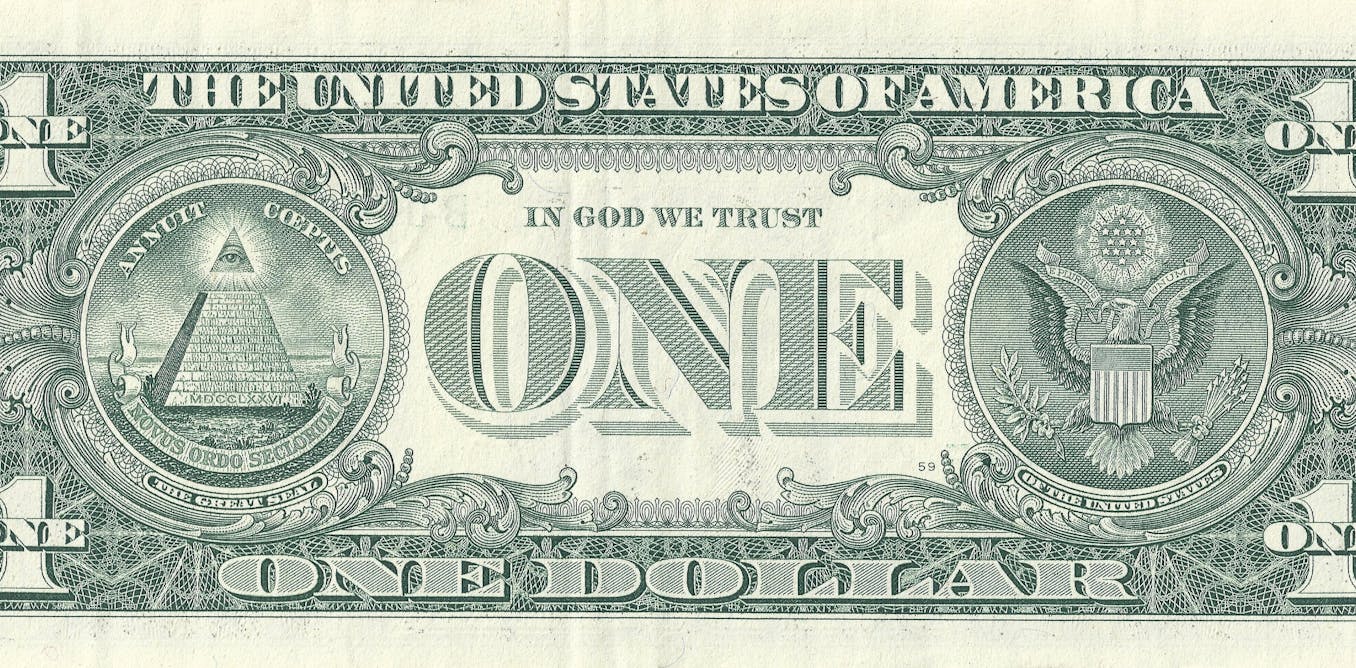
On the back of every dollar bill, the phrase Novus Ordo Seclorum (“New order of the ages”) hints at the principle guiding the US’ new security strategy.
The attack on Venezuela and the capture of President Nicolás Maduro herald the decoupling of Trump’s United States from the rules-based international order, and the end of liberal order as a whole. A new international order is now emerging, based on the use of force, revisionism and security on the American continent.
Here are five keys to understanding the outcomes of the military intervention, and the new order it ushers in.
1. Expanded presidential power
The attack cements the new doctrine of an imperious president, one who executes orders without waiting for congressional approval, legal validation or media opinion.
With checks and balances weakened, the second Trump administration is free to present the new order as a question of urgent security: with the US at war against drug trafficking (or migration) and threatened by “new powers” (a euphemism for China), it has no need to respect proper procedures or timelines.
Trump identifies himself with historic, founding American presidents like Washington, Lincoln and Roosevelt. All three were charismatic leaders, and with the 250th anniversary of the US republic approaching such comparisons feed into Trump’s authoritarian rhetoric.
Erosion of the US political and legal system is undeniable. The president has approved an extensive package of regulations that promote emergency powers, a permanent state of crisis, and suppression of political opposition and the judicial system. The attack on Venezuela is yet another milestone in the reconfiguration of the presidency’s relations to the legislative and judicial branches of power, in line with the Hamiltonian tradition of a strong and unifying executive branch.
Read more:
Trump sees himself as more like a king than president. Here’s why
2. (Latin) America for the (US) Americans
On the international stage, the attack on Venezuela advances a diplomatic agenda that is rooted in the defence of national interests. The concept of “America for the Americans” has made a strong comeback: Panama, Mexico and Canada have all been made to bow to Trump’s will, while the administration continues to push for control of Greenland.
In Latin America, Brazil and Colombia’s left-wing governments lead regional opposition to the US, while Chile’s newly elected José Antonio Kast and Argentina’s Javier Milei are Trump’s ideological allies. The continent as a whole is witnessing a broad shift towards nationalist, right-wing parties that oppose migration.
If Venezuela’s post-Maduro transition aligns with these values, any hope for national unity and a peaceful transition to full democracy will disappear.
Read more:
American dominance is not dead, but it is changing — and not for the better
3. Control of resources
Once again, it’s all about oil, but for different reasons than in Iraq. In a world where globalisation has shifted to geoeconomics, the United States wants to project its power in international energy markets and regulation. Venezuela’s infrastructure, ports and minerals are key to making this happen.
The US therefore doesn’t just want Venezuelan oil to supply its domestic market – it also wants to impose international prices and dominate supply. Its new vision aims to align energy sovereignty and technological development with trade and security.
Pax Silica – the international US-led alliance signed at the end of 2025 to secure supply chains for critical technologies such as semiconductors and AI – ushers in an era of transactional diplomacy: computer chips in exchange for minerals. For the “new” Venezuela, its oil reserves will allow it to participate in this new power dynamic.
Read more:
Why is Trump so obsessed with Venezuela? His new security strategy provides some clues
4. Geopolitical realignment
The American view of territory fuels a revisionist foreign policy based on sovereignty – similar to those of China, Israel, or Russia – which is rooted in the concept of “nomos”, as defined by mid-20th century German philosopher Carl Schmitt. This is a worldview where the division of nations into “friend or foe” prevails over a liberal worldview governed by cooperation, international law, democracy and the free market.
Under this logic, spheres of influence emerge, resources are distributed, and power blocs are balanced, as the above examples demonstrate: without opposition, China would dominate Southeast Asia, Russia would scale back its war in exchange for 20% of Ukraine and control over its material resources and energy, and Israel would redraw the map of the Middle East and strike trade agreements with neighbouring countries.
5. Europe, democracy and Hobbes
Ideals like democracy, the rule of law and free trade are fading fast, and without effective capacity, things don’t end well for the European Union. As we have seen with Gaza, the EU often has strong ideological disagreement with other major powers but doesn’t command enough respect to do anything. The US’ military intervention revives Hobbesian political realism, where freedom is ceded to an absolute sovereign in exchange for peace and security.
In Trump’s new order, it is presidential authority – not truth, laws or democratic values – that has the final say.
US domestic politics
2026 is an election year in the US, with 39 gubernatorial elections and a raft of state and local elections to be contested between March and November.
Through its actions in Venezuela, the Trump administration is effectively debating its model for succession. One faction, led by JD Vance, wants to avoid problems abroad and to renew the industrial economic model. The other, led by Secretary of State Marco Rubio, is committed to rebuilding the international order with a strong and dominant US. The outcome of the Venezuelan operation may tip the balance, and could determine Trump’s successor in the 2028 presidential elections.
The attack on Venezuela is not just an intervention in the region: it also reflects the changing times in which we live. While international Trumpism was previously confined to disjointed slogans, it has now taken its first step into military strategy. Gone are the days of soft power, transatlantic relations and peace in Ibero-America. A new order is being born.