
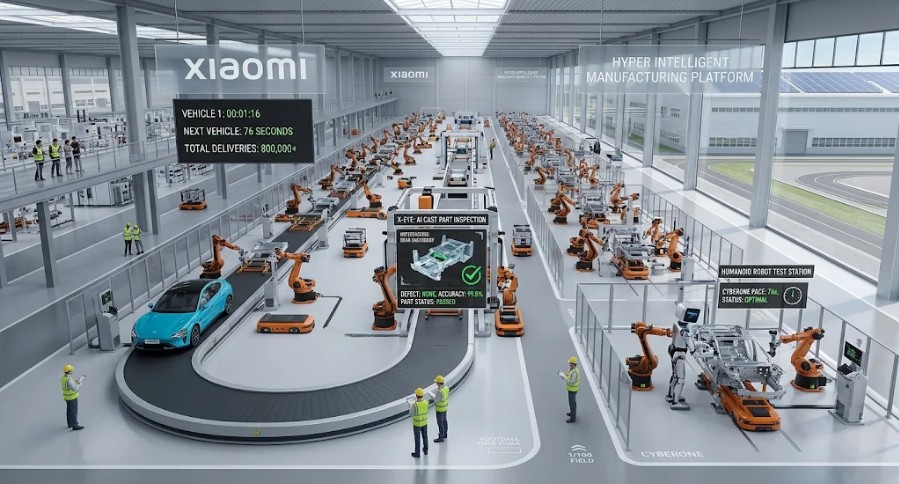
BEIJING — Tech giant Xiaomi has reached a landmark 800,000 electric vehicle (EV) deliveries just 29 months after handing over its first production car. The rapid scaling of the company’s automotive division highlights a major shift toward software-defined, hyper-automated manufacturing in China’s competitive EV market.
At full operating speed, Xiaomi’s 720,000-square-meter Beijing EV plant rolls off a finished vehicle every 76 seconds.
Inside the Beijing Hyper-Factory: Automation at Scale
The facility relies heavily on automated assembly and real-time artificial intelligence to maintain high throughput. Over 700 specialized industrial robots manage key assembly stations, material handling, welding, and structural joining across the line.
Xiaomi EV Beijing Plant: Key Operational Metrics
+--------------------------------------------------------------------------+
| PRODUCTION SPEED: One finished EV off the line every 76 seconds          |
| TOTAL DELIVERIES: Passed 800,000 units within 29 months of launch        |
| ON-SITE ROBOTICS: Over 700 specialized industrial robots active          |
| QUALITY ASSURANCE: X-Eye AI system delivers 99%+ cast part accuracy      |
| WORKFORCE REDUCTION: ~40%–50% fewer floor workers than traditional plants |
+--------------------------------------------------------------------------+
AI Quality Control and Humanoid Robot Pilots
Quality assurance is anchored by Xiaomi’s proprietary X-Eye visual inspection system. Mounted on robotic arms, the AI-driven X-ray system analyzes large hyper-cast underbody components. By scanning large single-piece castings, X-Eye detects structural micro-defects with an accuracy rate exceeding 99 percent.
In a milestone deployment for physical AI, Xiaomi tested its home-grown CyberOne humanoid robot directly on the active assembly line. Operating at a station responsible for part sorting and precision fastening, the bipedal robot successfully kept pace with the factory’s strict 76-second cycle time, proving that general-purpose humanoid robots can execute constrained, high-speed industrial assembly tasks alongside automated guided vehicles (AMRs).
Workforce Reductions and Sector-Wide Implications
The deployment of hyper-casting, self-optimizing software platforms, and automated inspection has significantly altered labor requirements on the factory floor.
Industrial Automation: Labor & Industry Impact Analysis
+--------------------------------------------------------------------------+
| ON-SITE FLOOR IMPACT                                                     |
| * Reduces direct assembly line labor requirements by an estimated        |
|   40% to 50% compared to legacy automotive plants.                       |
| * Replaces manual welding, physical measurement, and visual inspection   |
|   with robotics and autonomous software monitoring.                      |
+--------------------------------------------------------------------------+
| WIDER MANUFACTURING SECTOR EFFECTS                                       |
| * Shifts labor demand toward robotics engineering, AI model training,    |
|   and system maintenance rather than manual repetitive tasks.            |
| * Compels legacy automakers to accelerate capital expenditure in heavy   |
|   automation and software-defined manufacturing models.                  |
+--------------------------------------------------------------------------+
Floor Labor Disruption
Industry analysts estimate that hyper-automated plants like Xiaomi’s require 40% to 50% fewer direct assembly line workers than traditional automotive facilities. High-volume tasks historically performed by humans—such as structural spot-welding, dimensional laser audits, and preliminary casting inspections—are now fully autonomous.
Ripple Effects Across Manufacturing
Xiaomi’s speed-to-market and low unit-assembly times are accelerating pressure across the global automotive sector. Traditional OEMs and regional suppliers face mounting pressure to upgrade existing infrastructure or risk losing cost competitiveness to software-first tech companies entering vehicle production.
While hyper-automation reduces direct factory floor headcount, economic analysts emphasize that it reshapes rather than eliminates industrial employment, spurring demand for skilled technicians, software engineers, and robotics maintenance specialists across the broader industrial ecosystem.
Hyper-automation shifts human roles from manual assembly to technical oversight, driving operational efficiency while structural die-casting cuts production time by 45% and eliminates 840 welded joints. Although high-volume automation reduces direct assembly floor labour by an estimated 40% to 50%, it accelerates demand across the industrial ecosystem for software engineers, robotics specialists, and data analysts. As manufacturers balance these labour shifts against capital investment, software-driven factories like Xiaomi’s set a new benchmark for assembly speed, structural optimization, and long-term cost competitiveness.
The above is a direct shift from another earlier article we published that stated that AI adaptation will shift work demographics towards handworks more, it shows that the accompanying shift has to be researched and measured sector by sector and the changes are not generic in nature, however it supports the assumption and facts that the future of work will simply shift and become more efficient due to AI and Automation rather than cause huge layoffs and higher employments.
Xiaomi’s 720,000 square meter Beijing EV plant AI Generated Picture









