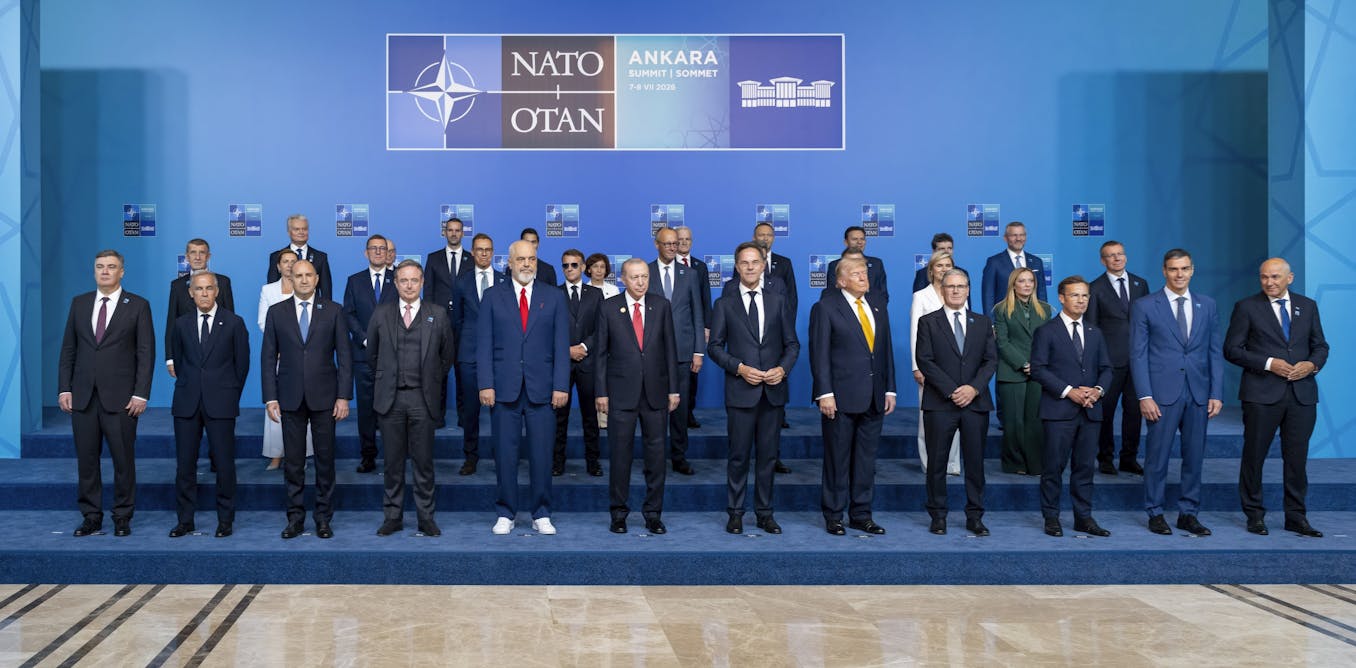
For the US’ allies, Nato summits have largely become a matter of damage control and evading the wrath of Donald Trump. With Washington’s support no longer a given, the special relationship between the US and the European Union (EU) is under increasing strain.
The recent Nato summit, held on July 7-8 in Ankara, Turkey, took place without any prospect of a ceasefire in Iran or Ukraine. As things stand, both conflicts are ongoing, proof that the US’ powers of deterrence are not as great as previously thought.
The latest summit was thus little more than a tactical readjustment, one that barely managed to renegotiate burden-sharing agreements, particularly with regard to Ukraine.
For Europe, the result is that it remains lost. Unlike Nato Secretary-General Mark Rutte, the continent continues to resist (or defy) Trump. However, it is also unable to make progress towards federal integration – a vital step towards building its own defence capabilities.
Trump’s threats
Trump’s continued, baseless threats to annex Greenland and moves to withdraw troops from Europe have antagonised key European leaders.
The Ankara summit should have served to improve relations between the US and its European allies, but it has failed to effectively address the damage of previous meetings. Trump does not embrace multilateralism, and instead relies entirely on his country’s indisputable military superiority.
What Trump wants is a change in the global order, in order to assert his country’s hegemony more forcefully and contain China, his true obsession. His main grievances are still Europe’s lagging military spending, and the lack of unconditional support from Nato partners in the war against Iran.
He has two main demands. First, that European nations increase their military spending to 5% of GDP (a target not even the US itelf currently meets). Second, that they purchase the bulk of their weapons from the US. Under this pressure, Europe has two options: give in, as Mark Rutte has done, or strive for true autonomy.
Read more:
Europe’s rearmament is moving fast – it must not overlook these three vital areas
No European defence without integration
The truth is that Europe neither wants to go it alone, nor is it able to do so. There are fears that Washington might pull out of Nato, but this scenario is highly unlikely. It would run counter to US strategic interests, and would entail major political and legal difficulties.
However, the alternative is Europe taking steps towards its own federal integration. It has not proven capable of doing this.
If the EU aspires to be a global geostrategic player – and even one day establish a European army – the logical next step would be to complete the political process of integration. Europe has the theoretical solution (something akin to a “United States of Europe”), but is neither willing nor able to put it into practice because most national elites and public opinion are not on board.
Under the circumstances, the only realistic aspiration is a more European NATO 3.0, with greater responsibilities in Europe and the surrounding area.
Russian attack is unlikely
Russia has become the main pretext for justifying Europe’s unprecedented rearmament drive. However, the threat to Central Europe and the Baltics is remote. More than four years of war in Ukraine have taken an enormous military and economic toll on Russia, and Vladimir Putin is currently in no position to launch a direct attack on any Nato country.
The Russian economy is showing clear signs of recession. If it has been unable to capture Kyiv in this time, it is unthinkable that it could occupy Warsaw or the Baltic capitals.
There are other possibilities, such as the “Narva scenario”, where the Estonian border city of Narva becomes a “grey zone” of conflict. Another is the possibility of Russia closing the Suwalki Corridor, a strip of land that runs between Poland and Lithuania, generally viewed as the most vulnerable point in Europe’s security architecture.
By closing the Suwalki corridor, Russia would test NATO’s Article 5 (whereby an attack on one member is an attack on all), but in reality, both of these strategic options pose too many risks and thus seem highly unlikely.
Nevertheless, Trump has pressed European governments to increase their military budgets. However, the issue is not that the EU spends too little on defence (it actually contributes over 50% more to Nato than the US), but that national fragmentation means it spends inefficiently.
Read more:
We asked Ukrainians what they think of Trump – more view him as an enemy than a friend
Divided defence spending
The current strategy runs entirely counter to European sovereignty because the perspective taken is always a national one. The ReArm Europe programme does not provide for effective integration in arms production, let alone a unified, continent-wide military force of any kind.
The failure of the European FCAS fighter is a prime example of how misguided national interests are undermining Europe’s interests.
The US and the EU share the aim of limiting Russian influence across Ukraine as much as possible. The goal is not the sudden collapse of Putin’s regime – this would be an extremely unpredictable outcome – so Western aid enables Ukraine to hold out but not win. The Russian threat offers an excuse to justify rearmament, and a mechanism has been put in place whereby the EU buys weapons from the US to pass them on to Ukraine.
Western military aid to Ukraine is therefore contingent on Western strategic calculations. Ukraine is paying a heavy price for this, and has had to make many economic concessions. The good news for Ukraine in all this is that it has now become a major player in drone manufacturing, and has been granted a license from Trump to produce Patriot missiles.
A weekly e-mail in English featuring expertise from scholars and researchers. It provides an introduction to the diversity of research coming out of the continent and considers some of the key issues facing European countries. Get the newsletter!