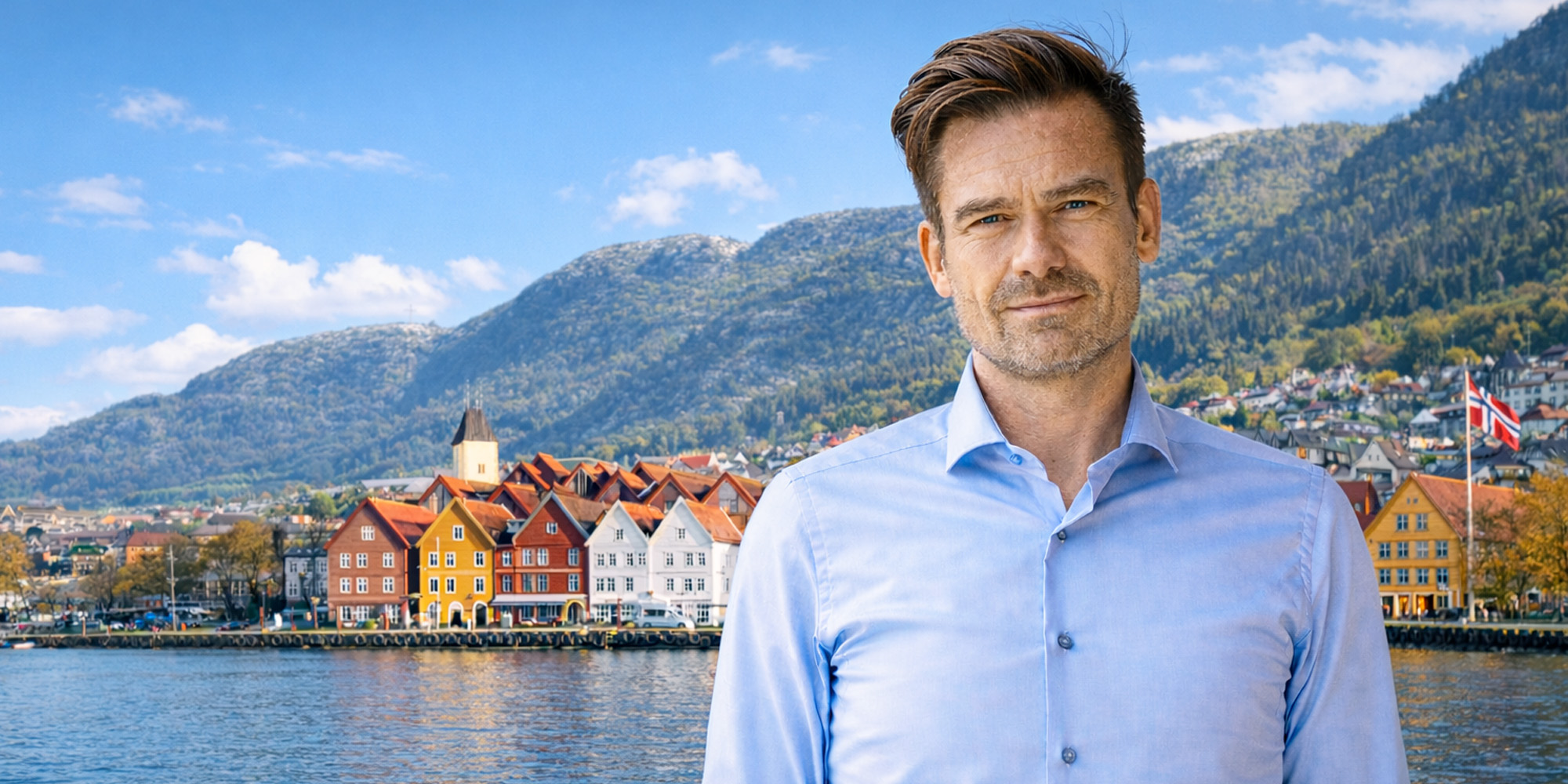
Norway has had a wealth tax for more than 130 years – and it still enjoys broad public support today. In this interview, Roger Bjørnstad, chief economist of the Norwegian Confederation of Trade Unions, explains why. He talks about disinformation campaigns run by wealthy opponents and about the shift in media coverage, as outlets ultimately decided to expose these campaigns ahead of the parliamentary elections in September. Bjørnstad also explains why billionaires’ threats to leave the country are misleading, why the wealth tax is good for the economy and for jobs – and what other countries can learn from it.
Without a wealth tax, the super-rich in Norway would often pay no taxes at all
Kontrast: Norway has had a wealth tax for more than 130 years. How is it perceived by the population today?
Roger Bjørnstad: It is indeed discussed a lot, especially in the run-up to the last elections, when it was a major topic. The debate was quite intense, but in the end the left-wing camp won the election. This is seen as support for the wealth tax, because it was such a central part of the electoral confrontation. Overall, the wealth tax is therefore viewed positively by the population, even though there are points where we as a trade union would consider adjustments to be sensible. The wealthy, however, have not given up hope of reducing the tax or abolishing it altogether—after all, as inequality has risen and untaxed capital income has led to accumulation of lots of wealth, the super rich pay high wealth tax even if their total tax bill is still relatively small.
The basic problem is this: capital income is difficult to tax. In Norway, dividends and profits are taxed—but mainly when they actually reach private individuals. Very wealthy people avoid this by parking their wealth in holding companies. As long as the money remains there, no private income tax is due. In this way, enormous amounts of wealth accumulate in these companies over the years. The only tax they pay on this is the wealth tax. The more wealth is held there, the higher the wealth tax naturally becomes. This is one of the main reasons for the debate in Norway.
I do think, however, that the wealth tax has broad support overall—precisely because the rich pay hardly any taxes on their capital income. For them, the wealth tax is often the only tax they pay at all.
The media played an important role and changed their stance during the election campaign
Kontrast: What role have the media played in the debate and in the positive perception of the wealth tax?
Roger Bjørnstad: The media played an important role in the election campaign. Very wealthy people financed large campaigns. At first, some media outlets supported these campaigns and adopted their messages.
Over the course of the debate and ahead of the election, however, many media outlets changed course and began to actively counter the disinformation surrounding the wealth tax. They played an important role in exposing false claims made by these campaigns.
Kontrast: Why do you think the media made this change in direction?
Roger Bjørnstad: Because the disinformation was extreme and was clearly financed by super-rich individuals. There was an attempt to create the impression that the wealth tax affects ordinary people—which is simply not true. I believe the media realized that these false claims needed to be corrected.
Kontrast: This argument is also very widespread in Austria, even though the models being discussed clearly affect only the super-rich…
Roger Bjørnstad: Exactly. That is why we set up a task force in Norway that could respond immediately to false information. It consisted of experts and researchers and was therefore very credible—and it was funded by the trade unions.
This task force sent targeted corrections directly to the media. That was very effective.
A right-wing government abolished the inheritance tax
Kontrast: Apart from Norway, only Spain in the EU still has a wealth tax, but many countries have an inheritance tax. Norway abolished the inheritance tax in 2014—why?
Roger Bjørnstad: That was a right-wing government. The inheritance tax at the time partly affected ordinary people and therefore had little support. It was poorly designed. The government used this to abolish it.
Kontrast: Two years ago, the social-democratic government increased the wealth tax. Why did it decide to do so?
Roger Bjørnstad: To finance the budget—and because it had become clear how extreme wealth concentration is and how little tax the super-rich pay. The wealth tax is the only tax that really affects them. This increase is probably one of the reasons why the super-rich later financed these campaigns.
How Norway’s wealth tax works
- All Norwegians with net wealth of more than €150,000 (NOK 1.76 million) pay a wealth tax. For couples, the exemption threshold is doubled. Debts are fully deducted.
- Overall, the tax amounts to about 1.1% per year — around 0.525% goes to municipalities, and 0.475% (0.575% for very large fortunes) goes to the central government.
- Wealth mainly includes real estate, shares, and business equity stakes. Valuation is based on market value, but in some cases there are substantial valuation discounts, i.e. reductions: up to -75% for the primary residence, -30% for business assets, and -20% for shares.
- It is collected through an annual electronic tax return, much of which is already pre-filled by banks and insurance companies. If irregularities are found, documentation may be required or penalties imposed.
- For the state, this generates around €2.7 billion per year.
Taxes on the rich are good for the economy, they work, and they are easy to implement
Kontrast: A common argument is that high wealth taxes cause rich people to leave the country. What do your experiences show?
Roger Bjørnstad: I believe that this is a wrong analysis. In reality, it is about the enormous amounts of wealth in their holding companies. The actual reason for their relocation is the high dividend tax on private distributions, not the wealth tax.
The dividend tax applies as soon as they withdraw the money for private use. These people want to get the money out of their holding companies without paying dividend tax—and they use the attack on the wealth tax as a pretext to support a right-wing government that also lowers the dividend tax.
Studies clearly show, however, that the wealth tax harms neither investment nor employment. And even if rich people leave the country, the capital remains in Norwegian companies.
Kontrast: In Austria one often hears that the wealth tax does not work, is difficult to implement, and harms the economy. What do you say to that?
Roger Bjørnstad: That is not true. Studies show that it is even good for the economy and for jobs, because it promotes investment instead of allowing large fortunes to lie unused in accounts or in safe assets.
And as for administration: that is not a problem at all. We have comprehensive tax reports. Banks and institutions automatically report assets. Real estate is valued in a standardized way. The system already exists—you just have to use it.
Kontrast: Opponents of a wealth tax say that it is impossible to control what the super-rich own—for example artworks or luxury watches.
Roger Bjørnstad: That is irrelevant. What matters are real estate and company shares. No one is interested in living-room furnishings. This argument is pure distraction.
The super-rich finance parties and campaigns against wealth taxes
Kontrast: Why, then, have so many countries abolished their wealth tax?
Roger Bjørnstad: Taxes are never popular. And today the super-rich are more strongly involved in politics, financing parties and campaigns—we see this, for example, in the United States. That makes the situation politically difficult.
Kontrast: What advice would you give to countries like Austria?
Roger Bjørnstad: You have to make visible how little tax is actually paid on capital income. The wealth tax is not an end in itself, but a consequence of this. If opponents can propose fair taxation of capital income—fine. If not, then a wealth tax is necessary.
The rights to the content remain with the original publisher.
Post Views: 294