Christian Ammer, University of Göttingen, discusses his article: Get out of the starting block quickly—Small initial differences in seed and seedling size affect tree survival and growth over 25 years
A race spanning decades—who will win?
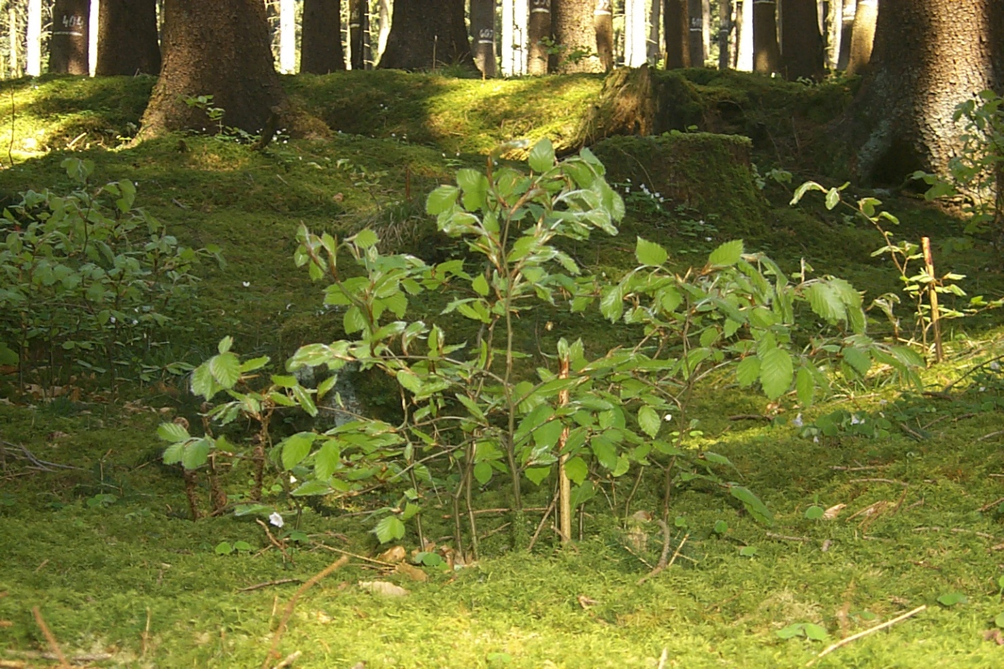
When seeds fall from old European beech trees during a mast year, several hundred thousand seedlings can sprout across an area of one hectare in autumn. Returning a few years later, there are significantly fewer of those plants remaining because the basic resources—such as light, water, and nutrients—are not sufficient for so many plants as they grow larger. It has been known for decades that this process of self-thinning in even-aged cohorts follows mathematical laws. Less clear, however, is the question of which of the many seedlings produced in a single year will ultimately manage to prevail. Interestingly, by the end of the very first growing season, some seedlings are a few centimetres taller than others. Given the longevity of trees, such tiny initial differences surely have no long-term significance —or do they?
Watching trees growing: Patience needed!
We studied the survival and growth of over 2,000 seedlings that had been germinated in the course of an experiment dealing with direct seeding of European beech under the canopy of mature Norway spruce trees. We examined the beech seedlings in 324 plot circles, each 0.5 m² in size. In these plots, we numbered all seedlings and recorded—initially annually and later every five years—which of those seedlings had survived and how much they had grown in terms of shoot length and diameter.
Just like in the ABBA song: “The winner takes it all”
The results of our observation were astonishing. The seedlings that were slightly taller than their immediate neighbours in the year of germination had a statistically significantly higher probability to survive than the other seedlings, even after 25 years. Once size differences had emerged, they increased from year to year and cemented the dominance structure within the cohort reflecting the classic case of asymmetric competition. Thus, larger plants not only received more resources due to their greater size and higher leaf number, but also by shading the other seedlings and leaving them with a disproportionately small share of resources.
How to become the largest seedling: Be a heavy seed
In a supplementary greenhouse experiment, we tested whether seed weight could explain the differences in seedling height after the first growing season. Surprisingly, we found a positive correlation between seed weight and seedling height. The curve follows a saturation relationship, meaning that instead of “the heavier the better”, being sufficiently heavy helps.
It remains exciting how the situation may change in a changing climate
Our study has shown that advantages in competition and survival appear early for these seedlings. However, whether these are also the individuals that prove to be the most resilient in the face of climatic extremes is to be tested.