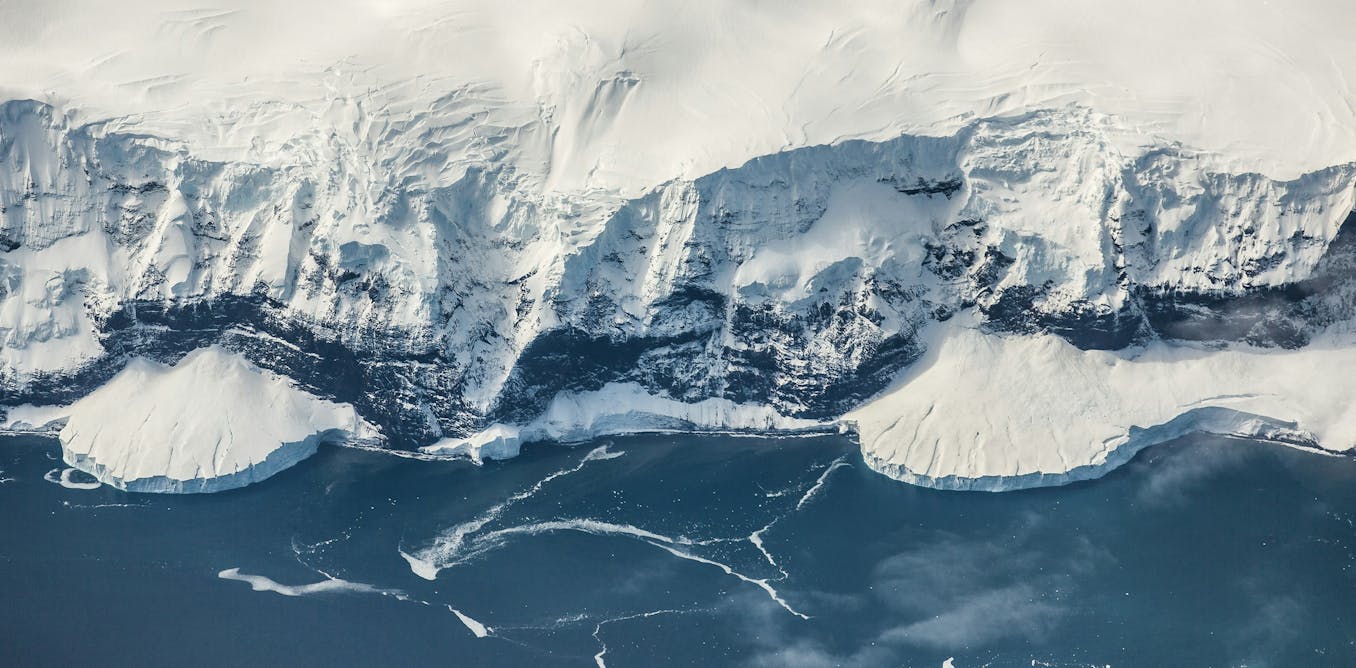
East Antarctica hosts the largest ice sheet on Earth, containing enough water to raise global sea levels by 52 metres, were it to fully melt. Yet it has puzzled scientists for decades how and why this ice sheet formed.
In fact, there are two interlinked mysteries. First, Antarctica became covered in ice around 34 million years ago – a period known as the Eocene-Oligocene transition – while the Arctic region stayed largely ice-free for another 25 million years or so.
Carbon dioxide levels in the atmosphere were falling dramatically at the time, and played an important role in falling temperatures. But if that was the sole factor behind the transition, both poles should have cooled together. They didn’t.
This means that something else was probably giving Antarctica a head start.
The second mystery is that sea-surface temperatures in the Southern Ocean remained unexpectedly warm for 10 million years or so after the East Antarctic Ice Sheet formed. This is not what we’d expect to see if the ice sheet had formed purely in response to global cooling, in which case the surrounding oceans should have cooled considerably too.
My new study with colleagues based in the UK and Germany, published in Science, points to an answer buried deep below the ice sheets: Antarctica’s mountains, and the slow motion geological forces that built them.
A continent on the move
This story begins around 170 million years ago, when Antarctica and Africa were last joined together as part of the supercontinent Gondwana. Their split sent Antarctica on a trajectory toward the South Pole – and this massive rupture also set off a chain of events far below the surface.
When continents break apart, hot material from Earth’s mantle wells up beneath them, cools and then sinks. This swirling motion destabilises the base of the neighbouring continent, triggering a series of lava lamp-like instabilities that remove chunks of its deep roots, one by one.
These disturbances, called “mantle waves”, sweep below continents over millions of years, travelling more than 1,000 kilometres as they ripple through the hot, sticky rock beneath the landmass.
My research team discovered this phenomenon several years ago. In two Nature papers, we pieced together multiple independent lines of evidence that all pointed to the same conclusion: mantle waves can trigger diamond-bearing volcanic eruptions – violent explosions that rocket magma from the deep roots of the continents, more than 150 kilometres below the surface.
We also found these mantle waves can generate unexplained pulses of uplifting land far from the rift zones where the continent originally broke.
Using computer models that simulate how landscapes evolve over tens of millions of years, we have now traced the effect these waves could have had in East Antarctica. Near the coast, the rifting formed a towering cliff-like feature, called an escarpment, more than two kilometres high.
Hundreds of kilometres inland, the mantle wave stripped away rock deep beneath the continent. Like a hot air balloon rising after dropping its ballast, the land above slowly lifted, creating a vast plateau and triggering a wave of erosion across the landscape.
The uplift didn’t stop there. It kept migrating inland, taking roughly 100 million years to reach the Gamburtsev mountains, over 1,500km from the coast. This range is now buried under 3km or more of ice.
Elevation matters enormously for ice. Air temperature drops by roughly 1°C for every 100 metres of elevation gained, so even a modest additional uplift can tip a mountain range from losing its snow each summer to keeping it year round.
Until around 50 million years ago, most of the Gamburtsev mountains sat below 1.5km, too low for much snow to survive the summer. But our models show that from around this time, the wave of uplift (see video above) reached this mountain region and pushed much of the range above 2km. At this elevation, snow and ice could persist and start building up.
According to our calculations, by around 45 million years ago, enough of East Antarctica’s landscape had crossed this threshold for mountain glaciers to take hold and begin spreading.
According to another strand of our analysis, the ice sheet started to form at precisely this time. By the point of continental glaciation, the global temperatures had fallen from a high of around 30°C 50 million years ago, to closer to 20°C.
Once glaciers formed on the highlands, two feedback loops took over. First, ice and snow reflect far more sunlight than bare rock, so as the ice sheet grew, it cooled the surrounding region further. Our modelling suggests this alone lowered global temperatures by around 1°C.
Second, as the air over Antarctica cooled, it held less water vapour, which is a powerful greenhouse gas. Drier air meant a weaker insulating blanket over the region, allowing temperatures to fall further still.
Together, these feedback loops let the ice sheet expand from its mountain strongholds down to the coast, eventually merging into the single ice sheet we see today.
Crucially, the global cooling of roughly 1°C was not enough to freeze the Arctic, as northern hemisphere landmasses didn’t have the elevation to cross this threshold. It would take another 25 million years or so, and much lower CO₂ levels and global temperatures, before major ice sheets could build up there too.
The temperature change that came from ice sheet formation was not enough to make temperatures plummet in polar oceans around Antarctica either, reconciling both mysteries surrounding the origin of its ice sheet.
Setting the stage for ice ages
Our work shows how geology sets the stage for ice ages. The height of the land determines whether a given climate is cold enough to grow ice.
This concept is important for other climate events in Earth’s past. If deep Earth processes can condition a landscape for ice long before the climate cools enough for ice sheets to form, they may too have contributed to earlier ice ages.
Understanding the growth of past ice sheets can also give us clues about the future. Our study shows that the conditions required for a continental ice sheet to form are extraordinarily specific, and took geological timescales to assemble.
When ice sheets melt, however, they disappear much faster than they formed. And once lost, they cannot simply grow back.

Thomas Gernon receives funding from the WoodNext Foundation, a fund of a donor-advised fund program. Gernon is a Visiting Professor at the GFZ Helmholtz Centre for Geosciences in Potsdam, Germany.