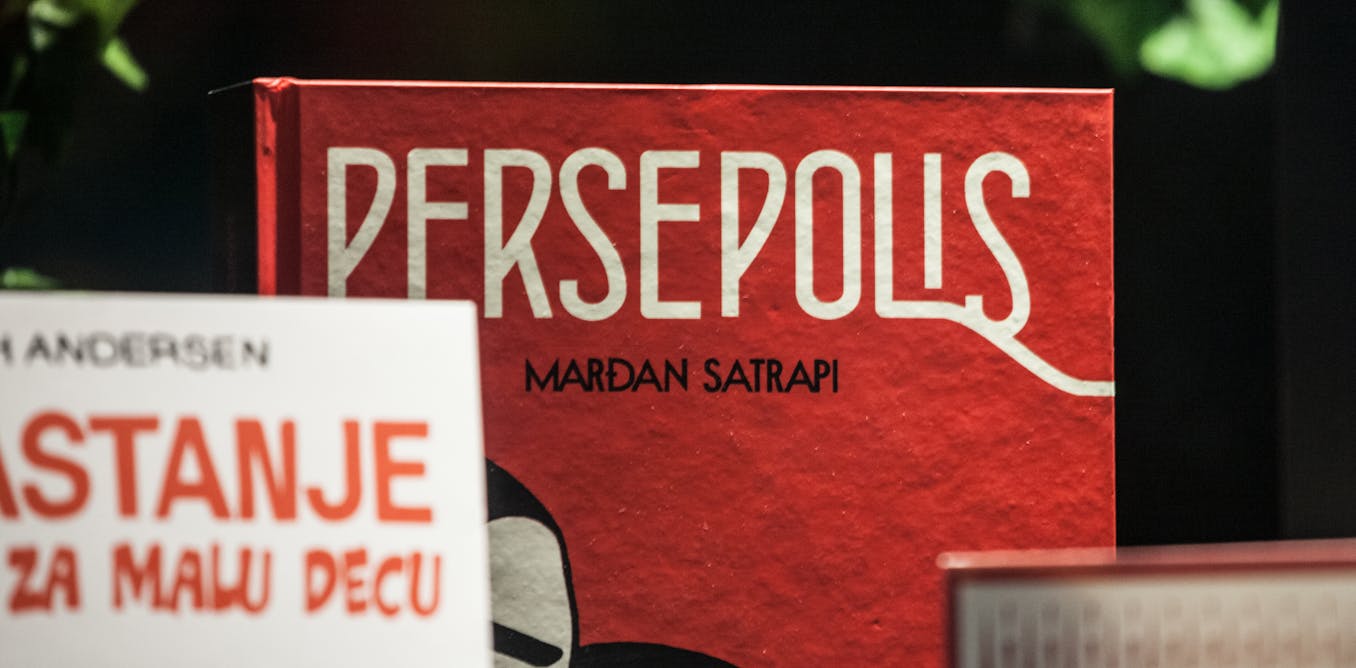
Comic book author Marjane Satrapi passed away last week in Paris at age 56, just before conflict between Israel and her native Iran re-erupted. While her work has enjoyed enduring fame, the present conflict has made it more relevant than ever before.
Satrapi’s work is unique for how it weaves her own personal story with Iran’s history and politics. In her comics and film Persepolis, for instance, there is a scene where the Iranian officer Reza Khan overthrows the Qajar Shah after the First World War, seeking to establish a secular republic. The British, who had installed monarchies in Iraq and Jordan, encouraged him instead to declare himself Shah in 1925. This gave rise to the Pahlavi dynasty in Iran, which would in turn be overthrown during the Islamic Revolution in 1979.
Satrapi’s characters inhabit these historical moments. They are influenced by them, and their lives are determined by their outcomes. Her stories are built on a deep understanding of Iranian resentment of foreign interference, told through a bold, monochrome comic format. But they haven’t always been to everyone’s liking.
Polarised opinions
Her comic Persepolis in particular is not without controversy. Critics claim it contains historical inaccuracies, but this expectation of total accuracy is a common misunderstanding of Satrapi. She was not a historian, she was an author who drew on her own experiences of life both within Iran and outside it.
I have first-hand experience of the controversy her work can cause. When I was teaching a History of Iran class at Bogazici University, in Istanbul, Turkey, in 2007, I assigned Persepolis. Students affiliated with the campus Communist party objected to me assigning the comic. They argued that, because much of Persepolis highlights religious oppression under the Islamic Republic, I had included it to surreptitiously argue for regime change.
This was not the case. I assigned it for the reasons a teacher assigns any text: because it was relevant to the subject, artistically worthwhile, and I knew it inside out.
But it didn’t matter. Protests outside my classroom endured to the point where I was eventually forced to resign, and left the country.
Personal, political, historical
Persepolis begins with the Revolution, when Marjane’s father, Ebi, tells his daughter why they took to the streets to fight: “2,500 years of tyranny and submission. First our own emperors. Then the Arab invasion from the west. Followed by the Mongolian invasion from the East. And finally modern imperialism.”
By “modern imperialism”, he is not just referring to British support for Reza Shah Pahlavi’s ascension in 1925, but to a litany of subsequent foreign meddling in Iran. After bringing the Shah to power, the British overthrew him during the second world war due to his pro-German leanings, replacing him with his pliant younger son, Mohammad Reza. After an internal coup led by Prime Minister Mohammad Mossadegh in 1953, MI6 and the CIA reinstalled Mohammad Reza.
Marjane Satrapi/Penguin Random House
From then on, the US provided the newly reinstated Shah with all manner of weapons to counter the neighbouring Soviets during the Cold War, including F-14s, the most advanced American fighter jet at the time. US military advisors and soldiers were present on Iranian soil, contributing further to the nationalist sentiment that led to the 1979 revolution and the overthrow of the monarchy.
Like the Russian Revolution, the Iranian Revolution led to an overthrow of a monarch. But just as it took time, effort and violence for the Bolsheviks to seize and retain power, the path to power for Khomeini’s Islamic Republicans – and for the Iranian people – was not smooth.
Persepolis shows us what it was like to come of age during this period, when Khomeini’s faction consolidated power as a result of the Iraqi invasion of Iran in September 1980. The resulting war led to a resurgence of Iranian nationalism and support for the republic.
Read more:
Marjane Satrapi, the woman who helped the world understand Iran
‘Ey Iran’
During the early years of the Iran-Iraq War, Marjane remembers hearing the song “Ey Iran” on Iranian state radio, to accompany the news that Iran’s F-14 fleet had raided Iraq in retaliation for bombing Tehran and other locations.
But the song was neither the anthem of the monarchy nor the Islamic Republic of 1979. Its origins date back to the second world war, when American troops entered Iran, joining British and Soviet forces who had invaded the country to prevent it from falling into German hands.
The presence of so many foreign troops on Iranian soil led to a nationalist backlash among the Iranians. “Ey Iran” was written by poet Hossein Gol-e-Golab after he witnessed an American soldier beating an Iranian greengrocer. Its opening lines are:
Oh Iran, oh bejewelled land
Oh, your soil is the wellspring of the arts
Far from you may the thoughts of evil be
May you remain lasting and eternal
Oh enemy, if you are of stone, I’m of iron
May my life be sacrificed for my pure motherland
Out of Iran’s fleet of 79 F-14s, one was flown by the father of Marjane’s school friend, who died in the attack, fulfilling the last line of the song playing on the radio to celebrate the raid.
She does not shy away from the complex, awkward mark the twentieth century left on the Iranian people. She describes how her own father – a leftist who initially sought the overthrow of the Shah only to end up resenting the formation of the Islamic Republic – would tear up upon hearing the song. To this very day, any Iranian student of mine who hears the song becomes tearful. If one encounter with an American soldier during the Second World War created such an enduring artistic legacy, we can only wonder what the outcome will be of the latest American war with Iran.
While the ubiquitous words and melody of “Ey Iran” emerged from the tumult of the 1940s, Perspolis was the product of the 1980 invasion and the early days of the Islamic Republic. Satrapi’s unique and irreplaceable talent lay in synthesising so many pieces of her own lived experience – the invasion, multiple regime changes, songs, stories, wars – and capturing them in striking black and white.

A weekly e-mail in English featuring expertise from scholars and researchers. It provides an introduction to the diversity of research coming out of the continent and considers some of the key issues facing European countries. Get the newsletter!