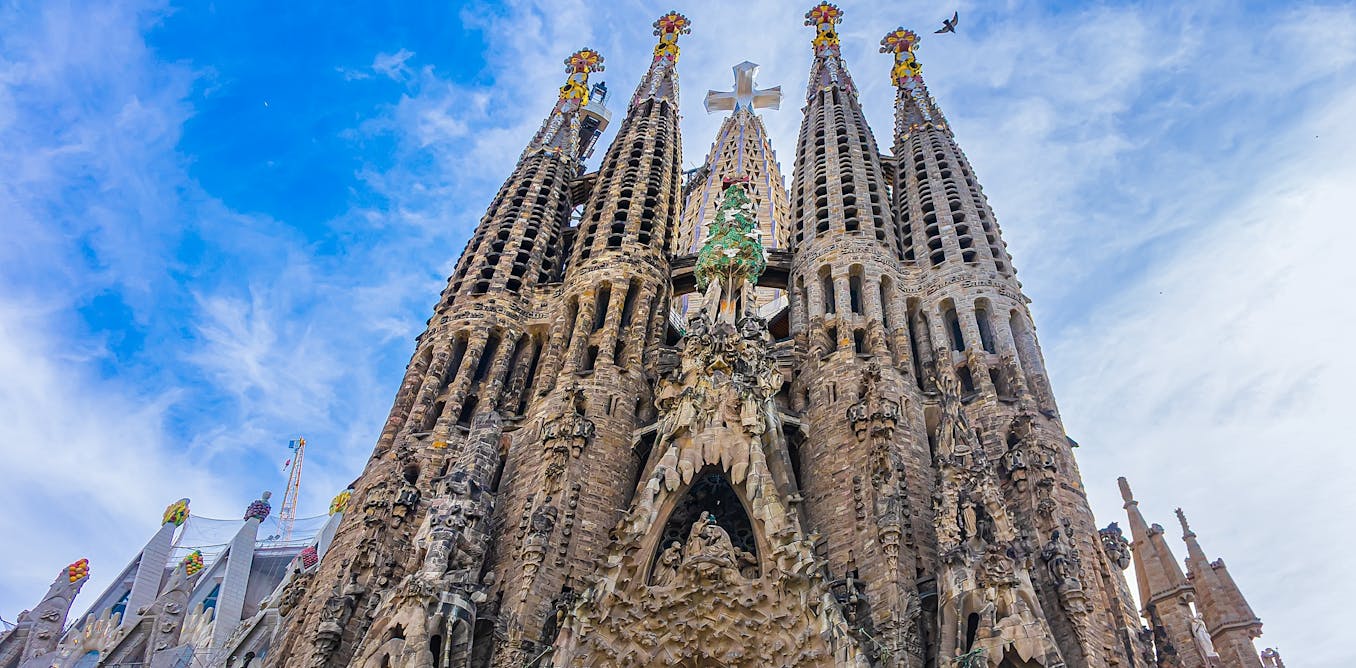
When Pope Leo XIV blessed the Sagrada Família’s tallest, gravity-defying tower on June 10, he took a moment to remember not only the church’s architect, Antoni Gaudí, but also the many people – workers and funders alike – who have made its ongoing construction possible over the last 140 years.
“Together with Gaudí, as we commemorate the centenary of his death, we remember and give thanks this evening to all the supporters and benefactors, the artists and the workers who cooperated in the construction of an architectural masterpiece, which is also an eloquent catechesis made of stones, colors and light,” the Pope said in his homily at the Sagrada Família during his tour of Spain.
As a business school professor, I have written case studies on the Sagrada Família, and regularly take students and executive programme participants there.
It may seem like an unlikely place to take business executives: a mammoth, wildly ambitious project whose creator died with just a fraction of work completed, and whose progress has been derailed by a century and a half of Barcelona’s tumultuous history, from fires and civil war to funding shortages and debate over what to do with a singular undertaking so intimately associated with its architect.
Certainly, Gaudí is not a conventional leader, nor is the Família a conventional church. Yet both offer a number of timeless lessons in leadership, particularly when it comes to vision, mission and innovation.
How to craft a vision
Gaudí’s vision for Sagrada Família did not come to him as a bolt from the blue. It was the product of years of observation and reflection.
Gaudí took over the Sagrada Família project in 1883, inheriting plans to build a conventional neo-Gothic church on the site. He initially stuck to those plans while reconsidering the potential scope and purpose of the church.
By the 1890s he had envisioned something much grander: an immense basilica with 18 spires and three monumental façades. Gaudí’s vision evolved continuously over decades, as he used other architectural projects as laboratories of ideas that could be put to use in the basilica. Over time, his architectural vision – with its unique structure, symbolism, geometry and spirituality – became increasingly coherent.
The takeaway here is that Gaudí imagined boldly and refined patiently, until form and purpose aligned. Vision is rarely perfect from the start, it is crafted over time to create meaningful direction.
Read more:
The Islamic legacy built into Gaudí’s most famous designs
Making vision resonate
A vision only gains relevance when others can see what you see, when they are moved to join your quest and it becomes their mission as well.
Paulo Freitas/Unsplash
Gaudí created many drawings and plaster models of his planned church, and was adept at communicating in simple language and vivid metaphors. He allowed his colleagues – ironworkers, stoneworkers, ceramicists, many of them lifelong collaborators – to work out the details without constant oversight. This meant that when many of the original drawings and models were lost in a fire after the architect’s death, the craftsmen were able to recall and restore much of the plan and pass it on to the next generation of architects.
In addition, the Sagrada Família has required vast sums of money to build. As an expiatory temple, it relies on individual alms rather than public funds, and Gaudí understood that he needed to convince others of its greatness and inspire them to contribute. He was a tireless fundraiser, even pouring his own earnings into realising his dream. Yet the lion’s share of the funds came from thousands of individual donations, making it a work truly by and for the masses who had been moved to buy into Gaudí’s vision.
Gaudí invited people, motivated by meaning that touches both intellect and emotion, to become partners in a shared mission.
Read more:
Three lesser-known Antoni Gaudí buildings to visit to mark the centenary of his death
Innovation across generations
During Gaudí’s lifetime, slow periods in the building were used to take stock, to dream, and to design new solutions. After juggling other projects, he devoted his time exclusively to building the Sagrada Família from 1914 until his death in 1926.
The basilica is a revolutionary structure in architecture which combines beauty with mathematical principles. Its innovations include a tree-like column system instead of straight pillars, and the use of catenary arches throughout.
Equally important, Gaudí employed radically innovative forms, symbolism and the sculptural storytelling of the façades to revive faith and make spiritual meaning accessible and compelling to a society increasingly shaped by secular modernity.
Read more:
The mathematical secrets hidden at the heart of Barcelona’s Sagrada Família
While Gaudí was exceptionally creative, every innovation responded to the larger mission of bringing greater light, strength and harmony to his structures. The lesson Gaudí leaves us: innovation is meaningful when it serves a greater purpose.
The less obvious leader
Certainly, Gaudí was a different kind of leader. But he shows us the value of broadening our definitions of what a leader can and should be.
In recent research, I and my colleagues looked at how leaders emerge in self-directed teams. This setting is revealing because it allows us to see how leaders emerge naturally, rather than being appointed from above.
We found that in newly formed teams, confident and leadership-seeking people are the ones who typically emerge as leaders. But the most assertive person may not be the only good leader in the long term. This also raises the question of what motivates a person to lead in the first place.
In a new team, the desire to lead is generally determined by a person’s identification with a leadership role and their intrinsic desire to lead. However, other leaders are driven by a different, more communal motive that views leadership as a duty or service to others.
These individuals are less concerned with the self and more with community. Their traits – including building trust, collaboration and empathy – do not place them front-and-centre in a new team, but they do come to matter more as a team matures. They are associated with warmth and, as our study found, with competence.
As a leader, Gaudí undoubtedly falls into this second, more subtle category. These traits were all evident in the vision, planning and work he displayed during his life. But today, 100 years after his death, they still guide the Sagrada Família construction team – which is itself 140 years old, and counting.

A weekly e-mail in English featuring expertise from scholars and researchers. It provides an introduction to the diversity of research coming out of the continent and considers some of the key issues facing European countries. Get the newsletter!