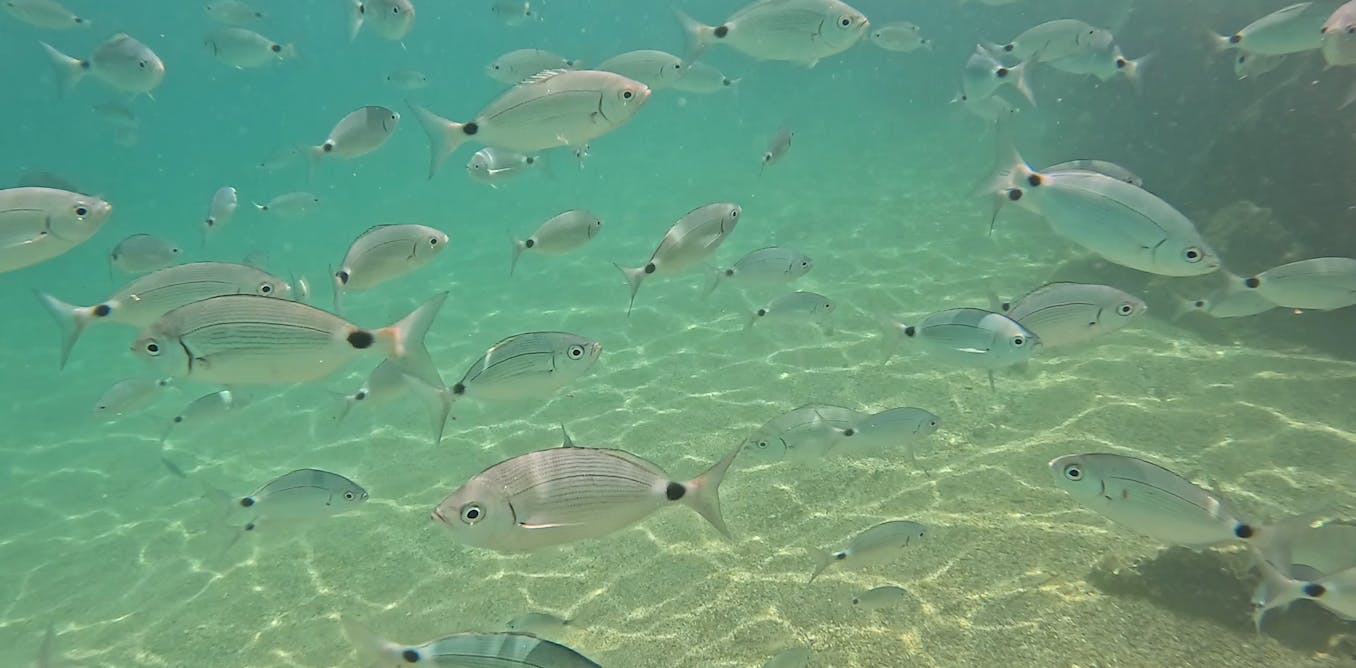
Over the past twenty years, nearly half of commercially important Mediterranean fish species have shifted their distribution due to climate change, causing marine species to move away from their historical locations. These significant changes in fish habits are expected to have a major impact on biodiversity, ecosystems and fishing opportunities.
On a global scale, species have been observed shifting towards higher latitudes and depths, in search of cooler conditions.
However, at regional scales, the picture is far more complex. Our recent study demonstrates that in the Mediterranean Sea, as a result of climate change, warm water-favouring thermophilic species that prefer moderately warm temperatures, such as the starry skate Raja asterias, are changing their distribution towards the south and west, while cool water-favouring boreal species, such as the black-bellied angler Lophius budegassa, are only changing their distribution in depth.
The broader picture of this ecological process is known as meridionalization through which native warm-water species expand and cold-water species decline.
Temperature-associated habitat selection: the Mediterranean predicament
The Mediterranean is one of the most vulnerable ecosystems in the world due to multiple and cumulative human pressures, including a high level of climate risk that will increase in the future. These combined impacts are already driving major ecological changes in marine species.
The Mediterranean is also a semi-enclosed basin, connected to the global ocean only through the Strait of Gibraltar, which limits the options available to species attempting to track suitable environmental conditions.
However, even if these Mediterranean species move north, they cannot go very far: they soon encounter geographical continental constraints, such as the French continental zone, in the Gulf of Lions.
An alternative to moving northwards is to move towards deeper waters in search of cooler temperatures, when their physiological limits allow it. However, at the regional scale, the picture is far more complex, with very different dominant patterns emerging.
In our recent scientific study conducted along the eastern Spanish Mediterranean coast, from Murcia to northern Catalonia:
“ We found that almost half of the commercially valuable Mediterranean species have changed their distribution over the last two decades: 42 out of the 102 species analysed showed significant distributional shifts.”
Although these changes vary among species, they are dominated by southward and south-westward movements along the Iberian Peninsula, particularly towards the Gulf of Alicante.
Depth-related changes were also diverse, but were mainly characterised by shifts towards shallower waters.
Why are fish moving ‘swimming against’ global patterns, southwards and toward shallower waters?
These species shifts can be explained by local climate velocity, a measure that describes both the speed and direction of ocean warming.
Climate velocity tracks the rate of change in sea surface temperature, indicating the direction and speed species should move to conserve the initial or preferred temperature conditions of their habitat. As such, if species displacements correlate with climate velocity, species are more likely to remain within suitable climatic conditions.
Our results show that the largest distributional shifts are strongly associated with areas experiencing the fastest warming. As a result, many species have shifted the centre of distribution of their populations towards the south-west.
Among these species are the four-spot megrim (Lepidorhombus boscii, the picarel (Spicara smaris and the starry ray Raja asterias, which given their preference for moderately warm-water temperature, have moved south-westwards, shifting in the same direction as the velocity climate change. However, in addition to the horizontal displacement, they have also moved toward shallower waters:
“Contrary to our expectations, species were predominantly shifting towards shallower waters, more coastal areas because depth naturally decreases in this region as species move south.”
Julia Julve
These findings highlight the regional-scale impacts of climate change on commercially important marine species. There is an urgent need to implement climate-smart fisheries management measures, as adaptation to climate change is no longer a future challenge, but a present-day necessity.
Climate-smart solutions involve management measures that focus on implementing regional and local strategies such as identifying marine climate refugia, which attract species and provide an environment in which fish stocks can thrive in spite of climate change, and that prioritises their protection and conservation.
Improving the adaptative responses of the small-scale fishing sector is also a key climate-smart solution. This can only happen if fishers and local communities play a significant role in the decision-making processes, and if scientists, fisheries and policymakers work together to adopt much needed climate-adaptive practices.
This article was co-written with the help of the following authors: Hidalgo, M., Puerta, P., García Molinos, J., Zamanillo, M., Brito-Morales, I., González-Irusta, J. M., Esteban, A., Punzón, A., García-Rodríguez, E., Vivas, M., & López-López, L.
Created in 2007 to help accelerate and share scientific knowledge on key societal issues, the Axa Research Fund – now part of the Axa Foundation for Human Progress – has supported over 750 projects around the world on key environmental, health & socioeconomic risks. To learn more, visit the website of the AXA Research Fund or follow @ AXAResearchFund on LinkedIn.

A weekly e-mail in English featuring expertise from scholars and researchers. It provides an introduction to the diversity of research coming out of the continent and considers some of the key issues facing European countries. Get the newsletter!