Beneath the shifting waters of Alexandria’s eastern harbour, on Egypt’s Mediterranean coast, lie the drowned remnants of a once-splendid city – ports, palaces and temples swallowed by the sea. Submerged by earthquakes and a rising sea level, these lost monuments have become the focus of survey and excavations by the European Institute for Underwater Archaeology, in conjunction with Egypt’s Ministry of Tourism and Antiquities.
Much of our recent work has centred around Antirhodos Island, revealing a temple to the ancient Egyptian goddess Isis which was renovated by Cleopatra VII, and the Timonium – a palace built by her partner, the Roman general Mark Antony.
The shipwrecks from the Royal Port of Antirhodos tell the story of how Alexandria changed from a place emphasising the great wealth and extravagance of the Ptolemaic dynasty to an economic powerhouse of the Roman world.
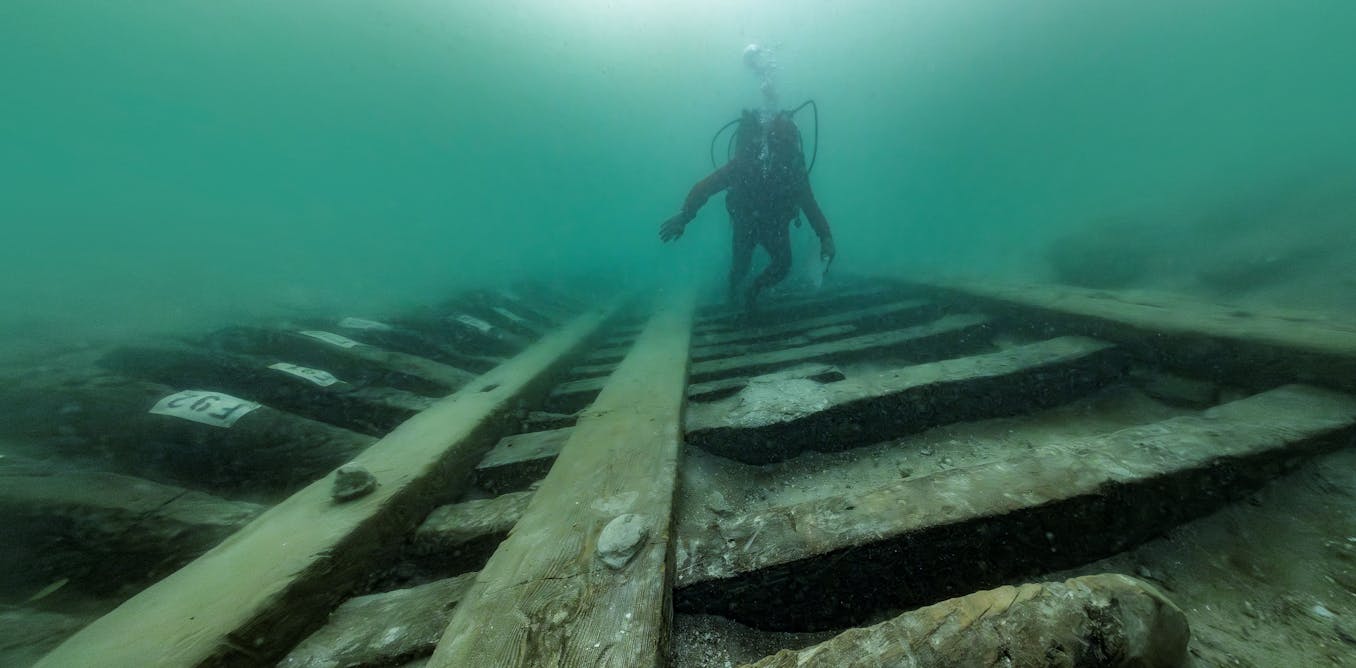
Our most recent excavations have revealed a shipwreck dating to the early Roman period. Buried beneath the sand were the remains of a thalamagos. This is a type of Nile yacht with a very colourful reputation in Roman literature as “party boats”. But the discovery of such a vessel in a busy commercial harbour was unusual. We asked ourselves: were we thinking about this wreck in the right way?
Discovering the ship
The wrecks in the Royal Port were discovered through a new high-resolution sonar survey of the seabed. This produced enormous quantities of data that was fed into a machine learning algorithm trained to recognise the “signatures” of shipwrecks. The initial results were promising, with excavations on targets generated by the algorithm revealing a small boat and a 30m-long merchant ship.
Together with a similar merchant ship found in the early years of the project, these finds illustrate the commercialisation of the Royal Port in the Roman period.
At the outset of the 2025 mission, we were confident the wreck was a merchant ship. But with each dive, new findings reshaped our understanding, gradually revealing a vessel unlike the one we thought we were investigating.
The wreck has many typical features of Roman Imperial shipbuilding, but the Greek graffiti carved into its planks suggests that it was built and repaired in Alexandria. And its shape is unlike the cargo vessels found elsewhere in the Royal Port. At around 28m long and 7m wide, the preserved remains indicated that we were working on a flat-bottomed boat with a relatively wide and boxy hull. The bow and stern were asymmetrical, giving sweeping curves to the extremities of the ship. But it lacked a mast step, suggesting that it was rowed. The wreck did not have the ideal shape or propulsion system of a seagoing freighter, making it something of a mystery.
In search of clues, we turned to the 500 or so fragments of Ptolemaic and Roman papyri (the material made from the pithy stem of a water plant that these civilisations used to write on) that document nautical subjects. About 200 of these name different types of river vessels, which were often referred to by the cargoes that they carried, from grain, wine and stone to manure and corpses.
One of the infrequently mentioned types of boat is the thalamagos or cabin boat. This kind of vessel is depicted on the Palestrina mosaic, a roughly contemporary landscape with the boat found in a temple outside Rome.
With its crescent shape and series of oars, the mosaic ship bears a striking similarity to the material remains from the Royal Port. While investigations into our wreck are just beginning, it seems that we have found a thalamegos – one of the infamous “party boats” of the Nile.
What happened on ancient party boats
The example on the Palestrina mosaic depicts a cabin boat being used to hunt hippopotami, a ritual associated with the Pharaohs of ancient Egypt. The link between this type of boat and royalty is heard in the philosopher Seneca’s dismissal of them as “the plaything of kings”.
While the Ptolemaic royal family did have Nile yachts, and even supersized versions of them, we can assume that vessels the size of ours would have been a common sight on the river. Indeed, the ancient geographer Strabo wrote about Alexandrians holding feasts aboard cabin boats in shady spots on the waterways around the city. He described them as part of the revelry and licentious behaviour associated with the public festivals at the nearby town of Canopus.
These Roman authors, however, were likely playing up the culture of luxury and excess of their recently defeated enemy’s court and the “degenerate” lifestyles of its people. To simply think about our thalamagos purely as a party boat would be to cherry pick racy Roman stories and fall for their propaganda.
The mundane detail of the administrative papyri reveals that thalamagoi were more than luxurious yachts. They could carry cargo and were also used to transport officials up and down the river. Consequently, the discovery of a cabin boat in a bustling commercial port is not entirely unexpected.
There is, however, another possibility. Our boat was found close to the temple of Isis and may even have been destroyed in the same seismic event that caused the collapse of this sanctuary. Was it a luxurious temple barge used during festivals such as the celebration of the Navigation of Isis?
This celebrated the “opening of the sea” following the winter season was one of the festivals that got Strabo so worked up about the behaviour of its participants. It was actually a festival to ensure the protection of the grain fleet upon which Rome relied to feed its hungry urban population. Strabo chose to overemphasise aspects of the event to suit the anti-Ptolemaic prejudices of his Roman audience.
Detailed post-excavation analysis on this wreck is now underway. We want to understand exactly what our ship looked like and how it performed on the Nile. There is also more work to be done in the library with the ancient texts. What’s for sure is that we’re only just starting to get to know the secrets of this thalamagos.
Looking for something good? Cut through the noise with a carefully curated selection of the latest releases, live events and exhibitions, straight to your inbox every fortnight, on Fridays. Sign up here.

Damian Robinson receives funding from the Hilti Foundation.
Franck Goddio receives funding from the Hilti Foundation.