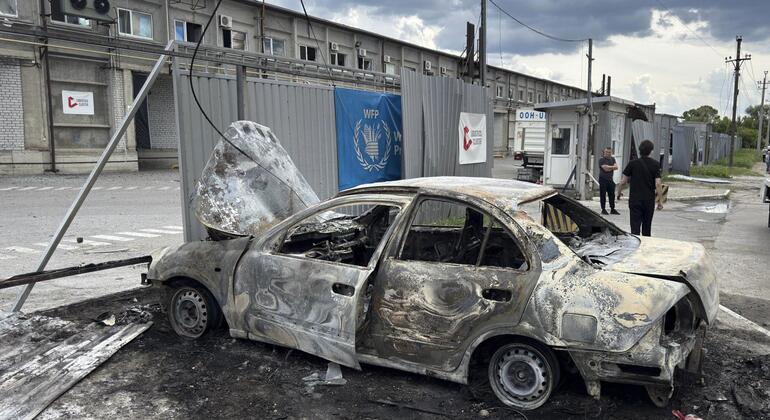
“Absolutely unacceptable,” WFP chief Cindy McCain tweeted on Tuesday, a day after the airstrike. “These deliberate attacks MUST end. Aid workers and humanitarian assets are not a target.”
The UN agency said on Monday that a warehouse used for its humanitarian operations “was targeted by a precision-guided, Iskander ballistic missile,” marking the second time the facility has come under fire in six months.
The warehouse was storing enough humanitarian food assistance to support 130,000 people living near the frontline, with an estimated value of around $1.4 million.
Aid under attack
“This is the second time this warehouse has been hit. In November 2025, it was damaged by a drone strike,” said Richard Ragan, WFP Representative in Ukraine.
“Over the past 18 months, WFP has recorded more than 84 incidents affecting its warehouses, vehicles, distribution points, and the assets of its local humanitarian partners across Ukraine,” he added.
He stressed that targeting humanitarians during conflict is a crime and a violation of international humanitarian law.
Feeding thousands monthly
In the wake of the attack, WFP teams were on site to assess the full extent of the damage, and all personnel were marked as safe.
Despite increasing security risks, the agency said its teams continue to provide critical food and cash assistance to nearly 600,000 people every month in frontline regions of Ukraine.
Massive attack in Kyiv
The incident occurred a day after Russia carried out a massive drone and missile attack in the capital Kyiv and neighbouring regions, which killed two people and injured nearly 90.
UN humanitarians said it was one of the largest combined air attacks on the country since the start of the full-scale war in February 2022.
Russia has warned that it will carry out more strikes on the city, according to media reports.
‘This nonsense has to stop’
The UN Humanitarian Coordinator for Ukraine, Matthias Schmale, visited one of the sites impacted in Monday’s attack and recorded a video that was posted on social media.
He noted that “the whole market was burnt down” while a nearby metro station – where people were sheltering – was impacted.
He recalled that the attack came 10 days after bombardment that left 24 dead in the city, saying “this nonsense has to stop.”
Apart from Kyiv, attacks across Ukraine and frontine hostilities between 22 and 25 May killed nearly 20 and injured over 200 more civilians, with the regions of Kherson, Dnipro, Sumy, Kharkiv and Donetsk reportedly repeatedly impacted.
Humanitarians provided immediate emergency support after the attacks.
More civilian casualties
The full-scale Russian invasion of Ukraine is now in its fifth year.
UN human rights monitors recently reported that more people were killed and injured in Ukraine during the first quarter of 2026 than in the same period in any of the last three years.
At least 238 civilians were killed, and 1,404 injured, in April, thus bringing the number of verified civilian casualties in 2026 at the time to 815 killed and 4,174 injured.
These figures represented a 21 per cent increase compared to January-April 2025, and a 93 per cent increase compared to the same period in 2024.
UN partners also report that between January and April of this year, at least 62 incidents affecting humanitarian personnel, vehicles, supplies and facilities were recorded across the country.