Imagine struggling to follow conversations in a noisy restaurant or keep up in a busy office, yet being told by a doctor that your hearing is fine. That is the frustrating reality for people living with cochlear synaptopathy, or hidden hearing loss.
Around 34 million adults in the EU live with a disabling hearing loss, according to the Hearing Health Forum EU. But the true scale of the problem is likely much larger, because conventional hearing tests cannot detect cochlear synaptopathy at all.
There is no clinical diagnosis for the condition and no approved treatment, leaving many people with real hearing difficulties and no help available.
This hidden hearing loss can be debilitating, explained Professor Ingeborg Dhooge, who heads the Ear, Nose and Throat department at Ghent University hospital in Belgium. Dhooge was a clinical consultant on a research initiative called EarDiTech, which investigated the condition between 2022 and 2026.
The project was funded by the European Innovation Council, which helps researchers and innovators convert bold scientific ideas into real-world products.
“Everywhere you go, there is always noise,” Dhooge said. “When you go shopping, there is noise, music playing. At work, people are often placed in open plan offices. This creates a lot of background noise, which interferes with the productivity of those patients.”
Current options are limited: training people to lip read and focus more on speech sounds. But the EarDiTech researchers developed a test that can detect hidden hearing loss, and have been working on new software for hearing aids.
How hearing goes wrong
In the inner ear, sound is detected by tiny hair cells that convert vibrations into neural signals, which travel to the brain via synaptic connections between the hair cells and the auditory nerve.
Until recently, it was thought that age-related hearing loss starts with damaged hair cells.
“
To some extent, hearing aids can help, but it’s difficult because with them everything becomes louder, but not necessarily clearer.
“We now know that the first damage to the auditory structures is not the hair cells, but it’s actually these synapses that connect the hair cells to the brain,” explained Professor Sarah Verhulst, who leads the Hearing Technology lab at Ghent University.
The distinction matters, stressed Verhulst. As coordinator of the EarDiTech research, she understood the stakes: you only need one synapse per hair cell to detect a sound, but you need many working together to decode speech in a noisy environment.
The standard clinical tool for assessing hearing is the audiogram, in which patients are played tones at different pitches and volumes through headphones and asked to signal if they can hear them.
It measures hair cell performance, but says nothing about how many working synapses a patient has. Therefore, it cannot capture the difficulties those with cochlear synaptopathy face in the real world.
Counting synapses
The EarDiTech test combines electrodes placed on the forehead and earlobes with a specially designed audio stimulus, developed through years of research into modelling the auditory system.
“We built these computer models of the hair cells and the synapses,” Verhulst said. “Basically, we can simulate the auditory nerve responses or the synapses’ response in the whole cochlear model. Using this computational method, we can then see which audio stimulus is best able to fire off all these synapses at the same time.”
The test is designed to produce the strongest possible synaptic response. When someone with healthy synapses hears the stimulus, the electrodes detect a large spike in neural activity. In those with synapse loss, the response is smaller.
“By comparing the size of a patient’s response to the normal hearing response, we can estimate the degree of cochlear synaptopathy,” Verhulst said.
The researchers have shrunk the technology into a compact, portable device. Clinical trials at Ghent University have shown it can identify cochlear synaptopathy across different age groups.
The test is simple and requires no surgical procedure, so it can fit easily into everyday clinical practice, giving audiologists and ear, nose and throat specialists a tool they currently do not have.
The next step is obtaining CE marking, to certify that the device meets EU requirements for medical diagnostic equipment. Verhulst said that once they have investment to fund this, she expects it to take around 18 months to 2 years. “I think when it’s on the market, ear, nose and throat doctors and hospitals will use it,” she added.
A smarter hearing aid
Detecting hidden hearing loss is only half the challenge. The other part is finding a solution.
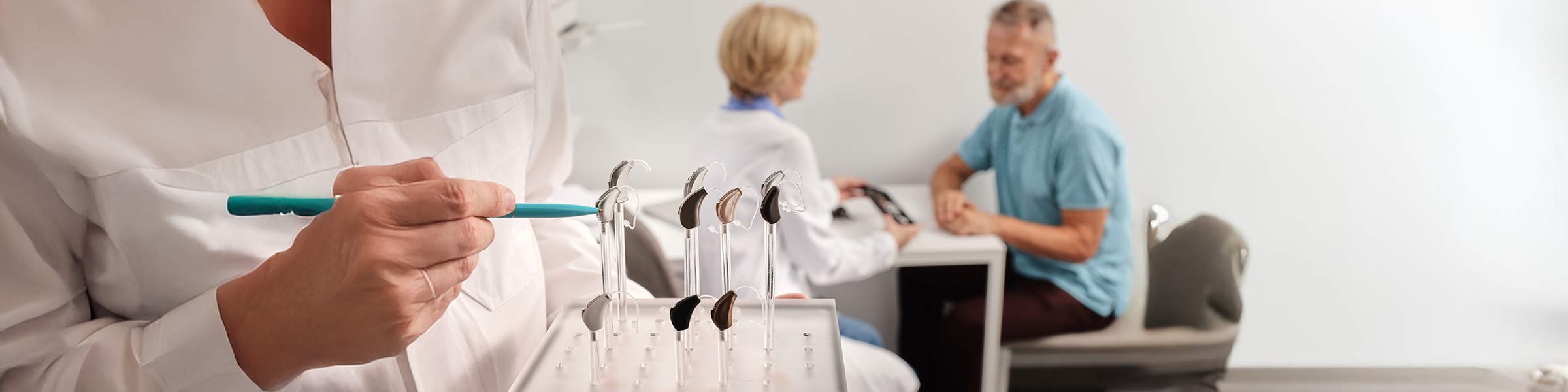
Standard hearing aids mainly amplify sound, which does not really help people who struggle to pick out speech from background noise.
“To some extent, hearing aids can help, but it’s difficult because with them everything becomes louder, but not necessarily clearer,” said Dhooge. “This means that patients can still struggle to pick out different sounds in noisy environments.”
To address this, the team used machine learning to train a software algorithm on two computational models: one simulating normal hearing, the other simulating the faulty sound processing of someone with cochlear synaptopathy.
The goal was an algorithm that could modify incoming sound in a way that best stimulated the synapses a patient still has. That would improve their ability to follow speech in noisy environments.
“
We now know that the first damage to the auditory structures is not the hair cells.
Clinical trials have shown measurable benefits in patients with cochlear synaptopathy. The team have also shown that the algorithm can run on low battery power and on processing chips commonly used in hearing aids.
In theory, this means the algorithm could run on the next generation of hearing aids, or even consumer earbuds. Verhulst envisages a future in which people will be able to tell their phone that they want to hear better and it will activate the hidden hearing loss software on the earbuds.
For now, the EarDiTech team is actively seeking hardware manufacturers, such as hearing aid makers and chipset companies, who can help them further develop their software and turn it into products patients can actually buy.
The algorithm uses each patient’s CochSyn test results to adjust sound to their specific degree of damage – something no current hearing aid can do.
Beyond the clinic
Hidden hearing loss has only been properly identified in the last decade, and there is still limited understanding of how many people are affected or how it develops with age.
“Now we have a tool that we can use in the clinic to gain a better idea of how big the problem is and how impaired people are,” Dhooge said. “We can conduct long-term studies following up patients and see how it evolves.”
That evidence base, researchers hope, will be what persuades health systems to act.
Research in this article was funded by the EU’s Horizon Programme. The views of the interviewees don’t necessarily reflect those of the European Commission. If you liked this article, please consider sharing it on social media.