2026 marks 100 years since the death of Antoni Gaudí, the architect of the Basilica of the Sagrada Família in Barcelona. While the temple’s beauty is extraordinary in its own right, it becomes even more profound when we explore the numerical forms that lie behind its striking forms.
By contemplating the mathematical principles that underpin its structure, the visual harmony of the whole takes on a new dimension, endowing it with a renewed functionality, balance and coherence.
Mathematician Claudi Alsina i Català deeply studied the mathematics of the Sagrada Família. He undertook his initial studies in this field at the University of Barcelona, and supervised the doctoral thesis of Jordi Faulí, the architect currently in charge of the temple’s ongoing construction.
In his memoirs, Alsina stated:
Many had wondered whether the design of the Sagrada Família contained some module or system of proportions that guided the building’s metric relationships. (…) One Saturday afternoon, sitting at my desk at home, with all the data and documents on this mysterious proportional system – if indeed it existed – I discovered it. The 7.5-metre module and the ratios between the divisors of 12 (1:4, 1:3, 1:2, 3:4, 2:3, 1) seemed to explain a great deal.
12: the magic number
It is no surprise that the number 12 plays a prominent role in the structure of the church. Gaudí conceived the Sagrada Família as a synthesis of architecture and religious symbolism, and the number 12 features heavily in the Bible: Jacob’s 12 sons, the 12 tribes of Israel, the 12 apostles and the crown of 12 stars in the Book of Revelation are just a few examples.
But its significance is not merely symbolic. From a mathematical point of view, 12 is a number particularly well-suited to establishing proportions, as it has many divisors. According to Alsina, the relationships between these divisors account for much of the basilica’s proportional system.
Read more:
The Sagrada Familia: how Gaudí’s masterpiece became a myth and a divisive political tool
The 7.5-metre module
Drawing on Alsina’s work, we invite you to take a brief mathematical tour of the Sagrada Família.
The temple’s dimensions are based on the number 12 and a module of 7.5m. It is 90m long (7.5 × 12) and 60m wide (7.5 × 8). The width of the main nave is 45m (7.5 × 6).
In terms of height, the highest vault is that of the apse, at 75m (7.5 × 10), followed by the vault of the transept at 60 metres (7.5 × 8). The nave vault is 45m high (7.5 × 6), the side aisle 30m (7.5 × 4), and the choir 15m (7.5 × 2).
The Tower of Jesus Christ is the central and tallest of the cathedral. It stands at 172.5 metres (7.5 x 23), close to the height of the landmark hill of Montjuïc. It is crowned by a four-armed cross, 17m high and 13.5m wide. Surrounding this are the four Evangelist Spires, which reach a height of 135m (7.5 x 18).
Canaan, CC BY
The 138-metre high Tower of the Virgin Mary is the second tallest in the basilica. It is crowned by a 12-pointed star, which rests on three supporting arms. This star has a diameter of 7.5m, and is made up of a regular dodecahedron, with pyramid-shaped pentagonal points rising from each face. Its reflections of daylight and night-time illumination lend this star a unique beauty.
Read more:
From Frank Lloyd Wright to Edwin Lutyens, why do unbuilt buildings continue to fascinate us?
Polyhedral towers
Polyhedrons also feature prominently in the towers of the Sagrada Família. The four towers of the Glory façade are topped by dodecahedrons, the four towers of the Nativity façade by truncated irregular octahedrons, and the four towers of the Passion façade by truncated cubes.
On each of the 12 towers, a spire rises above these polyhedrons. Those dedicated to the evangelists are crowned with regular icosahedrons containing spotlights that illuminate the large cross that sits atop the Tower of Jesus Christ. Just above each icosahedron is a sculpture that symbolically depicts each evangelist. There are numerous star-shaped polyhedrons throughout the church, particularly on the Nativity façade.

Yura Tarasovskyy/Shutterstock
A forest of towers
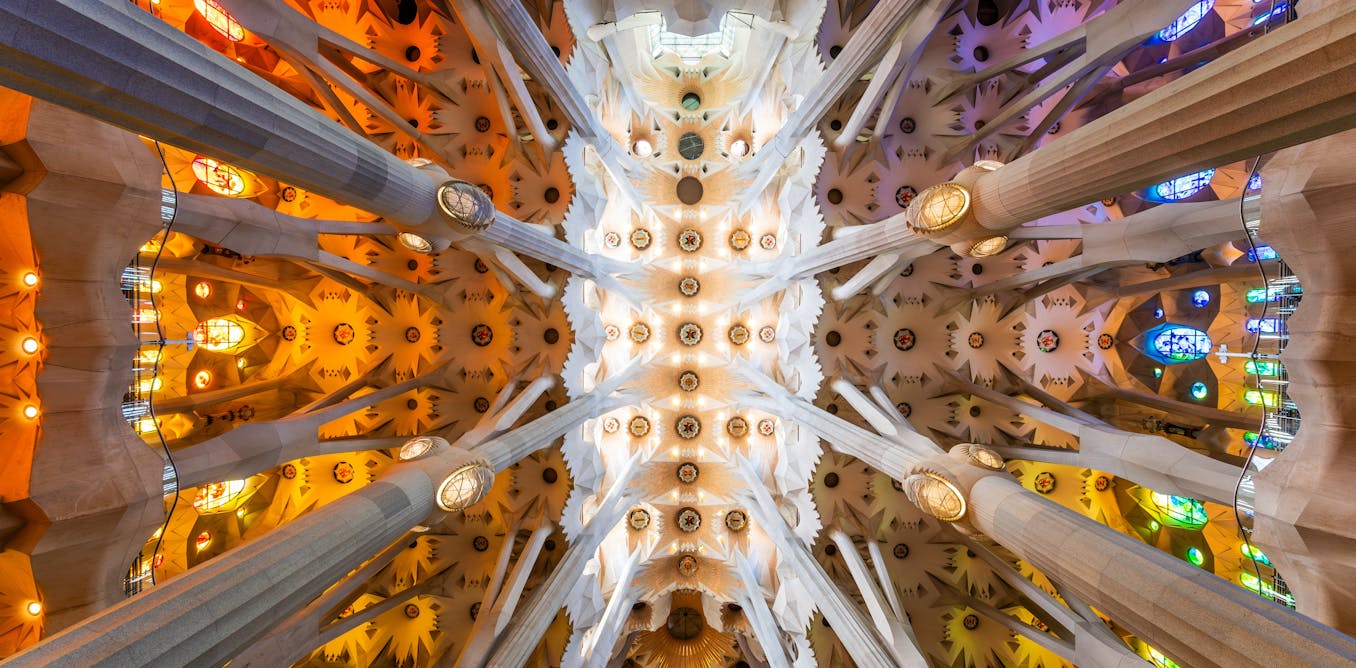
Catenary arches feature prominently as key structural elements of the church, as they are a highly effective way to transfer loads to the ground without the need for additional support. They can be seen in the system of sloping columns that support the vaults of the interior naves, the vaults and ceilings themselves, and the Nativity façade.
Inside the Sagrada Família, there are four different types of column. All are double-helix torsion columns – each has a rounded, star-shaped polygonal base, and is formed by the intersection of two opposing Solomonic columns. Above each one is a knot from which different branches emerge, similar to those of a tree, which very efficiently support the towers and the roof of the church.
The skylights in the roof are also one-sheet hyperboloids. Made up of straight lines, they are easy to construct, and optimise the capture and projection of light.
The symbolism of 7 and 33
The church has other deeply symbolic hidden features. Take, for instance, the canopy above the high altar, which forms a regular heptagon 5 metres in diameter, whose seven sides symbolise the seven gifts of the Holy Spirit.

Jordi Domènech/Wikimedia Commons/, CC BY-SA
On the Passion façade there is a magic square in which the sum of all rows, columns and diagonals is 33. It appears to be inspired by the magic square featured in the engraving Melancholia I by Albrecht Dürer.
The mathematics that underpins the Sagrada Família makes it all the more beautiful. While the building itself is a sight to behold, a deeper understanding of the principles behind it inspires even greater admiration for the enduring genius of Antoni Gaudí.

A weekly e-mail in English featuring expertise from scholars and researchers. It provides an introduction to the diversity of research coming out of the continent and considers some of the key issues facing European countries. Get the newsletter!