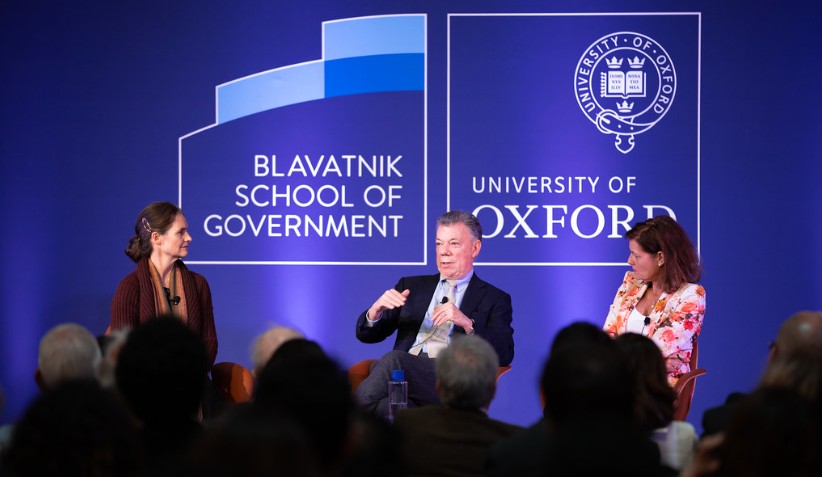
NEW YORK — As artificial intelligence rapidly integrates into military hardware, former world leaders and human rights advocates are issuing urgent warnings against leaving life-or-death battlefield decisions to machine algorithms.
Speaking on behalf of The Elders during high-level sessions at the United Nations General Assembly, former President of Colombia and Nobel Peace Laureate Juan Manuel Santos urged the international community to establish binding global governance frameworks to ensure humanity retains absolute control over lethal force.
“To a machine, a person is data, and death is simply a command,” Santos stated, emphasizing the ethical crisis posed by automated targeting systems.
Ethical and Legal Risks in Algorithmic Warfare
The warning comes as defense forces worldwide accelerate the deployment of autonomous drones, uncrewed combat vehicles, and AI-assisted targeting software.
Humanitarian advocates and legal scholars argue that fully autonomous weapons systems violate core principles of international humanitarian law and the established rules of war:
- Erosion of Human Judgment: Algorithms lack the moral reasoning, contextual understanding, and capacity for empathy required to make distinctions between combatants and civilians.
- Speed and Escalation: Autonomous systems process targets at speeds beyond human comprehension, significantly increasing the likelihood of rapid, unintended escalation or accidental catastrophic clashes.
- Absence of Accountability: When an algorithm commits a war crime or targets non-combatants, clear lines of legal responsibility—spanning software developers, commanders, and field personnel—become dangerously blurred.
Push for Binding International Governance
The Elders—an independent group of global leaders founded by Nelson Mandela—are advocating for a legally binding treaty to ban fully autonomous lethal weapons.
During the UN General Assembly proceedings, Santos joined representatives from a growing coalition of nations—including Austria, Brazil, Mexico, Nigeria, Belgium, and the Philippines—calling for decisive multilateral action. The group urges world leaders to finalize negotiations on a global framework that explicitly mandates meaningful human control over all target selection and engagement decisions.
UN Secretary-General António Guterres has echoed these calls, urging member states to enact binding regulations on autonomous weapons to prevent algorithms from determining human life and death.
For further coverage on global diplomatic efforts and discussions on AI governance at the UN, you can watch U.N. General Assembly calls for binding AI safeguards, which provides visual reporting on international calls for binding safeguards over military and commercial artificial intelligence.
Former President of Colombia and Nobel Peace Laureate and Member of The Elders Juan Manuel Santos Flickr Picture by OPHI – Oxford Poverty and Human Development Initiative